Indietro
Thermodynamics and Biochemical Energetics: Foundations for Metabolic Reactions
Guida di studio - Note intelligenti
 Appunti personalizzati basati sui tuoi materiali, ampliati con definizioni chiave, esempi e contesto.
Thermodynamics & Biochemical Energetics
Introduction to Thermodynamics in Biochemistry
Thermodynamics provides the framework for understanding energy changes in biochemical reactions. It helps predict whether a reaction can occur spontaneously and how cells harness and transform energy for metabolism.
Thermodynamics studies energy transformations and the direction of chemical processes.
Bioenergetics applies thermodynamic principles to biological systems, focusing on energy flow in living organisms.
Free Energy Change (ΔG) and Reaction Spontaneity
The change in free energy (ΔG) determines if a reaction is spontaneous or requires energy input. It is a central concept in predicting the direction of biochemical reactions.
ΔG is the difference in chemical free energy between reactants and products from an initial state to equilibrium.
ΔG < 0: Reaction is exergonic (spontaneous).
ΔG > 0: Reaction is endergonic (non-spontaneous).
ΔG does not provide information about the reaction rate.
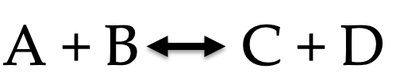
Equations for Free Energy Change
Free energy change can be calculated using the reaction quotient (Q) and the equilibrium constant (Keq).
Equation:
Where R is the gas constant (8.314 J/mol·K), T is temperature in Kelvin, Q is the reaction quotient, and Keq is the equilibrium constant.
At standard conditions (1 M concentrations):
Standard Free Energy Change (ΔG0 and ΔG'0)
Standard free energy change (ΔG0) is measured under standard conditions (1 M concentrations). In biochemistry, ΔG'0 is used, which assumes pH 7.0 and 55 M H2O.
ΔG'0 and K'eq are intrinsic properties of a reaction.
ΔG' = ΔG'0 + 2.3RT log Q
Q varies with cellular conditions and influences the sign and magnitude of ΔG'.
Relationship Between ΔG'0, K'eq, and Q
The direction and spontaneity of a reaction depend on the relationship between ΔG'0, K'eq, and Q.
If Q < K'eq, ΔG' is negative (reaction proceeds forward).
If Q > K'eq, ΔG' is positive (reaction proceeds in reverse).
Application: Glycolysis Reaction Table
Different steps in glycolysis have distinct ΔG'0, Q, and ΔG' values, reflecting their distance from equilibrium and their regulatory significance.
Reaction | K'eq | Q (liver) | Q (heart) | Near Equilibrium? | ΔG'0 (kJ/mol) | ΔG' (heart) (kJ/mol) |
|---|---|---|---|---|---|---|
Phosphorylation of glucose | 1 x 10³ | 2 x 10⁻² | 8 x 10⁻² | No | -17 | -24 |
Phosphorylation of Fructose-6P | 1 x 10³ | 9 x 10⁻² | 3 x 10⁻² | No | -17 | -26 |
Cleavage of Fructose 1,6BP | 1 x 10⁻⁴ | 1.2 x 10⁻⁶ | 9 x 10⁻⁶ | Yes | +23 | -6 |
Bioenergetics: Coupling Reactions and ATP
Reaction Coupling in Biochemistry
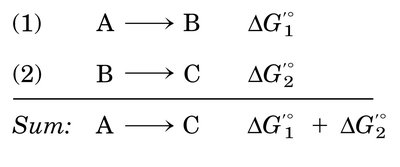
Many biosynthetic reactions are endergonic and require coupling to exergonic reactions to proceed. This is a fundamental strategy in metabolism.
Endergonic reactions (ΔG > 0) are coupled to exergonic reactions (ΔG < 0) to make the overall process spontaneous.
ATP hydrolysis is the most common exergonic reaction used for coupling.
ATP: The Energy Currency of the Cell
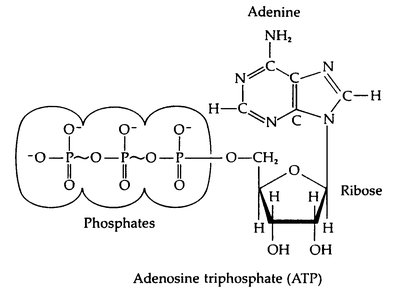
ATP (adenosine triphosphate) is the primary energy carrier in cells. Its hydrolysis releases energy that drives many cellular processes.
ATP consists of adenine, ribose, and three phosphate groups.
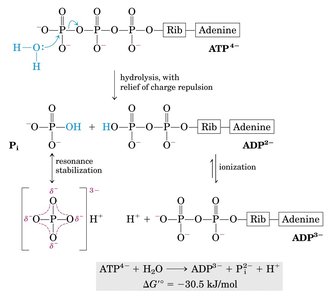
Hydrolysis of ATP to ADP and Pi:
ΔG'0 for ATP hydrolysis ≈ -30.5 kJ/mol
ATP is kinetically stable, requiring an enzyme for rapid hydrolysis.
Phosphate Transfer Potential
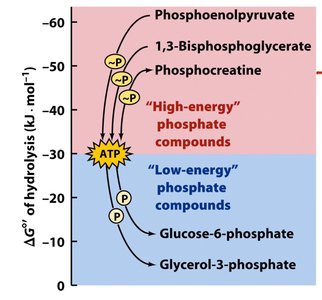
Some molecules have higher phosphate transfer potential than ATP, allowing them to phosphorylate ADP to ATP in metabolic pathways.
Phosphoenolpyruvate (PEP): ΔG'0 ≈ -61.9 kJ/mol
Creatine phosphate: ΔG'0 ≈ -43.0 kJ/mol
ATP: ΔG'0 ≈ -30.5 kJ/mol
Glucose 6-phosphate: ΔG'0 ≈ -13.8 kJ/mol
Direct Coupling by Enzymes
Enzymes can directly couple ATP hydrolysis to endergonic reactions, preserving bond energy and ensuring efficient energy transfer.
Example: Hexokinase catalyzes ATP + Glucose → ADP + Glucose-6-phosphate without a Pi intermediate.
Oxidation and Reduction in Biochemistry
Redox Reactions and Cellular Respiration
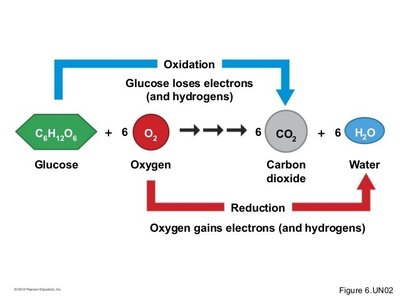
Oxidation-reduction (redox) reactions are central to energy production in cells. Cellular respiration involves the oxidation of glucose to CO2 and H2O, releasing energy.
Oxidation: Loss of electrons (often as hydrogen atoms).
Reduction: Gain of electrons.
NAD+, FAD, and FMN are key electron carriers in metabolism.

Stepwise Oxidation of Glucose
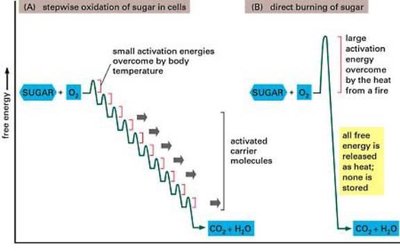
Cells oxidize glucose in a stepwise manner, capturing energy in activated carrier molecules rather than releasing it all as heat.
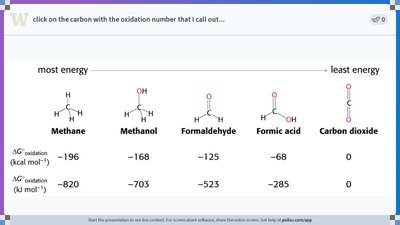
Oxidation States of Carbon
The oxidation state of carbon in organic molecules determines the amount of energy released upon oxidation. The more oxidized the carbon, the less energy it contains.
Oxidation number: -1 for each bond to hydrogen, 0 for each bond to carbon, +1 for each bond to O, N, or S.
NAD+ and FAD: Electron Carriers
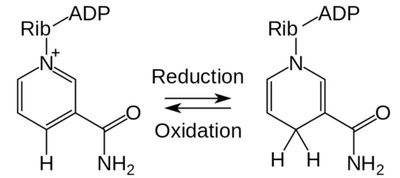
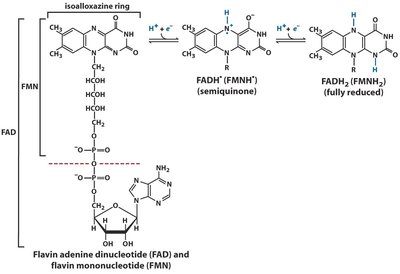
NAD+ (nicotinamide adenine dinucleotide) and FAD (flavin adenine dinucleotide) are coenzymes that shuttle electrons during metabolic reactions.
NAD+ is reduced to NADH during catabolic reactions.
FAD is reduced to FADH2.
Vitamins and Coenzymes in Metabolism
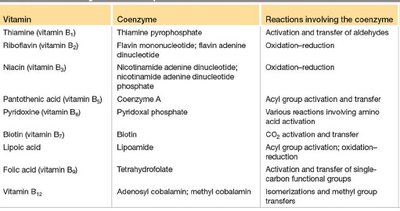
Many coenzymes are derived from vitamins and are essential for enzyme-catalyzed redox reactions and group transfers.
Vitamin | Coenzyme | Reactions involving the coenzyme |
|---|---|---|
Thiamine (B1) | Thiamine pyrophosphate | Activation and transfer of aldehydes |
Riboflavin (B2) | Flavin mononucleotide; flavin adenine dinucleotide | Oxidation-reduction |
Niacin (B3) | Nicotinamide adenine dinucleotide; nicotinamide adenine dinucleotide phosphate | Oxidation-reduction |
Pantothenic acid (B5) | Coenzyme A | Acyl group activation and transfer |
Pyridoxine (B6) | Pyridoxal phosphate | Various reactions involving amino acid activation |
Biotin | Biotin | CO2 activation and transfer |
Lipoic acid | Lipoamide | Acyl group oxidation; activation and transfer |
Folic acid | Tetrahydrofolate | Activation and transfer of single-carbon functional groups |
Vitamin B12 | Adenosyl cobalamin; methyl cobalamin | Isomerizations and methyl group transfers |