 Indietro
Transposable Genetic Elements and Genome Complexity: Study Notes for Biochemistry Students
Guida di studio - Note intelligenti
 Appunti personalizzati basati sui tuoi materiali, ampliati con definizioni chiave, esempi e contesto.
Complexity of Eukaryotic Genomes
Composition of the Human Genome
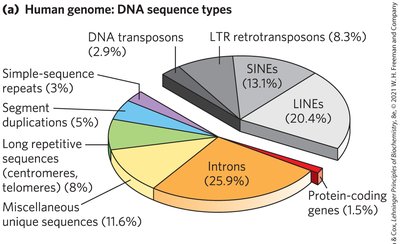
The human genome is composed of a diverse array of DNA sequence types, reflecting its complexity and evolutionary history. Understanding these components is essential for appreciating genetic variability and instability.
Protein-coding genes: Only about 1.5% of the genome encodes proteins.
Introns: Non-coding regions within genes, comprising 25.9% of the genome.
Transposable elements: Includes DNA transposons (2.9%), LTR retrotransposons (8.3%), SINEs (13.1%), and LINEs (20.4%).
Other sequence types: Simple-sequence repeats, segment duplications, long repetitive sequences (centromeres, telomeres), and miscellaneous unique sequences.
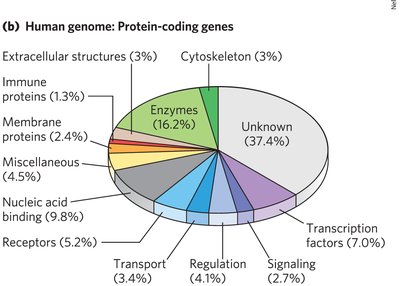
Protein-coding genes are further classified by function, with enzymes, cytoskeleton, immune proteins, and others represented. Notably, a large fraction remains functionally unknown.
Transposable Genetic Elements
Discovery and Significance
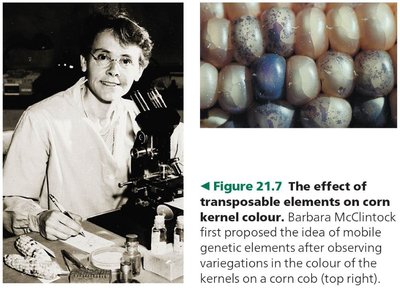
Transposable genetic elements, also known as mobile genetic elements, were first discovered by Barbara McClintock in maize. These elements can move within the genome, causing genetic instability and variation. Their movement does not follow classical Mendelian genetics and can result in chromosome breakages and rearrangements.
Mobile genetic elements: DNA sequences capable of moving within the genome.
Genetic instability: Their movement can disrupt genes, cause mutations, and lead to phenotypic variation.
Historical impact: McClintock's work led to a Nobel Prize in Physiology or Medicine in 1983.
Types of Transposable Elements
Transposable elements are classified into two major types based on their mechanism of movement:
Transposons (DNA-based): Move directly as DNA, either by cut-and-paste or copy-and-paste mechanisms. Encode the enzyme transposase.
Retrotransposons: Move via an RNA intermediate. Encode reverse transcriptase to convert RNA back to DNA for insertion.
Examples include bacterial IS or Tn elements, maize Ac/Ds elements, human mariner elements, LINEs, and SINEs.
Transposons: Structure and Mechanisms
Structural Features of Class A Transposons
Class A transposons exhibit several conserved structural features:
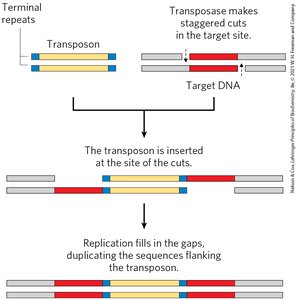
Terminal Inverted Repeats (TIR): Short, conserved sequences at both ends, serving as recognition sites for transposase.
Direct Repeats (DR): Created at the site of insertion; their length is characteristic for each transposon.
Transposase gene: Highly conserved, essential for transposition.
Movement: Can excise and insert into any chromosome, using cut-and-paste or copy-and-paste mechanisms.
Biological function: No known function in the host; excessive activity can be lethal.
Inactive transposons are common due to mutations in the transposase gene.
Mechanisms of Transposition
Transposons move within the genome by two main mechanisms:
Cut-and-paste (non-replicative): The transposon is excised and inserted elsewhere, with no net increase in copy number.
Copy-and-paste (replicative): A DNA copy is made and inserted, increasing the copy number.

Genetic Effects of Transposons
Transposon activity can have significant genetic consequences:
Chromosome breaks and translocations: Unrepaired DNA breaks can disrupt cell division.
Gene/exon translocations: Faulty cuts can move genes or exons, affecting function.
Insertion near promoters: Can alter gene expression, leading to diseases such as cancer.
Insertion in coding sequences: May cause loss of protein function.
Unequal crossing-over: Misalignment of transposons during meiosis can result in gene duplications or deletions.
Footprint of TE: Removal leaves direct repeats, potentially affecting translation.

Case Study: Maize Ac/Ds Elements
Ac/Ds Elements and Phenotypic Effects
Maize provides a classic example of transposon activity. The Ac (activator) element is autonomous, encoding transposase, while Ds (dissociator) is nonautonomous and requires Ac for movement. Their insertion near genes produces visible, non-lethal phenotypic effects, such as variegated kernel coloration.
Ac: Full-length, encodes transposase, causes target site duplication.
Ds: Partial, lacks transposase, moves only in presence of Ac.
Phenotypic effects: Sectors of dominant and recessive traits in the same kernel, explained by transposon movement.


Timing of Transposition and Sector Size
The size of phenotypic sectors in maize kernels is related to the timing of transposition during development. Early events produce larger sectors, while late events produce smaller ones.

Transposons in Other Organisms
Transposon Activity in Plants and Humans
Transposons are widespread in plants, contributing to phenotypic diversity. In humans, mariner elements (Tc1/mariner superfamily) are the largest family of DNA-based transposons, though most are inactive. Their presence is associated with genetic diseases involving large deletions or repeated DNA sequences.
Mariner elements: Comprise 2.9% of human genome; associated with genetic instability.
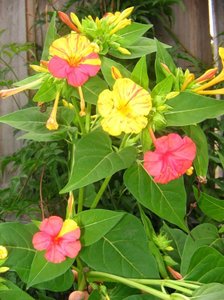
Plant examples: Variegated flowers such as Mirabilis jalapa and Camellia japonica.
Retrotransposons: Structure and Function
Types of Human Retrotransposons
Retrotransposons are abundant in eukaryotic genomes and move via RNA intermediates. They are believed to have originated from ancient retroviral infections. The main types in humans are:
LINEs (Long INterspersed Elements): Autonomous, non-LTR, encode reverse transcriptase, comprise ~21% of genome.
SINEs (Short INterspersed Elements): Non-autonomous, non-LTR, rely on LINEs for reverse transcription, comprise ~13% of genome.
LTR retrotransposons: Viral-like, have LTRs and encode RT and integrase, but lack envelope proteins, comprise ~8% of genome.
LINEs: Structure and Activity
LINEs are long, non-LTR elements with an internal RNA polymerase II promoter. They encode a protein similar to reverse transcriptase and another of unknown function. LINEs are highly variable and still active, with new insertions occurring in the human genome.
Copy number: ~850,000 copies, most partial.
Activity: At least 100 transcriptionally active L1 elements per genome.
Significance: Responsible for most reverse transcription in mammalian genomes, including creation of processed pseudogenes.
SINEs: Structure and Activity
SINEs are short, non-LTR, non-autonomous elements with an internal polymerase III promoter. The Alu family is the most prominent, with ~1,000,000 copies. SINEs rely on LINEs for reverse transcription and insertion.
Copy number: ~1,500,000 copies, 100-300 bp units.
Activity: Highly polymorphic, with new insertions occurring frequently.
LTR Retrotransposons
LTR retrotransposons are viral-like elements with LTRs, encoding reverse transcriptase and integrase. They cannot produce viral particles due to lack of envelope proteins. Examples include human ERV and THE-1 elements.
Copy number: ~450,000 copies, full-length units 6-11 kb.
Functional Impact: Human Diseases
Transposon-Associated Diseases
De novo transpositions of LINEs and SINEs can disrupt gene function, leading to hereditary and somatic diseases.
Hemophilia: Alu SINE insertion in exon 14 of factor VIII gene.
Colon cancer: L1 LINE insertion in APC gene.
Neurofibromatosis: Alu element insertion in a critical gene.
Summary Table: Types of Transposable Elements
Type | Mechanism | Key Enzyme | Copy Number in Human Genome | Example |
|---|---|---|---|---|
DNA Transposons | Cut-and-paste or copy-and-paste | Transposase | 2.9% | Mariner elements |
LINEs | Copy-and-paste (via RNA) | Reverse transcriptase | 20.4% | L1 elements |
SINEs | Copy-and-paste (via RNA, non-autonomous) | Uses LINE RT | 13.1% | Alu elements |
LTR Retrotransposons | Copy-and-paste (via RNA) | RT, Integrase | 8.3% | ERV, THE-1 |
Key Equations and Concepts
Transposon insertion:
Retrotransposon cycle:
Further Reading
For deeper understanding, refer to Lehninger Biochemistry (Nelson and Cox), especially chapters 25-27, and the figures referenced in the lecture notes.
