 Indietro
Water, Weak Interactions, and the Generation of Order in Biochemistry
Guida di studio - Note intelligenti
 Appunti personalizzati basati sui tuoi materiali, ampliati con definizioni chiave, esempi e contesto.
Water, Weak Interactions, and the Generation of Order in Biochemistry
Introduction to Water in Biochemistry
Water is fundamental to all biochemical processes, serving as the solvent of life and influencing the structure, dynamics, and interactions of biomolecules. Its unique chemical and physical properties underpin the organization and function of cells and organisms.
The Molecular Hierarchy of Structure
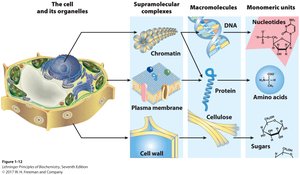
Biological systems are organized in a hierarchical manner, from monomeric units to complex cellular structures.
Monomeric units: Nucleotides, amino acids, and sugars are the building blocks of macromolecules.
Macromolecules: DNA, proteins, and cellulose are polymers formed from monomeric units.
Supramolecular complexes: Chromatin, plasma membranes, and cell walls are assemblies of macromolecules.
Cell and organelles: The highest level of organization, where all previous structures function together.
Properties of Water
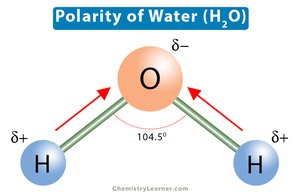
Water is a simple, yet highly polar molecule, with two hydrogen atoms covalently bonded to an oxygen atom. Its polarity and ability to form hydrogen bonds make it an excellent solvent for polar and ionic substances, and a poor solvent for nonpolar molecules.
Polarity: The oxygen atom is more electronegative than hydrogen, resulting in partial negative (δ−) and partial positive (δ+) charges.
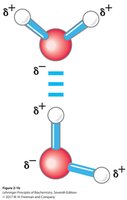
Cohesion: Water molecules are highly cohesive due to hydrogen bonding, allowing for phenomena such as water transport in plants.
Hydrogen Bonding in Water
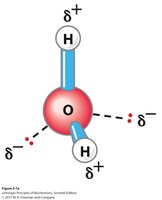
Hydrogen bonds are a type of dipole–dipole interaction where a hydrogen atom is shared between two electronegative atoms (commonly oxygen or nitrogen). In water, each molecule forms an average of 3.4 hydrogen bonds with its neighbors, leading to a dynamic, yet structured, liquid state.
Strength: Hydrogen bonds are weaker than covalent bonds (4–20 kJ/mol vs. ~470 kJ/mol), but are critical for the specificity and stability of biomolecular structures.
Biological importance: Hydrogen bonds are essential for the structure of DNA, proteins, and other macromolecules.
Water as a Solvent
Water dissolves many substances due to its polarity and hydrogen bonding capacity. It hydrates ions and polar molecules, facilitating biochemical reactions and molecular mobility.
Hydration shells: Water molecules surround ions and polar molecules, stabilizing them in solution.
Thermal motion: Water's liquid state allows for rapid molecular movement, essential for biochemical interactions.
Noncovalent Interactions in Biochemistry
Noncovalent interactions, though individually weak, collectively govern the structure and function of biomolecules. They are reversible, allowing for dynamic molecular interactions.
Ionic interactions (Salt bridges): Occur between oppositely charged atoms or groups. Strongest in nonpolar environments, weakened in water due to its high dielectric constant.
Dipole–dipole interactions: Occur between molecules with permanent dipoles, including hydrogen bonds.
Van der Waals interactions: Weak, transient interactions due to temporary charge asymmetries. Significant when many atoms are in close contact.
The Hydrophobic Effect
The hydrophobic effect is the tendency of nonpolar molecules to associate in aqueous solution, driven by the increase in entropy of water molecules. This effect is crucial for the formation of biological membranes and the folding of proteins.
Membrane formation: Lipids self-assemble into bilayers, with hydrophobic tails sequestered away from water.
Protein folding: Nonpolar amino acid side chains cluster in the protein interior, stabilizing the folded structure.
pH and Biochemical Systems
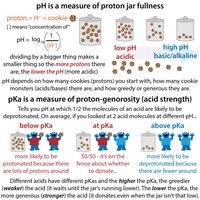
pH is a measure of hydrogen ion concentration and is critical for maintaining the structure and function of biomolecules. Small changes in pH can disrupt ionic interactions and hydrogen bonds, leading to loss of function.
Definition:
Physiological relevance: Human blood pH is tightly regulated around 7.4; deviations can be life-threatening.
Acids and bases: Acids donate protons (H+), bases accept protons. The strength of an acid or base is given by its dissociation constant ( or ).
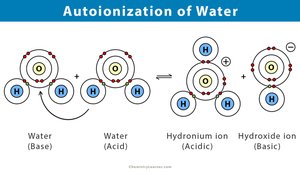
Water ionization: , with at 25°C.
pOH: , and .
Buffer Systems
Buffers are solutions that resist changes in pH upon addition of acid or base. They are composed of a weak acid and its conjugate base, and are most effective near the acid's pKa value.
Henderson–Hasselbalch equation: Relates pH, pKa, and the ratio of conjugate base to acid:
Biological importance: Buffers maintain the pH necessary for enzyme activity and structural integrity of biomolecules.
Summary Table: Types of Noncovalent Interactions
Interaction Type | Strength (kJ/mol) | Example | Biological Role |
|---|---|---|---|
Ionic (Salt bridge) | ~20 | Charged amino acid side chains | Stabilizes protein structure |
Hydrogen bond | 4–20 | Base pairing in DNA | Specificity in molecular recognition |
Van der Waals | 2–4 | Nonpolar side chain interactions | Protein folding, membrane stability |
Key Equations
pH:
pOH:
Relationship:
Henderson–Hasselbalch:
Water ionization constant:
Conclusion
Water and weak interactions are central to the structure, dynamics, and function of all biological molecules. Understanding these principles is essential for further study in biochemistry, including protein structure, enzyme function, and cellular metabolism.
