 Indietro
A Tour of the Cell: Structure, Function, and Organization
Guida di studio - Note intelligenti
 Appunti personalizzati basati sui tuoi materiali, ampliati con definizioni chiave, esempi e contesto.
Cell Types and Classification
Prokaryotic vs. Eukaryotic Cells
Cells are the fundamental units of life and are classified into two major categories: prokaryotic and eukaryotic. Understanding their differences and similarities is essential for studying cell biology.
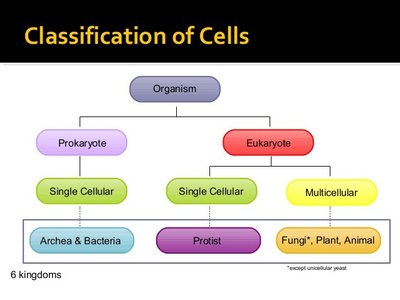
Prokaryotic cells lack a nucleus and membrane-bound organelles. They are found in the domains Archaea and Bacteria and are always single-celled, simpler, and smaller (typically 10x smaller than eukaryotic cells).
Eukaryotic cells contain a membrane-bound nucleus and organelles. Organisms in the domain Eukarya are made up of eukaryotic cells, which can be single-celled or multicellular, and are larger (10–100 μm).
Both cell types have a plasma membrane, ribosomes, DNA, and cytoplasm.

Comparison of Cell Types
Similarities: Plasma membrane, ribosomes, DNA, cytoplasm, and the same genetic code.
Differences: Eukaryotes have organelles (including nucleus), prokaryotes have a nucleoid region and cell wall. Only some eukaryotes have a cell wall.
Classification Table: Three Domains of Life
This table compares key characteristics of Bacteria, Archaea, and Eukarya.
Characteristic | Bacteria | Archaea | Eukarya |
|---|---|---|---|
Nuclear envelope | Absent | Absent | Present |
Membrane-bound organelles | Absent | Absent | Present |
Peptidoglycan in cell wall | Present | Absent | Absent |
Membrane lipids | Unbranched hydrocarbons | Some branched hydrocarbons | Unbranched hydrocarbons |
RNA polymerase | One kind | Several kinds | Several kinds |
Initiator amino acid for protein synthesis | Formyl-methionine | Methionine | Methionine |
Introns in genes | Very rare | Present in some genes | Present in many genes |
Growth response to antibiotics | Growth inhibited | Growth not inhibited | Growth not inhibited |
Histones associated with DNA | Absent | Present in some species | Present |
Circular DNA | Present | Present | Absent |
Growth at temperatures >100°C | Not possible | Some species | Not possible |
Cell Structure and Organization
Internal Organization of Eukaryotic Cells
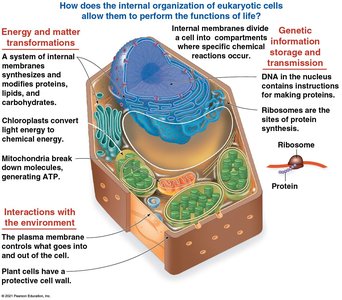
Eukaryotic cells are highly organized, with internal membranes dividing the cell into compartments where specific chemical reactions occur. This compartmentalization allows for efficient functioning and specialization.
Energy and matter transformations: Internal membranes synthesize and modify proteins, lipids, and carbohydrates. Chloroplasts convert light energy to chemical energy, and mitochondria break down molecules to generate ATP.
Genetic information storage and transmission: DNA in the nucleus contains instructions for making proteins. Ribosomes are the sites of protein synthesis.
Interactions with the environment: The plasma membrane controls what goes in and out of the cell. Plant cells have a protective cell wall.
Overview of Animal and Plant Cells
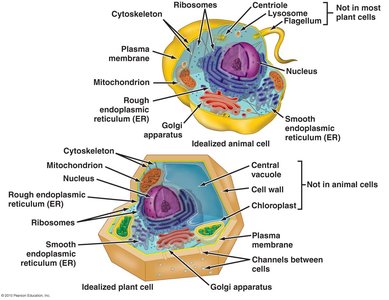
Animal and plant cells share many organelles but also have distinct features. Plant cells contain a cell wall, chloroplasts, and a central vacuole, while animal cells do not.
Animal cells: Nucleus, mitochondria, endoplasmic reticulum (rough and smooth), Golgi apparatus, lysosomes, cytoskeleton, plasma membrane, ribosomes, centrioles, flagella (not in most plant cells).
Plant cells: Nucleus, mitochondria, endoplasmic reticulum (rough and smooth), Golgi apparatus, cytoskeleton, plasma membrane, ribosomes, central vacuole, cell wall, chloroplasts, channels between cells (plasmodesmata).
Prokaryotic Cell Structure
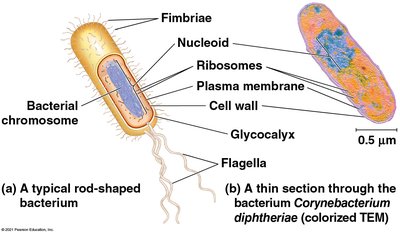
Components of Prokaryotic Cells
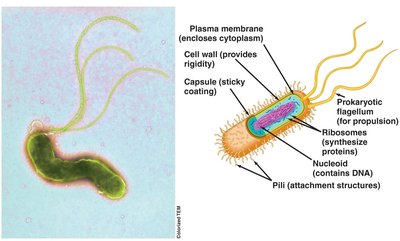
Prokaryotic cells are structurally simpler than eukaryotic cells but possess essential features for survival and function.
Plasma membrane: Encloses cytoplasm and regulates entry/exit of substances.
Cell wall: Provides rigidity and protection.
Capsule: Sticky coating for protection and adherence.
Flagella: Used for propulsion.
Pili: Attachment structures.
Ribosomes: Sites of protein synthesis.
Nucleoid: Region containing DNA.
Cell Wall Differences in Bacteria
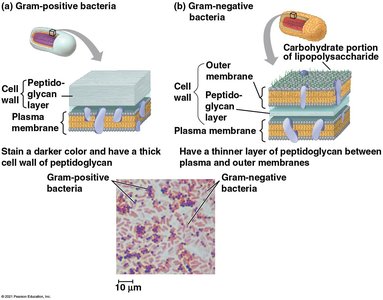
Bacterial cell walls are classified as Gram-positive or Gram-negative based on their structure and staining properties.
Gram-positive bacteria: Thick peptidoglycan layer, stain darker.
Gram-negative bacteria: Thin peptidoglycan layer between plasma and outer membranes, stain lighter, have an additional carbohydrate portion of lipopolysaccharide.
DNA Organization in Prokaryotes
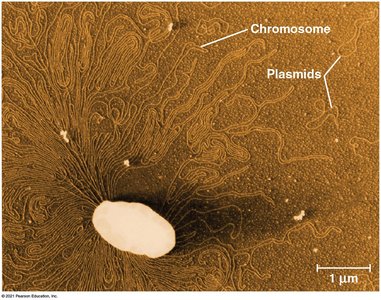
Prokaryotic DNA is organized differently from eukaryotic DNA. Most prokaryotes have a single, circular chromosome and may also contain plasmids—small, circular DNA molecules.
Chromosome: Contains essential genetic information.
Plasmids: Carry additional genes, often for antibiotic resistance or other functions.
Eukaryotic Cell Structure
Organelles and Their Functions
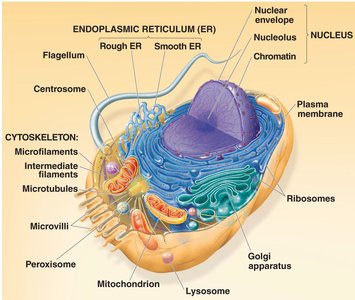
Eukaryotic cells contain specialized organelles, each with distinct functions that contribute to the cell's overall operation.
Nucleus: Houses DNA, controls cell activities, enclosed by a double membrane (nuclear envelope).
Nucleolus: Site of ribosome component synthesis.
Ribosomes: Protein synthesis; found free in cytoplasm or bound to ER.
Endoplasmic reticulum (ER): Rough ER (protein synthesis), Smooth ER (lipid synthesis, detoxification, calcium storage).
Golgi apparatus: Modifies, sorts, and ships proteins and lipids.
Lysosomes: Digestive enzymes for breakdown and recycling.
Vacuoles: Storage, water regulation, and structural support (central vacuole in plants).
Mitochondria: ATP production via cellular respiration.
Chloroplasts: Photosynthesis in plant cells.
Peroxisomes: Oxidation of various compounds, breakdown of fatty acids and toxins.
Cytoskeleton: Structural support, movement, and transport within the cell.

Differences Between Plant and Animal Cells
Plant cells: Cell wall (cellulose), chloroplasts, central vacuole.
Animal cells: Lysosomes, centrioles, flagella (not in most plant cells).
Membrane Structure
Plasma Membrane Composition
The plasma membrane is a dynamic structure that protects the cell and regulates its interactions with the environment. It is composed of a phospholipid bilayer with embedded proteins and carbohydrates.
Phospholipids: Glycerol backbone, two fatty acid tails (hydrophobic), and a phosphate group (hydrophilic head).
Fluid mosaic model: Proteins and phospholipids move freely within the membrane.
Proteins: Serve as channels, receptors, and enzymes.
Carbohydrates: Attached to proteins or lipids, involved in cell recognition.


Cell Organization and Function
Cell Variety and Versatility
Cells are the smallest unit of life and exhibit a wide variety of shapes, sizes, and organelle compositions. This versatility is controlled at the genetic level and allows cells to perform specialized functions.
Structure determines function: The shape and internal organization of a cell are closely linked to its role in the organism.
Genetic control: DNA directs the synthesis of proteins and organelles, determining cell specialization.
Hierarchy of Organization
Cells demonstrate a hierarchy of organization, from monomers to polymers to organelles, each contributing to the cell's function.
Monomer: Basic building block (e.g., amino acid).
Polymer: Chain of monomers (e.g., protein).
Organelle: Structure composed of polymers (e.g., ribosome).
Function: The role the organelle plays in the cell (e.g., protein synthesis).
Summary Table: Key Organelles and Functions
Organelle | Function |
|---|---|
Nucleus | Decision maker; contains DNA (genes) |
Nucleolus | Makes components for ribosomes |
Ribosomes | Protein synthesis |
Rough ER | Protein production for secretion and membrane |
Smooth ER | Lipid and carbohydrate production, detoxification, calcium storage |
Golgi apparatus | Modification and shipping of molecules |
Lysosomes | Breakdown and recycling of materials |
Vacuoles | Storage and water regulation |
Chloroplast | Photosynthesis (light to chemical energy) |
Mitochondria | Cellular respiration (food to ATP) |
Cytoskeleton | Support, movement, transport |
Vocabulary and Key Terms
Prokaryotic vs. Eukaryotic
Nucleoid region
Cytoplasm
Plasma membrane
Nuclear envelope
Nuclear lamina
Nuclear matrix
Histones
Chromatin vs Chromosome
Chaperonins
Transport vesicles
Hydrolytic enzymes
Phagocytosis
Motor proteins
Tubulin
Actin
Cell wall
ECM
Integrins
Organelles: Nucleus, ribosomes, smooth ER, rough ER, Golgi, lysosomes, vacuoles, mitochondria, chloroplast
Cytoskeleton: Microtubules, microfilaments, intermediate filaments
Junctions: Tight junctions, gap junctions, plasmodesmata, desmosomes
Questions for Review
Identify similarities and differences between prokaryotic and eukaryotic cells.
Give an example of the hierarchy of organization within a cell.
Describe how cargo in the cell is moved around from one location to another.
Which organelle has a lumen with low pH?
What organelle performs cellular respiration?
Identify the organelles that would be found in a prokaryote.
What organelles perform detox of drugs/poisons?
Identify the organelles that are part of the Endomembrane system.
What organelles help in the synthesis/modification of proteins?
What are the building block proteins of each class of fibers found in the cytoskeleton?
Equations and Formulas
Photosynthesis (in chloroplasts)
The process of photosynthesis can be summarized by the following equation:
Cellular Respiration (in mitochondria)
The process of cellular respiration can be summarized by the following equation:
Fluid Mosaic Model of Membrane
The plasma membrane is described by the fluid mosaic model, which can be represented as:
Take Home Points
Know the terms in bold and underlined.
Compare and contrast prokaryotic and eukaryotic cells.
Understand the differences between animal and plant cells.
Know the function of each organelle and how they fit into the bigger picture of the cell.
