 Indietro
A Tour of the Cell: Structure and Function in General Biology
Guida di studio - Note intelligenti
 Appunti personalizzati basati sui tuoi materiali, ampliati con definizioni chiave, esempi e contesto.
Chapter 4 – A Tour of the Cell
Learning Objectives
Explain why cells are small and describe surface area-to-volume ratio.
Explain two parts of cell theory.
Compare and contrast prokaryotic and eukaryotic cells, and animal and plant cells.
Describe the structure and function of the nucleus, chromosomes, and ribosomes.
Identify the parts of the endomembrane system and describe their roles.
Compare and contrast mitochondria and chloroplasts.
Describe the cytoskeleton and its functions.
Relate plant cell walls and plasmodesmata to their functions.
Describe the four functional categories of organelles in eukaryotic cells.
Cell Theory
Fundamental Principles
The cell theory is a cornerstone of biology, stating that:
All living organisms are composed of cells.
All cells arise from pre-existing cells.
Cells are the basic unit of structure and function in all living things.
The Small Size of Cells and Surface Area-to-Volume Ratio
Why Cells Are Small
Cells must remain small to efficiently exchange materials (nutrients, waste) with their environment. As cell size increases, the surface area-to-volume ratio decreases, limiting the rate of exchange.
Smaller cells have a larger surface area relative to their volume, allowing more efficient transport.
Large cells have more surface area overall, but less relative to their volume.
Surface Area-to-Volume Ratio Formula:
Single Large Cube | 27 Small Cubes | |
|---|---|---|
Total Volume | 27 units3 | 27 units3 |
Total Surface Area | 54 units2 | 162 units2 |
Surface-to-Volume Ratio | 2 | 6 |
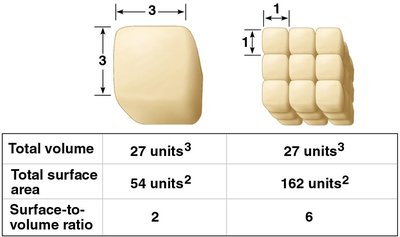
Example: Human cells are microscopic, with ~36 trillion cells in the body, maximizing exchange efficiency.
Structure of the Plasma Membrane
Phospholipid Bilayer
The plasma membrane is a selectively permeable barrier composed of a phospholipid bilayer with embedded proteins.
Phospholipids: Have hydrophilic heads and hydrophobic tails.
Proteins: Serve as channels, receptors, and enzymes.
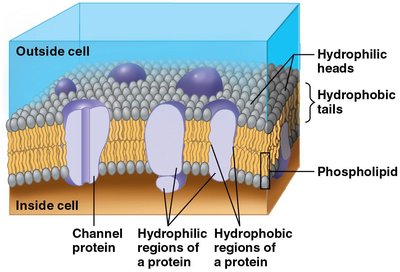
Example: Channel proteins allow specific molecules to cross the membrane.
Prokaryotic vs. Eukaryotic Cells
Key Differences
Prokaryotic Cells: Lack a nucleus and membrane-bound organelles. DNA is located in the nucleoid region.
Eukaryotic Cells: Have a nucleus and various membrane-bound organelles.
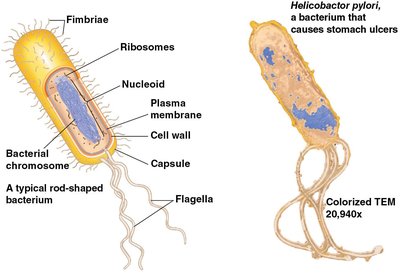
Example: Bacteria are prokaryotes; plants and animals are eukaryotes.
Animal vs. Plant Cells
Structural Comparison
Animal Cells: Lack cell walls and chloroplasts; contain centrioles and lysosomes.
Plant Cells: Have cell walls, chloroplasts, and a large central vacuole; lack centrioles.
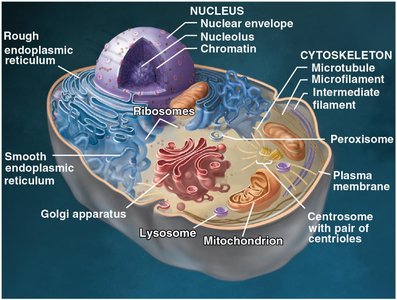
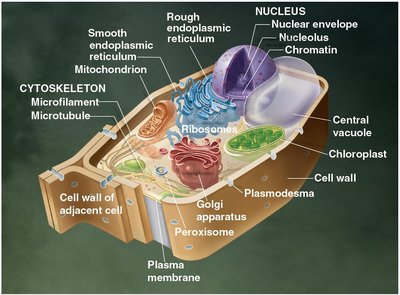
Example: Plant cells can perform photosynthesis; animal cells cannot.
Cytoplasm and Cytosol
Definitions and Functions
Cytoplasm: The entire contents within the cell membrane, including organelles and cytosol.
Cytosol: The fluid portion of the cytoplasm.
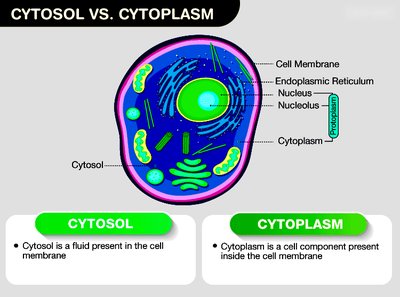
Example: Enzymatic reactions occur in the cytosol.
The Nucleus, Chromosomes, and Ribosomes
Nucleus Structure and Function
The nucleus is the command center of the cell, housing DNA and directing protein synthesis via messenger RNA (mRNA).
Chromatin: Complex of DNA and proteins forming chromosomes.
Nuclear Envelope: Double membrane with pores for transport.
Nucleolus: Site of ribosomal RNA (rRNA) synthesis.
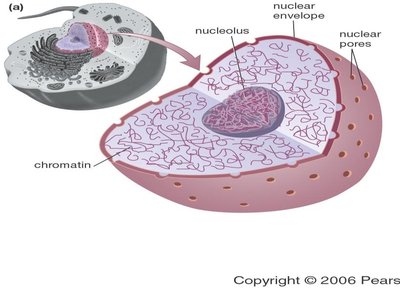
Example: Human cells have 46 chromosomes.
Ribosomes
Ribosomes are composed of rRNA and proteins, synthesizing proteins according to DNA instructions.
Located in cytosol or attached to the endoplasmic reticulum (ER).
Cells with high protein production have many ribosomes.
Example: Pancreatic cells have abundant ribosomes for enzyme production.
The Endomembrane System
Components and Functions
The endomembrane system is a network of organelles involved in synthesis, distribution, storage, and export of molecules.
Nuclear envelope
Endoplasmic reticulum (ER)
Golgi apparatus
Lysosomes
Vesicles and vacuoles
Plasma membrane
Endoplasmic Reticulum (ER)
Rough ER: Studded with ribosomes; synthesizes proteins.
Smooth ER: Lacks ribosomes; synthesizes lipids and detoxifies chemicals.
Example: Liver cells have abundant smooth ER for detoxification.
Golgi Apparatus
Modifies, sorts, and ships cell products received from the ER.
‘Cis’ side receives vesicles; ‘trans’ side ships products.
Enzymes modify proteins and glycoproteins.
Example: Secretory cells use the Golgi to package hormones.
Lysosomes
Membrane-enclosed sacs containing digestive enzymes.
Digest food particles and recycle damaged organelles.
Provide an acidic environment for enzyme activity.
Example: Lysosomes remove webbing between fingers during fetal development.
Vacuoles
Large vesicles with diverse functions.
Central vacuole in plants stores water, waste, and defensive compounds.
Contractile vacuole in protists expels excess water.
Example: Plant vacuoles store caffeine and nicotine for defense.
Energy-Converting Organelles
Mitochondria
Mitochondria carry out cellular respiration, converting food energy to ATP.
Double membrane; inner membrane forms cristae.
Contains its own DNA and ribosomes.
Example: Muscle cells have many mitochondria for energy.
Chloroplasts
Chloroplasts are found in plant cells and perform photosynthesis.
Double membrane; contains chlorophyll.
Thylakoid stacks (grana) are sites of light reactions.
Stroma is the site of dark reactions.
Example: Leaf cells contain numerous chloroplasts.
The Cytoskeleton and Cell Surfaces
Cytoskeleton Structure and Function
The cytoskeleton is a network of protein fibers that maintain cell shape, anchor organelles, and enable movement.
Microtubules: Hollow rods of tubulin; involved in cell shape, division, cilia, and flagella.
Intermediate Filaments: Reinforce cell shape; anchor organelles.
Microfilaments (Actin Filaments): Solid rods of actin; support cell shape and enable movement.
Example: Muscle contraction relies on actin filaments.
Cilia and Flagella
Flagella: Long, whip-like structures for locomotion; composed of microtubules.
Cilia: Short, hair-like structures for movement and feeding; absent in plant cells.
Example: Cilia in the trachea move mucus and debris.
Extracellular Matrix (ECM) and Cell Walls
ECM: Animal cells secrete ECM for support, adhesion, and communication.
Cell Wall: Plant cells have a rigid cell wall made of cellulose for support and protection.
Plasmodesmata: Channels in plant cell walls for communication and transport.
Example: Cell walls keep plants upright; plasmodesmata allow water and nutrients to move between cells.
Functional Categories of Eukaryotic Organelles
Grouping by Function
Genetic Control: Nucleus, ribosomes
Manufacturing, Distribution, Breakdown: ER, Golgi apparatus, lysosomes, vacuoles
Energy Processing: Mitochondria, chloroplasts
Structural Support, Movement, Communication: Cytoskeleton, plasma membrane, cell wall
Example: The nucleus controls gene expression; mitochondria produce ATP.
Additional info: Academic context was added to clarify definitions, examples, and functional relationships among cell structures. All images included are directly relevant to the adjacent explanations and reinforce key concepts.
