 Indietro
Aerobic Cellular Respiration and Fermentation: Energy Harvest in Cells
Guida di studio - Note intelligenti
 Appunti personalizzati basati sui tuoi materiali, ampliati con definizioni chiave, esempi e contesto.
Ch. 6 - Cellular Respiration: Obtaining Energy from Food
Overview of Cellular Respiration
Cellular respiration is a fundamental metabolic pathway that enables cells to extract energy from organic molecules, primarily glucose. This process is essential for both eukaryotic and prokaryotic organisms, providing ATP—the universal energy currency of the cell. Cellular respiration is closely linked to photosynthesis, as the products of one process serve as the reactants for the other.
Cellular respiration occurs in all eukaryotes and many prokaryotes.
It requires oxygen (O2) in its aerobic form and produces carbon dioxide (CO2) as a waste product.
ATP is generated through a series of enzyme-catalyzed reactions.
Energy carriers such as NADH and FADH2 are produced and later converted to ATP.
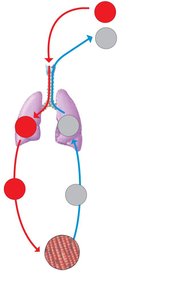
Photosynthesis and Cellular Respiration: Complementary Processes
Photosynthesis and cellular respiration are interconnected processes. Photosynthesis converts solar energy into chemical energy stored in glucose, while cellular respiration releases that energy for cellular work.
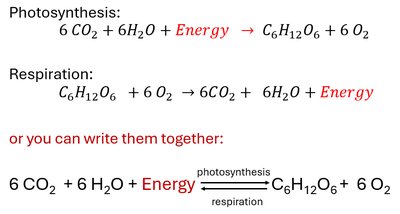
Photosynthesis equation:
Cellular respiration equation:
These equations are essentially the reverse of each other.
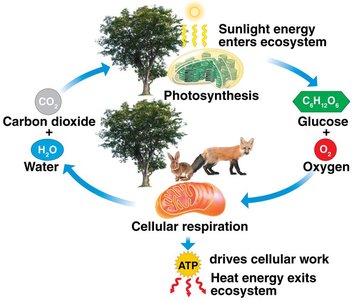
Energy Flow in Ecosystems
Most ecosystems depend on photosynthesis for energy input. Autotrophs (producers) convert sunlight into chemical energy, while heterotrophs (consumers) obtain energy by consuming other organisms.
Producers: Plants and other autotrophs use photosynthesis.
Consumers: Animals, fungi, and other heterotrophs rely on consuming organic matter.
Cellular respiration releases energy from glucose to drive cellular work.
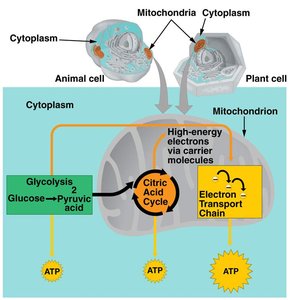
Aerobic Cellular Respiration: Pathways and Locations
Major Steps of Aerobic Cellular Respiration
Aerobic cellular respiration consists of several stages, each occurring in specific cellular locations:
Glycolysis: Occurs in the cytosol; breaks down glucose into pyruvate.
Preparatory Reactions: Pyruvate is converted to acetyl CoA in the mitochondria.
Citric Acid Cycle (Krebs/TCA Cycle): Occurs in the mitochondrial matrix; produces ATP, NADH, FADH2, and CO2.
Electron Transport Chain (ETC) and ATP Synthase: Located in the inner mitochondrial membrane; generates most ATP.
Glycolysis
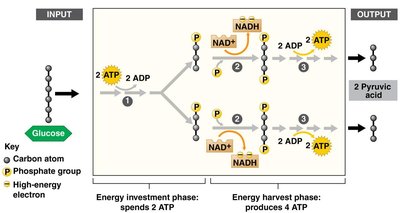
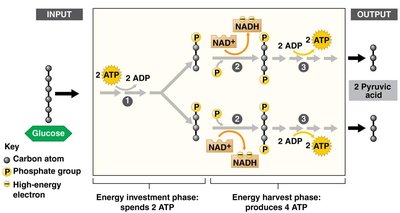
Glycolysis is the first step in cellular respiration and does not require oxygen. It splits one glucose molecule into two pyruvate molecules, producing a net gain of 2 ATP and 2 NADH.
Location: Cytosol
Net products: 2 ATP, 2 NADH, 2 pyruvate per glucose
Energy investment phase: Uses 2 ATP
Energy harvest phase: Produces 4 ATP
Preparatory Reactions (Transition Step)
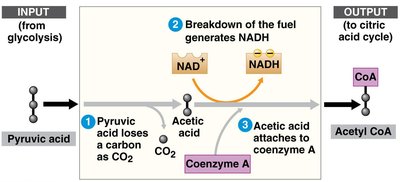
Before entering the citric acid cycle, pyruvate is converted to acetyl CoA. This step releases CO2 and generates NADH.
Location: Mitochondrial matrix (eukaryotes)
Process: Pyruvate (3C) loses a carbon as CO2, forming acetyl CoA (2C)
Products: 2 NADH per glucose
Citric Acid Cycle (Krebs Cycle)
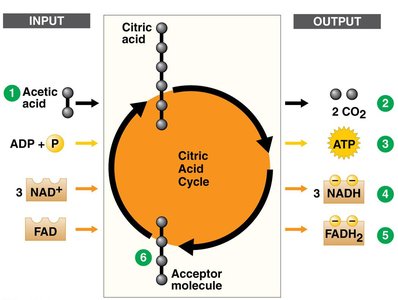
The citric acid cycle is a series of enzyme-driven reactions that further oxidize acetyl CoA, producing ATP, NADH, FADH2, and CO2.
Location: Mitochondrial matrix
Products per glucose: 2 ATP, 6 NADH, 2 FADH2, 4 CO2
Function: Supplies high-energy electrons to the electron transport chain
Electron Transport Chain and ATP Synthase
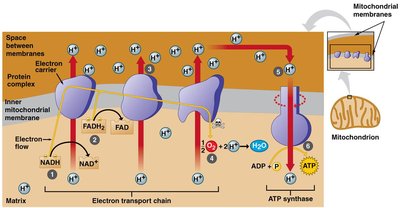
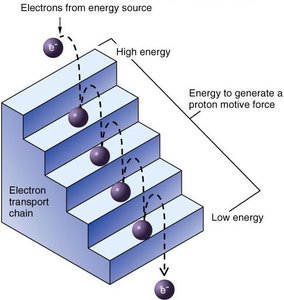
The electron transport chain (ETC) uses electrons from NADH and FADH2 to generate a proton gradient across the inner mitochondrial membrane. ATP synthase uses this gradient to produce ATP.
Location: Inner mitochondrial membrane
Process: Electrons are transferred through protein complexes, losing energy at each step
Oxygen: Final electron acceptor, forming water
ATP yield: Most ATP is produced here (about 28 per glucose)
Mitochondrial Structure and Function
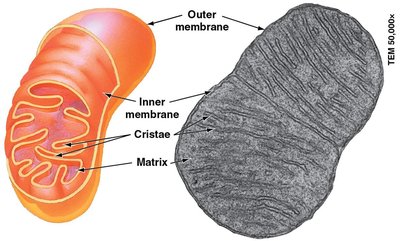
Mitochondria are specialized organelles with a double membrane. The inner membrane is highly folded (cristae), increasing surface area for the ETC and ATP synthase.
Structure-function relationship: Large surface area accommodates many ETC complexes
Matrix: Site of citric acid cycle

Summary of ATP Yield
The complete aerobic breakdown of one glucose molecule yields about 32 ATP, though theoretical values may reach 36-38 ATP.
Glycolysis: 2 ATP
Citric Acid Cycle: 2 ATP
Electron Transport Chain: About 28 ATP
Fermentation: Anaerobic Energy Production
Fermentation Pathways
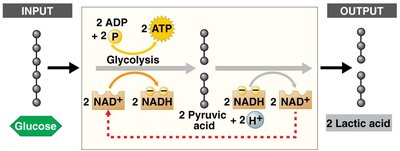
When oxygen is unavailable, cells can regenerate NAD+ through fermentation, allowing glycolysis to continue. Fermentation produces no additional ATP beyond glycolysis.
Lactic acid fermentation: Pyruvate is converted to lactic acid
Alcoholic fermentation: Pyruvate is converted to ethanol and CO2
Purpose: Restores NAD+ for glycolysis
ATP yield: Only 2 ATP per glucose (from glycolysis)
Oxygen and the Evolution of Life
Atmospheric Oxygen and Biological Evolution
Earth's atmosphere initially contained little oxygen. The evolution of photosynthesis in cyanobacteria led to the accumulation of O2, enabling aerobic respiration and the evolution of complex life forms.
First life: Used anaerobic pathways
Photosynthesis: Began ~2.8 billion years ago
Great Oxidation Event: O2 accumulated, causing mass extinctions
Eukaryotes: Appeared when O2 reached ~2% of present levels
Multicellular life: Evolved when O2 reached current levels (~700 million years ago)
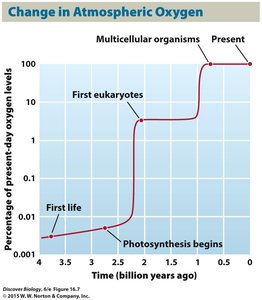
Table: Comparison of Aerobic Respiration and Fermentation
Process | Oxygen Required? | ATP Yield (per glucose) | End Products |
|---|---|---|---|
Aerobic Respiration | Yes | ~32 | CO2, H2O |
Fermentation | No | 2 | Lactic acid or ethanol + CO2 |
Key Terms and Concepts
ATP (Adenosine Triphosphate): Main energy carrier in cells
NADH/FADH2: Electron carriers used in respiration
Glycolysis: First step in glucose breakdown
Citric Acid Cycle: Central metabolic pathway in mitochondria
Electron Transport Chain: Series of proteins that generate ATP
Fermentation: Anaerobic pathway to regenerate NAD+
----------------------------------------
