 Indietro
Aerobic Cellular Respiration: Pathways and Mechanisms
Guida di studio - Note intelligenti
 Appunti personalizzati basati sui tuoi materiali, ampliati con definizioni chiave, esempi e contesto.
Types of Phosphorylation
Substrate-Level and Oxidative Phosphorylation
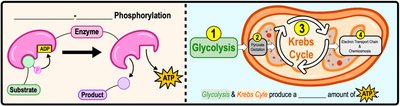
Phosphorylation is the process of adding a phosphate group to ADP to form ATP, the cell’s primary energy currency. During aerobic cellular respiration, ATP is produced via two main types of phosphorylation:
Substrate-Level Phosphorylation: Direct transfer of a phosphate group from a substrate to ADP, catalyzed by an enzyme. This occurs during glycolysis and the Krebs cycle, producing a modest amount of ATP.
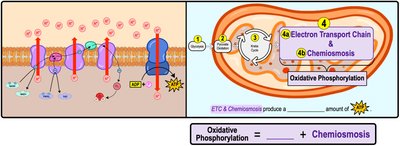
Oxidative Phosphorylation: Utilizes energy from redox reactions in the electron transport chain (ETC) to create a proton gradient, which powers ATP synthesis via chemiosmosis. This process generates the majority of ATP during cellular respiration.
Example: Glycolysis and the Krebs cycle produce ATP via substrate-level phosphorylation, while the ETC and chemiosmosis produce ATP via oxidative phosphorylation.
Glycolysis
Overview and Phases
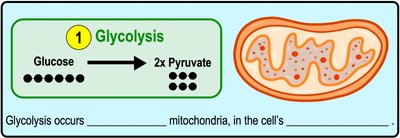
Glycolysis is the first step of cellular respiration, breaking down glucose (a six-carbon sugar) into two molecules of pyruvate. It occurs in the cytoplasm and does not require oxygen.
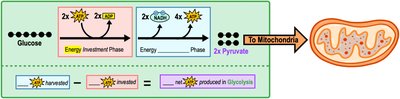
Energy Investment Phase: Requires input of 2 ATP molecules to activate glucose.
Energy Harvest Phase: Produces 4 ATP and 2 NADH molecules, resulting in a net gain of 2 ATP and 2 NADH per glucose.
Net Products: 2 pyruvate, 2 NADH, and 2 ATP per glucose molecule.
Example: Glycolysis occurs in the cytoplasm, outside the mitochondria.
Pyruvate Oxidation
Conversion of Pyruvate to Acetyl-CoA
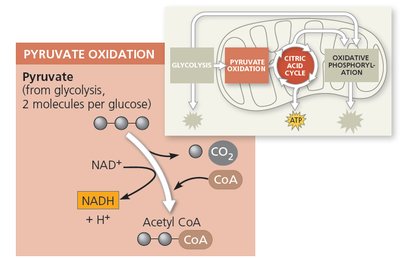
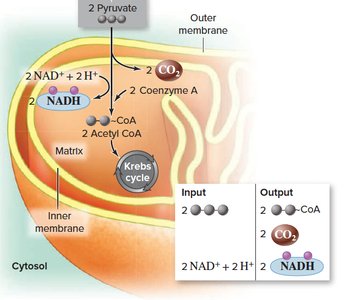
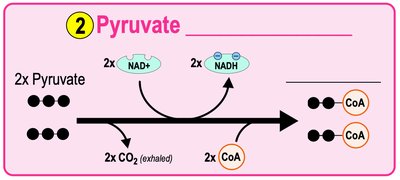
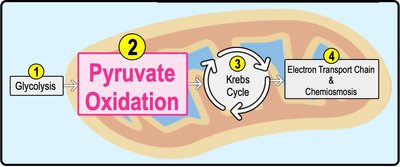
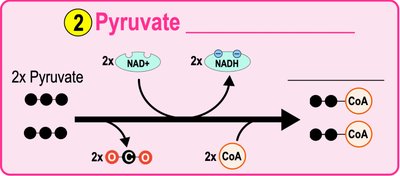
Pyruvate oxidation is the second step of cellular respiration, linking glycolysis to the Krebs cycle. Each pyruvate is transported into the mitochondrial matrix and converted into acetyl-CoA, releasing CO2 and producing NADH.
Location: Mitochondrial matrix
Products per glucose: 2 acetyl-CoA, 2 NADH, 2 CO2
Function: Prepares substrates for entry into the Krebs cycle
Example: Pyruvate oxidation connects glycolysis to the citric acid cycle.
Krebs Cycle (Citric Acid Cycle)
Oxidation of Acetyl-CoA and Energy Production
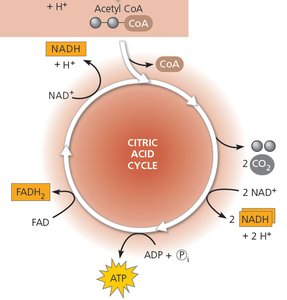
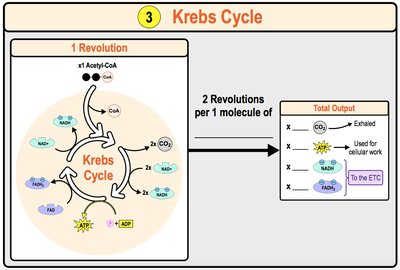
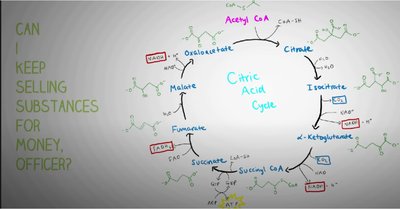
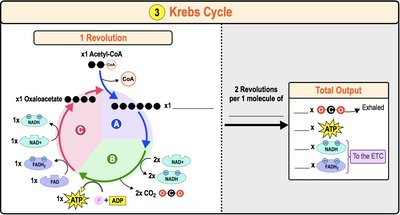
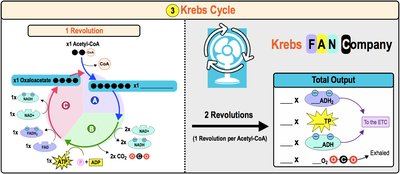
The Krebs cycle, also known as the citric acid cycle or TCA cycle, is the third stage of aerobic cellular respiration. It oxidizes acetyl-CoA, producing ATP, NADH, FADH2, and CO2.
Phases:
Acetyl-CoA Entry: Acetyl-CoA combines with oxaloacetate to form citrate.
Citrate Oxidation: Citrate is rearranged and oxidized, producing ATP, NADH, and CO2.
Oxaloacetate Regeneration: Oxaloacetate is regenerated, producing NADH and FADH2.
Rounds: Two rounds per glucose molecule (one per acetyl-CoA).
Products per glucose: 2 ATP, 6 NADH, 2 FADH2, 4 CO2
Example: The Krebs cycle is central to energy production and provides electrons for the ETC.
Electron Transport Chain (ETC)
Generation of Proton Gradient and ATP Synthesis
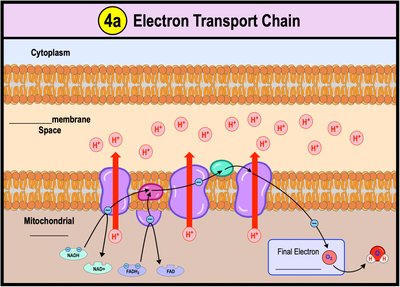
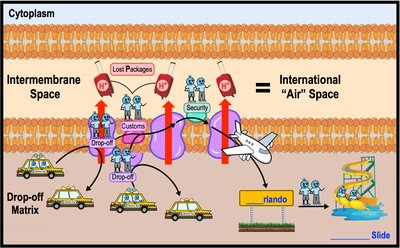
The electron transport chain is the fourth step of aerobic respiration, located in the inner mitochondrial membrane. It uses electrons from NADH and FADH2 to drive a series of redox reactions, pumping H+ ions into the intermembrane space and creating a proton gradient.
Final Electron Acceptor: Oxygen gas (O2), which combines with H+ to form water.
Function: The proton gradient powers ATP synthesis via chemiosmosis.
Example: The ETC is essential for oxidative phosphorylation and the majority of ATP production.
Chemiosmosis
ATP Synthesis via Proton Gradient
Chemiosmosis is the process by which the energy stored in the proton gradient created by the ETC is used to synthesize ATP. The enzyme ATP synthase facilitates the diffusion of H+ ions back into the mitochondrial matrix, driving the phosphorylation of ADP.
Oxidative Phosphorylation: Combination of ETC and chemiosmosis, resulting in the production of large amounts of ATP.
ATP Synthase: The enzyme responsible for ATP production during chemiosmosis.
Example: Most ATP generated during cellular respiration is produced by oxidative phosphorylation.
Review of Aerobic Cellular Respiration
Stages and Total Products
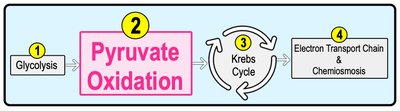
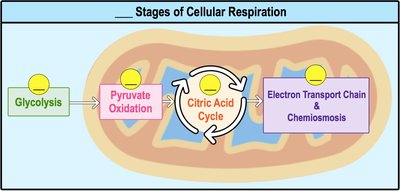
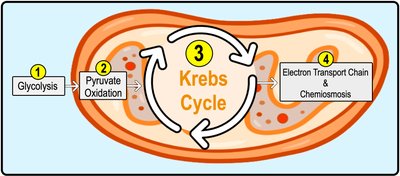
Aerobic cellular respiration consists of four main stages: glycolysis, pyruvate oxidation, Krebs cycle, and electron transport chain/chemiosmosis. The majority of ATP is produced during the final stage, utilizing the energy stored in NADH and FADH2.
Stages: Glycolysis → Pyruvate Oxidation → Krebs Cycle → ETC & Chemiosmosis
Total ATP Yield: Approximately 30-38 ATP molecules per glucose
Key Products: CO2 (exhaled), H2O (formed from O2), NADH, FADH2, ATP
Example: The potential energy for ATP synthesis is stored in NADH and FADH2 produced during earlier stages.
Total Products Table
Stage | ATP | NADH | FADH2 | CO2 | Location |
|---|---|---|---|---|---|
Glycolysis | 2 | 2 | 0 | 0 | Cytoplasm |
Pyruvate Oxidation | 0 | 2 | 0 | 2 | Mitochondrial Matrix |
Krebs Cycle | 2 | 6 | 2 | 4 | Mitochondrial Matrix |
ETC & Chemiosmosis | ~26-34 | 0 | 0 | 0 | Inner Mitochondrial Membrane |
Additional info: The oxygen atom used to form water in cellular respiration comes from molecular oxygen (O2), not from glucose or CO2.
