 Indietro
Aerobic Cellular Respiration: Redox Reactions, Pathways, and Fermentation
Guida di studio - Note intelligenti
 Appunti personalizzati basati sui tuoi materiali, ampliati con definizioni chiave, esempi e contesto.
Respiration
Redox Reactions in Cellular Respiration
Redox reactions are fundamental to cellular respiration, involving the transfer of electrons between molecules. These reactions drive the energy transformations necessary for ATP production.
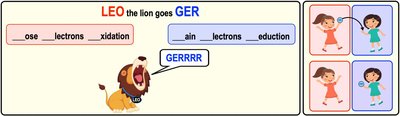
Oxidation: The process of losing one or more electrons.
Reduction: The process of gaining one or more electrons (overall charge is reduced).
Oxidation and reduction reactions always occur simultaneously (one molecule is oxidized while another is reduced).
Mnemonic: "LEO the Lion goes GER" — Lose Electrons = Oxidation; Gain Electrons = Reduction.
Example: In a redox reaction, if Molecule A loses electrons and Molecule B gains them, Molecule A is oxidized and Molecule B is reduced.
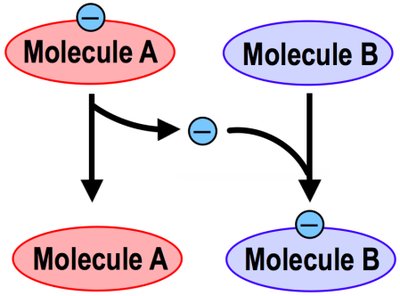
Key Practice: Oxidation is the loss of electrons; reduction is the gain of electrons.
Application: When glucose donates electrons to NAD+, glucose is oxidized.
Electron Carriers: NADH & FADH2
Electron carriers are molecules that transport electrons during cellular respiration, facilitating energy transfer.
NADH and FADH2 are the main electron carriers, each carrying high-energy electrons.
NAD+ and FAD are the oxidized forms; NADH and FADH2 are the reduced forms.
These carriers shuttle electrons to the Electron Transport Chain (ETC), acting like an "electron taxi."
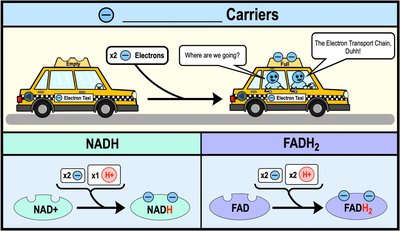
Memory Tool: NADH and FADH2 are "heavier" because they carry electrons.
Practice: Before harvesting energy from glucose, NAD+ acts as the electron carrier.
Introduction to Aerobic Cellular Respiration
Aerobic cellular respiration is the process of breaking down glucose in the presence of oxygen to produce ATP, the cell's energy currency.
Aerobic: Requires oxygen gas (O2).
Occurs in multiple stages, mostly inside the mitochondria.
Overall Equation:
Glucose is oxidized; oxygen is reduced.
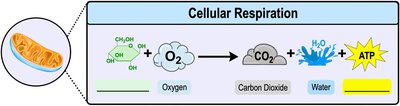
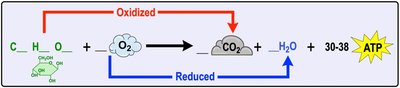
Practice: Water is a by-product of cellular respiration; oxygen is the final electron acceptor.
Stages of Aerobic Cellular Respiration
Aerobic cellular respiration consists of four main stages, each contributing to the breakdown of glucose and the production of ATP.
1. Glycolysis
2. Pyruvate Oxidation
3. Krebs Cycle (Citric Acid Cycle)
4. Electron Transport Chain & Chemiosmosis
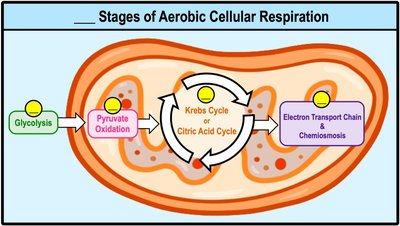
Order of Stages: Glycolysis → Pyruvate Oxidation → Krebs Cycle → Electron Transport Chain & Chemiosmosis
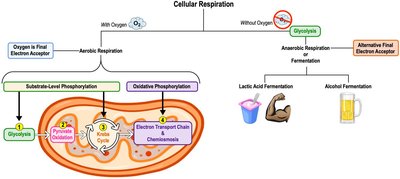
Map of Cellular Respiration
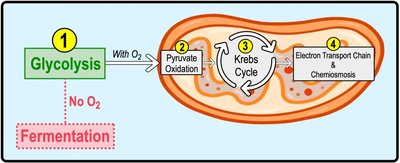
This map illustrates the flow of cellular respiration, including aerobic and anaerobic pathways.
With oxygen: Aerobic respiration proceeds through all four stages.
Without oxygen: Fermentation or anaerobic respiration occurs.
Oxygen is the final electron acceptor in aerobic respiration.
Types of Phosphorylation
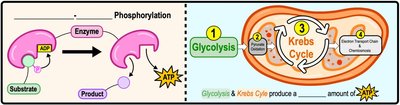
ATP is synthesized during cellular respiration by two main types of phosphorylation: substrate-level and oxidative.
Substrate-Level Phosphorylation: Direct transfer of a phosphate group from a substrate to ADP via an enzyme, producing a small amount of ATP during glycolysis and the Krebs cycle.
Oxidative Phosphorylation: Uses energy from redox reactions in the ETC to build a proton gradient, which powers ATP synthesis via chemiosmosis, producing most of the cell's ATP.
Chemiosmosis: Diffusion of ions (H+) across a membrane down their concentration gradient.
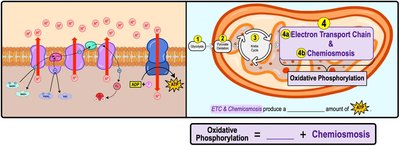
Practice: Substrate-level phosphorylation occurs in glycolysis and the Krebs cycle; oxidative phosphorylation occurs in the final steps.
Glycolysis
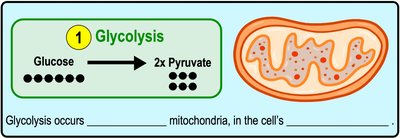
Glycolysis is the first step of cellular respiration, breaking down glucose into two pyruvate molecules.
"Glyco" = sugar; "lysis" = to split.
Glucose (6 carbons) is split into two 3-carbon pyruvates.
Occurs in the cytoplasm; does not require oxygen.
Phases:
Energy Investment Phase: Uses 2 ATP to start glycolysis.
Energy Harvest Phase: Produces 2 NADH and 4 ATP (net gain: 2 ATP).
Net products: 2 pyruvate, 2 NADH, 2 ATP per glucose.
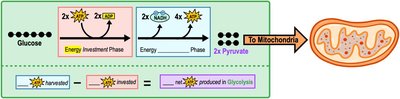
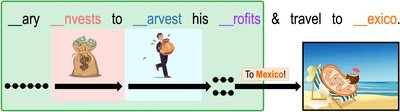
Practice: Glycolysis results in the net production of 2 NADH, 2 pyruvate, and 2 ATP.
Pyruvate Oxidation
Pyruvate oxidation is the second step, converting pyruvate into acetyl-CoA in the mitochondrial matrix.
Each pyruvate is converted to acetyl-CoA, producing NADH and CO2.
Products per glucose: 2 acetyl-CoA, 2 NADH, 2 CO2.
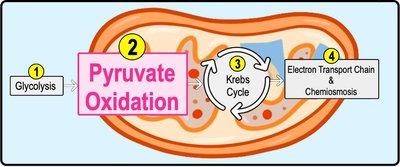
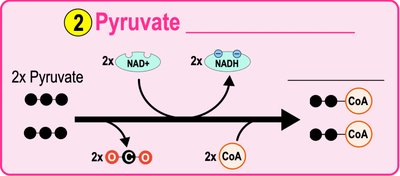
Practice: Pyruvate oxidation connects glycolysis to the Krebs cycle; it occurs in the mitochondrial matrix.
Krebs Cycle (Citric Acid Cycle)
The Krebs cycle is the third stage, oxidizing acetyl-CoA to produce ATP, NADH, and FADH2.
Acetyl-CoA enters and reacts with oxaloacetate to form citrate.
Citrate is oxidized, producing ATP, NADH, FADH2, and CO2.
Oxaloacetate is regenerated.
Two rounds per glucose (one per acetyl-CoA).
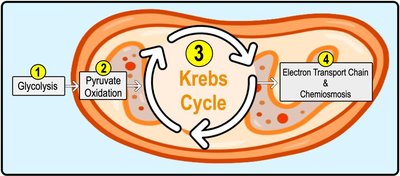
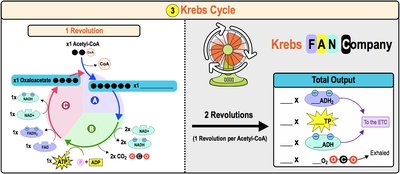
Practice: One glucose requires two turns of the Krebs cycle, generating 6 CO2, 10 NADH, 2 FADH2, and 4 ATP.
Electron Transport Chain (ETC)
The ETC is the fourth step, consisting of proteins in the mitochondrial inner membrane that transfer electrons and pump protons.
Electrons from NADH and FADH2 are passed through the chain in a series of redox reactions.
Energy is used to pump H+ into the intermembrane space, creating a gradient.
Oxygen is the final electron acceptor, forming water.
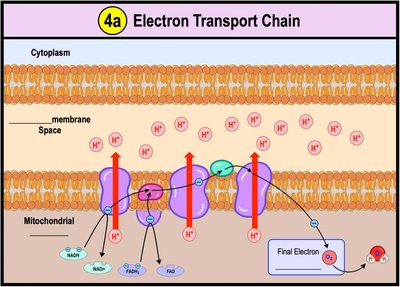
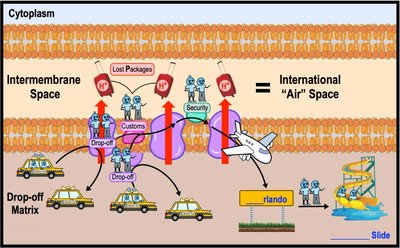
Practice: The ETC harnesses energy from high-energy electrons derived from glycolysis, pyruvate oxidation, and the Krebs cycle.
Chemiosmosis
Chemiosmosis captures the potential energy of the H+ gradient built by the ETC to synthesize ATP.
ATP synthase facilitates chemiosmosis and synthesizes ATP.
Oxidative phosphorylation combines ETC redox reactions and chemiosmosis to make ATP.
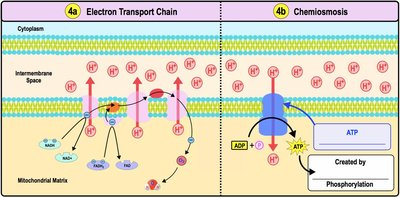
Practice: Chemiosmotic creation of ATP is driven by the potential energy of the H+ concentration gradient.
Review of Aerobic Cellular Respiration
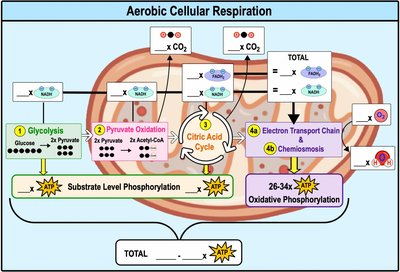
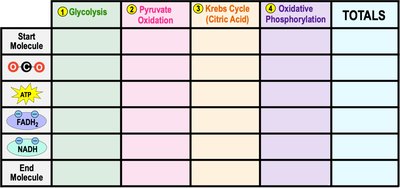
Summary of the four stages and their products from a single glucose molecule.
Energy is stored in NADH and FADH2 after the first three stages.
Most ATP is produced during oxidative phosphorylation.
Stage | CO2 | ATP | FADH2 | NADH |
|---|---|---|---|---|
Glycolysis | 0 | 2 | 0 | 2 |
Pyruvate Oxidation | 2 | 0 | 0 | 2 |
Krebs Cycle | 4 | 2 | 2 | 6 |
Oxidative Phosphorylation | 0 | 26-34 | 0 | 0 |
Total | 6 | 30-38 | 2 | 10 |
Practice: The oxygen atom in water produced during respiration comes from oxygen gas (O2).
Practice: Complete oxidation of one glucose yields approximately 30-38 ATP.
Fermentation & Anaerobic Respiration
When oxygen is unavailable, cells use fermentation or anaerobic respiration to regenerate NAD+ and produce ATP.
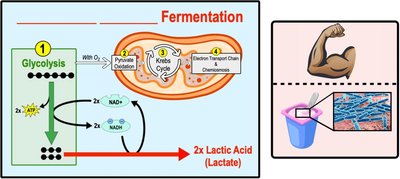
Without oxygen, the ETC cannot function, causing NADH to accumulate and NAD+ to decrease.
Fermentation uses electrons from NADH to reduce pyruvate, regenerating NAD+.
Pyruvate can be reduced to lactic acid or ethanol, depending on the organism.
Fermentation produces very little ATP; only some unicellular organisms can survive on it.
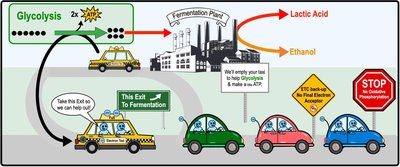
Practice: Fermentation allows a cell to recycle NADH to NAD+ for glycolysis.
Lactic Acid Fermentation
In lactic acid fermentation, pyruvate is reduced by NADH to form lactic acid (lactate) and NAD+.
Occurs in human muscle cells and bacteria (e.g., yogurt production).
Alcohol Fermentation
In alcohol fermentation, pyruvate is reduced by NADH to form ethanol and NAD+.
Produces beer from barley and wine from grapes.
Practice: Both lactic acid and alcohol fermentation oxidize NADH to NAD+.
Anaerobic Respiration
Some unicellular organisms can survive and make significant amounts of ATP without oxygen, using alternative electron acceptors.
Anaerobic respiration uses molecules like nitrate (NO3–), sulfate (SO42–), or CO2 as the final electron acceptor.
Produces more ATP than fermentation, but less than aerobic respiration.
Practice: Substrate-level phosphorylation occurs in both glycolysis and the Krebs cycle.
Practice: NAD+ is reduced to NADH during glycolysis, pyruvate oxidation, and the Krebs cycle.
