Indietro
Amino Acids and Protein Structure: Foundations of Protein Biochemistry
Guida di studio - Note intelligenti
 Appunti personalizzati basati sui tuoi materiali, ampliati con definizioni chiave, esempi e contesto.
Proteins and Amino Acids
Structure of Amino Acids
Proteins are polymers composed of monomeric units called amino acids. Each amino acid contains a central (alpha) carbon atom bonded to four different groups: an amino group (–NH2), a carboxyl group (–COOH), a hydrogen atom, and a variable side chain known as the R group. The R group determines the identity and properties of each amino acid.
General Structure: All amino acids share the same backbone structure, differing only in their R group.
Zwitterionic Nature: At physiological pH (~7.4), amino acids exist as zwitterions, with a positively charged amino group and a negatively charged carboxyl group.
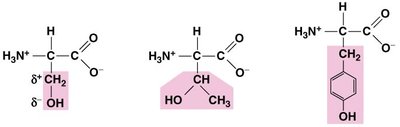
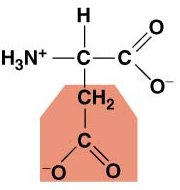
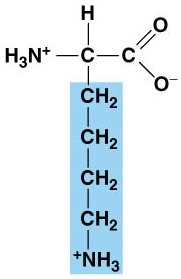
Families of Amino Acids: Amino acids are classified based on the properties of their side chains: nonpolar, polar uncharged, acidic (negative), and basic (positive).
Classification of Amino Acids
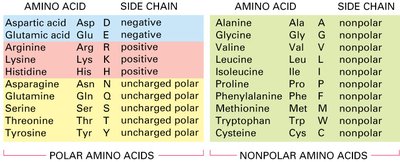
The 20 common amino acids are grouped according to the chemical nature of their side chains, which influences protein folding and function.
Nonpolar (Hydrophobic) Amino Acids: Side chains are mostly hydrocarbons, making them water-insoluble. Examples: Alanine, Valine, Leucine, Isoleucine, Methionine, Phenylalanine, Tryptophan, Proline, Glycine.
Polar (Hydrophilic) Amino Acids: Side chains contain groups that can form hydrogen bonds with water. Subdivided into:
Uncharged Polar: Serine, Threonine, Asparagine, Glutamine, Tyrosine, Cysteine.
Acidic (Negative): Aspartic acid, Glutamic acid.
Basic (Positive): Lysine, Arginine, Histidine.
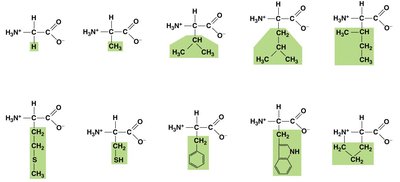
Special Amino Acids and Disulfide Bonds
Cysteine contains a sulfhydryl (–SH) group, which can form covalent disulfide bonds with another cysteine, stabilizing protein structure, especially in extracellular proteins. Proline introduces kinks in polypeptide chains due to its cyclic structure.
Disulfide Bonds: Covalent linkages between two cysteine residues, important for stabilizing tertiary and quaternary protein structures.
Example: Disulfide bonds are crucial in the structure of many extracellular proteins and in the formation of permanent curls in hair.

Peptide Bond Formation and Protein Structure
Polymerization of Amino Acids
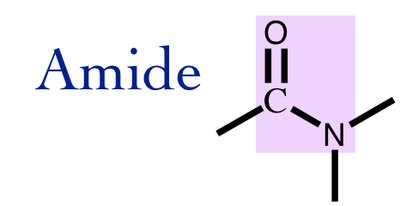
Amino acids are linked by peptide bonds through a dehydration synthesis (condensation) reaction, forming polypeptide chains. The resulting chain has directionality, with an N-terminus (free amino group) and a C-terminus (free carboxyl group).
Dehydration Synthesis: Removal of water to form a peptide bond between the carboxyl group of one amino acid and the amino group of another.
Hydrolysis: Addition of water to break peptide bonds, reversing polymerization.
Levels of Protein Structure
Proteins have four levels of structure, each contributing to their final shape and function:
Primary Structure: The linear sequence of amino acids in a polypeptide chain, determined by genetic information.
Secondary Structure: Local folding patterns stabilized by hydrogen bonds, including alpha helices and beta sheets.
Tertiary Structure: The overall three-dimensional shape of a single polypeptide, stabilized by interactions among R groups (hydrophobic interactions, van der Waals forces, hydrogen bonds, ionic bonds, and disulfide bridges).
Quaternary Structure: The association of multiple polypeptide subunits to form a functional protein complex.
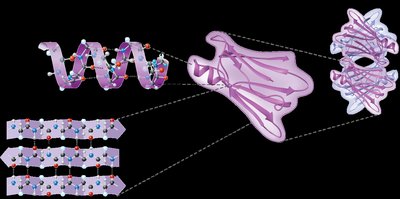
Protein Secondary Structure
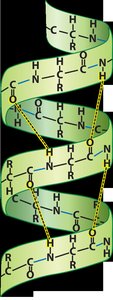
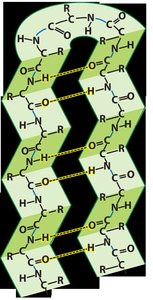
Secondary structures are stabilized by hydrogen bonds between the backbone atoms of the polypeptide chain. The two most common types are:
Alpha (α) Helix: A right-handed coil stabilized by hydrogen bonds between every fourth amino acid.
Beta (β) Sheet: Sheet-like structures formed by hydrogen bonds between segments of the polypeptide chain lying side by side.
Protein Tertiary and Quaternary Structure
Tertiary structure is the overall folding of a single polypeptide chain, driven primarily by hydrophobic interactions, van der Waals forces, hydrogen bonds, ionic bonds, and sometimes disulfide bonds. Quaternary structure arises when two or more polypeptide chains (subunits) associate to form a functional protein.
Hydrophobic Core: Nonpolar side chains are typically buried inside the protein, away from water, while polar side chains are exposed on the surface.
Examples: Hemoglobin (quaternary structure) is composed of four subunits; collagen (quaternary structure) is a fibrous protein with high tensile strength.
Protein Folding and Denaturation
Folding and Stability
Protein folding is usually spontaneous, resulting in the most energetically favorable conformation. Chaperone proteins may assist in folding, but the sequence of amino acids (primary structure) ultimately determines the final shape.
Denaturation: The loss of a protein's native structure due to disruption of noncovalent interactions (by heat, pH changes, salt concentration, etc.), leading to loss of function.
Renaturation: Some proteins can refold into their functional shape if the denaturing agent is removed.
Summary Table: Amino Acid Classification
Amino Acid | 3-Letter Code | 1-Letter Code | Side Chain Property |
|---|---|---|---|
Aspartic acid | Asp | D | Negative (acidic, polar) |
Glutamic acid | Glu | E | Negative (acidic, polar) |
Arginine | Arg | R | Positive (basic, polar) |
Lysine | Lys | K | Positive (basic, polar) |
Histidine | His | H | Positive (basic, polar) |
Asparagine | Asn | N | Uncharged polar |
Glutamine | Gln | Q | Uncharged polar |
Serine | Ser | S | Uncharged polar |
Threonine | Thr | T | Uncharged polar |
Tyrosine | Tyr | Y | Uncharged polar |
Alanine | Ala | A | Nonpolar |
Glycine | Gly | G | Nonpolar |
Valine | Val | V | Nonpolar |
Leucine | Leu | L | Nonpolar |
Isoleucine | Ile | I | Nonpolar |
Proline | Pro | P | Nonpolar |
Phenylalanine | Phe | F | Nonpolar |
Methionine | Met | M | Nonpolar |
Tryptophan | Trp | W | Nonpolar |
Cysteine | Cys | C | Nonpolar |
Key Equations
Peptide Bond Formation:
Zwitterion Formation (at neutral pH):
Examples and Applications
Luciferase: An enzyme that produces bioluminescence in fireflies.
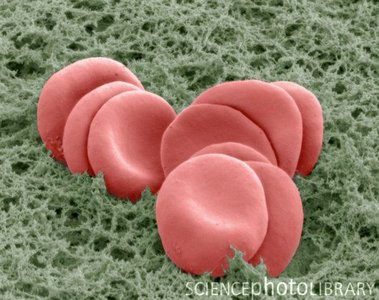
Hemoglobin: A quaternary protein that transports oxygen in red blood cells.
Collagen: A structural protein with high tensile strength, found in connective tissues.