 Indietro
Amino Acids: Structure, Properties, and Ionization
Guida di studio - Note intelligenti
 Appunti personalizzati basati sui tuoi materiali, ampliati con definizioni chiave, esempi e contesto.
Amino Acids
General Structure of Amino Acids
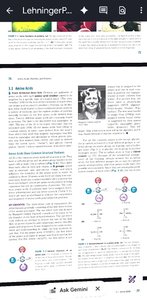
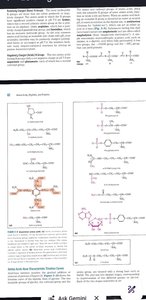
Amino acids are the building blocks of proteins and play a central role in biology. Each amino acid contains a central carbon atom (the α-carbon) bonded to four different groups: an amino group (–NH2), a carboxyl group (–COOH), a hydrogen atom, and a distinctive side chain (R group) that determines the identity and properties of the amino acid.
α-Carbon: The central carbon atom to which all other groups are attached.
Amino Group: Basic group, typically written as –NH2.
Carboxyl Group: Acidic group, typically written as –COOH.
R Group (Side Chain): Variable group that defines the specific amino acid.
Example: Glycine is the simplest amino acid, with a hydrogen atom as its R group.
Classification of Amino Acids
Amino acids are classified based on the properties of their side chains (R groups):
Nonpolar (Hydrophobic): Side chains are mostly hydrocarbons (e.g., alanine, valine, leucine).
Polar (Uncharged): Side chains contain groups that can form hydrogen bonds (e.g., serine, threonine).
Acidic: Side chains contain a carboxyl group and are negatively charged at physiological pH (e.g., aspartate, glutamate).
Basic: Side chains contain an amino group and are positively charged at physiological pH (e.g., lysine, arginine).
Additional info: Some amino acids have unique properties, such as proline, which introduces kinks in protein chains due to its cyclic structure.
Ionization of Amino Acids
Ionizable Groups and Zwitterions
Amino acids contain at least two ionizable groups: the amino group and the carboxyl group. In aqueous solution, amino acids can exist as zwitterions, molecules with both positive and negative charges but overall electrically neutral.
At low pH: Both amino and carboxyl groups are protonated; the amino acid carries a net positive charge.
At neutral pH: The carboxyl group is deprotonated (–COO–), and the amino group is protonated (–NH3+), forming a zwitterion.
At high pH: Both groups are deprotonated; the amino acid carries a net negative charge.
Titration of Amino Acids
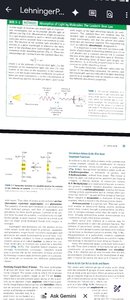
The titration curve of an amino acid shows how its net charge changes with pH. The curve typically has two buffering regions corresponding to the pKa values of the carboxyl and amino groups.
pKa1: The pH at which the carboxyl group loses a proton.
pKa2: The pH at which the amino group loses a proton.
Isoelectric Point (pI): The pH at which the amino acid has no net charge (zwitterion form dominates).
Equation for pI (for amino acids without ionizable side chains):
Ionizable Side Chains
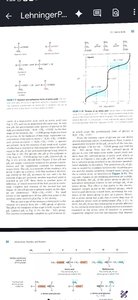
Some amino acids have ionizable side chains (e.g., aspartic acid, glutamic acid, lysine, arginine, histidine). These side chains introduce additional pKa values and affect the titration curve and isoelectric point.
Acidic Side Chains: Additional carboxyl group (e.g., aspartate, glutamate).
Basic Side Chains: Additional amino group (e.g., lysine, arginine, histidine).
Example: The titration curve of histidine shows three distinct buffering regions due to its ionizable side chain.
Reactions of Amino Acids
Peptide Bond Formation
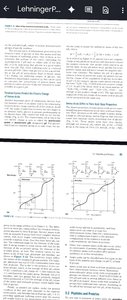
Amino acids are linked together by peptide bonds to form polypeptides and proteins. The peptide bond forms between the carboxyl group of one amino acid and the amino group of another, releasing a molecule of water (condensation reaction).
Equation for peptide bond formation:
Summary Table: Properties of Amino Acids
The following table summarizes the classification and properties of amino acids based on their side chains:
Class | Examples | Properties |
|---|---|---|
Nonpolar | Glycine, Alanine, Valine | Hydrophobic, found in protein interiors |
Polar (Uncharged) | Serine, Threonine | Hydrophilic, can form hydrogen bonds |
Acidic | Aspartate, Glutamate | Negatively charged at pH 7 |
Basic | Lysine, Arginine, Histidine | Positively charged at pH 7 |
Additional info: The chemical properties of amino acids determine protein structure and function, including enzyme activity, binding, and stability.
