 Indietro
An Introduction to Carbohydrates: Structure, Function, and Biological Importance
Guida di studio - Note intelligenti
 Appunti personalizzati basati sui tuoi materiali, ampliati con definizioni chiave, esempi e contesto.
An Introduction to Carbohydrates
Overview of Carbohydrates
Carbohydrates are essential biomolecules that play critical roles in cell structure, cell identity, and energy storage. They are classified based on the number of sugar units present:
Monosaccharides – single sugar units
Oligosaccharides – short chains of sugar units
Polysaccharides – long chains of sugar units
Carbohydrates have the general molecular formula (CH2O)n, where n can range from 3 to over a thousand. They contain a carbonyl group and multiple carbon-hydrogen bonds, which contribute to their chemical reactivity and energy storage capacity.
5.1 Sugars as Monomers
Monosaccharides: Structure and Diversity
Monosaccharides are the simplest carbohydrates and serve as building blocks for larger carbohydrates. They are important for providing chemical energy and as precursors for other biomolecules, such as nucleotides and amino acids.
Location of the carbonyl group: If at the end, the sugar is an aldose; if in the middle, it is a ketose.
Number of carbon atoms: Three (triose), five (pentose), or six (hexose).
Spatial arrangement of atoms: The arrangement of hydroxyl groups can vary, leading to different sugars with unique properties.
Linear and ring forms: In aqueous solutions, sugars often form ring structures, which can have functional consequences.
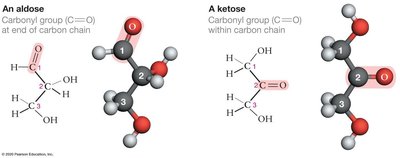
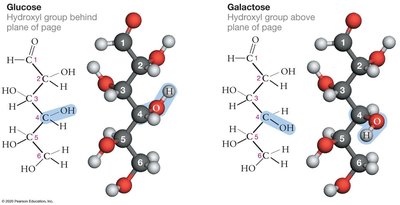
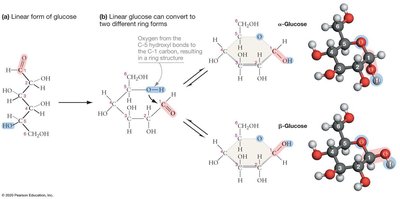
Each monosaccharide has a unique structure and function due to these variations.
5.2 The Structure of Polysaccharides
Formation and Types of Polysaccharides
Polysaccharides are polymers formed by linking monosaccharide monomers through condensation reactions, resulting in covalent glycosidic linkages. These linkages can be broken by hydrolysis reactions. The geometry of glycosidic bonds (e.g., α-1,4 or β-1,4) affects the structure and function of the polysaccharide.

Major Polysaccharides and Their Functions
Starch (plants): Storage polysaccharide composed of α-glucose monomers. Exists as unbranched (amylose) or branched (amylopectin) forms.
Glycogen (animals): Highly branched storage polysaccharide stored in liver and muscle cells. Similar to starch but with more frequent branching.
Cellulose (plants): Structural polysaccharide made of β-glucose monomers joined by β-1,4-glycosidic linkages. Forms linear strands that allow hydrogen bonding between adjacent chains, providing rigidity to plant cell walls.
Chitin (fungi, insects, crustaceans): Structural polysaccharide with N-acetylglucosamine (NAG) monomers. Similar structure to cellulose, with hydrogen bonds between strands.
Peptidoglycan (bacteria): Structural polysaccharide with alternating monosaccharides and peptide cross-links, forming bacterial cell walls.


5.3 What Do Carbohydrates Do?
Functions of Carbohydrates in Cells
Carbohydrates serve several vital functions in biological systems:
Precursors to other molecules: Used to synthesize nucleotides and amino acids.
Structural materials: Cellulose, chitin, and peptidoglycan provide structural support in plants, fungi, and bacteria, respectively.
Cell identity: Carbohydrates on cell surfaces (glycoproteins and glycolipids) are involved in cell-cell recognition and signaling.
Energy storage: Starch and glycogen store chemical energy that can be mobilized when needed.
Carbohydrates and Structural Support
Structural polysaccharides form long strands that may organize into fibers or sheets, providing strength and elasticity to cells and tissues. β-1,4-glycosidic linkages are resistant to hydrolysis, making these fibers durable and water-excluding, which is important for their structural role.

Carbohydrates in Cell Identity
Carbohydrates attached to proteins (glycoproteins) and lipids (glycolipids) on the cell surface serve as identification badges, mediating cell-cell recognition and communication. These molecules are crucial for processes such as immune response and fertilization.


Carbohydrates and Energy Storage
Carbohydrates are key energy storage molecules. In photosynthesis, plants convert sunlight into chemical energy stored in carbohydrate bonds. Carbohydrates store more energy than carbon dioxide because their C-H and C-C bonds have higher potential energy.

Enzymatic Breakdown of Polysaccharides
Starch and glycogen are easily hydrolyzed by enzymes to release glucose for energy. Glycogen is broken down by phosphorylase, while starch is digested by amylase enzymes. The released glucose is used to produce ATP, which powers cellular processes.
Summary Table: Major Polysaccharides
Polysaccharide | Organism | Function | Monomer | Linkage | Structure |
|---|---|---|---|---|---|
Starch | Plants | Energy storage | α-glucose | α-1,4 and α-1,6 | Helical, branched |
Glycogen | Animals | Energy storage | α-glucose | α-1,4 and α-1,6 | Highly branched |
Cellulose | Plants | Structural support | β-glucose | β-1,4 | Linear, forms fibers |
Chitin | Fungi, insects, crustaceans | Structural support | N-acetylglucosamine | β-1,4 | Linear, forms fibers |
Peptidoglycan | Bacteria | Structural support | Alternating monosaccharides | β-1,4 | Linear, peptide cross-links |
Key Equations
General formula for carbohydrates:
Photosynthesis (simplified):
ATP production from glucose (cellular respiration):
Additional info: The diversity of carbohydrate structures allows for a wide range of biological functions, from energy storage to cell signaling and structural support. Understanding the differences in glycosidic linkages and monomer composition is essential for grasping their roles in biology.
