 Indietro
CHAPTER 8: An Introduction to Metabolism: Cellular Energy and Enzyme Function
Guida di studio - Note intelligenti
 Appunti personalizzati basati sui tuoi materiali, ampliati con definizioni chiave, esempi e contesto.
An Introduction to Metabolism
Equilibrium and Metabolism
Metabolism encompasses all chemical reactions within a cell, many of which are reversible. In living cells, metabolic reactions do not reach equilibrium, which is essential for sustaining life. Cells are open systems, allowing the constant flow of materials in and out, preventing equilibrium and enabling continuous cellular work.
Closed systems reach equilibrium and can no longer do work.
Open systems (like cells) maintain a steady state by exchanging materials with their environment.
Catabolic pathways, such as cellular respiration, release free energy in a series of reactions, with products of one reaction serving as reactants for the next.
Example: Cellular respiration maintains a flow of glucose and waste products, ensuring reactions are pulled in one direction and equilibrium is never reached.
Types of Cellular Work
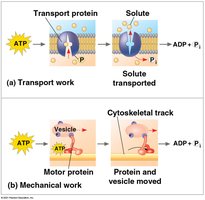
Cells perform three main types of work, all powered by ATP:
Chemical work: Driving endergonic (energy-consuming) reactions.
Transport work: Pumping substances across membranes against their concentration gradients.
Mechanical work: Physical movements such as muscle contraction or cilia beating.
ATP: The Energy Currency of the Cell
The Structure and Hydrolysis of ATP
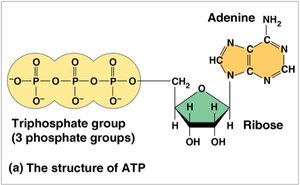
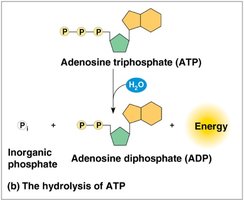
Adenosine triphosphate (ATP) consists of ribose (a sugar), adenine (a nitrogenous base), and three phosphate groups. The energy released from ATP is not from the phosphate bonds themselves, but from the chemical change to a state of lower free energy when ATP is hydrolyzed.
ATP hydrolysis: ATP + H2O → ADP + Pi + energy
The repulsion between the negatively charged phosphate groups stores potential energy, making the triphosphate tail highly reactive.
ATP Powers Cellular Work by Coupling Reactions
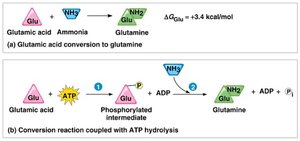
ATP hydrolysis is exergonic and can be coupled to endergonic reactions, making the overall process exergonic. The transfer of a phosphate group from ATP to another molecule (phosphorylation) makes the recipient molecule more reactive.
Phosphorylated intermediate: The molecule that receives the phosphate group, increasing its free energy and reactivity.
The ATP Cycle
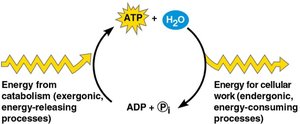
ATP is continuously regenerated in cells by adding a phosphate group to ADP, using energy from catabolic (exergonic) reactions. This cycle couples energy-yielding and energy-consuming processes.
ATP regeneration: ADP + Pi → ATP (requires energy input)
Enzymes and Metabolic Reactions
Enzymes as Catalysts
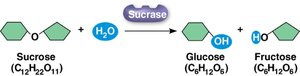
An enzyme is a macromolecule (usually a protein) that acts as a catalyst, speeding up specific reactions by lowering the activation energy (EA) barrier. Enzymes are not consumed in the reaction and can be used repeatedly.
Example: Sucrase catalyzes the hydrolysis of sucrose into glucose and fructose.
The Activation Energy Barrier
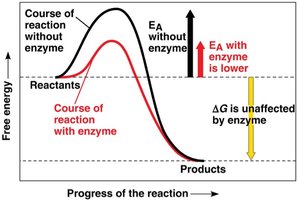
Every chemical reaction requires an initial input of energy to break bonds, called activation energy (EA). Enzymes lower this barrier, allowing reactions to proceed at moderate temperatures without denaturing proteins or indiscriminately speeding all reactions.
Enzymes do not affect the overall change in free energy (ΔG) of a reaction.
Enzyme Specificity and the Active Site
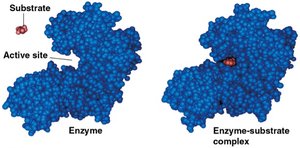
Each enzyme is specific to its substrate, which binds to the enzyme's active site (a pocket or groove on the enzyme). The enzyme-substrate complex forms, and the enzyme catalyzes the conversion of substrate to product.
Enzyme names often end in -ase (e.g., sucrase).
The fit between the active site and substrate determines specificity.
Catalysis in the Enzyme’s Active Site
The substrate is held in the active site by weak interactions (e.g., hydrogen bonds). The enzyme may orient substrates, stretch bonds, provide a favorable microenvironment, or participate directly in the reaction to lower EA.
Enzymes emerge unchanged after the reaction, allowing them to catalyze many cycles.
Factors Affecting Enzyme Activity
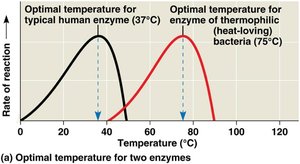
Enzyme activity is influenced by environmental factors such as temperature and pH. Each enzyme has an optimal temperature and pH for maximum activity.
Human enzymes typically function best at 37°C, while thermophilic bacteria have enzymes optimized for much higher temperatures.
Cofactors and Coenzymes
Many enzymes require nonprotein helpers called cofactors for activity. Inorganic cofactors include metal ions (e.g., Zn2+, Fe2+, Cu2+), while organic cofactors are called coenzymes (often derived from vitamins).
Enzyme Inhibitors
Certain chemicals can inhibit enzyme activity:
Competitive inhibitors resemble the substrate and bind to the active site, blocking substrate access.
Noncompetitive inhibitors bind elsewhere on the enzyme, altering its shape and reducing activity.
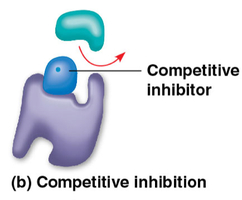
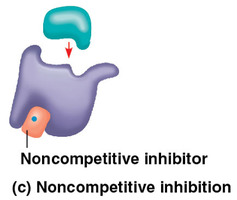
Toxins, poisons, pesticides, and antibiotics often act as enzyme inhibitors, sometimes irreversibly.
The Evolution of Enzymes
Enzymes are encoded by genes. Mutations can alter enzyme structure and function, potentially leading to new or improved activities. Beneficial mutations are favored by natural selection.
Allosteric Regulation of Enzymes
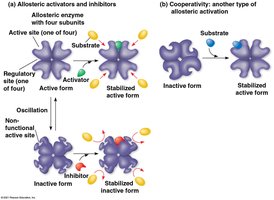
Allosteric regulation occurs when a molecule binds to a site other than the active site, causing a conformational change that affects enzyme activity. This can either inhibit or activate the enzyme.
Most allosteric enzymes are composed of multiple subunits and oscillate between active and inactive forms.
Cooperativity is a form of allosteric activation where substrate binding to one active site increases activity at other sites.
Feedback Inhibition
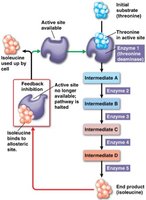
Feedback inhibition is a regulatory mechanism where the end product of a metabolic pathway inhibits an enzyme involved earlier in the pathway, preventing overproduction and conserving resources.
Localization of Enzymes Within the Cell
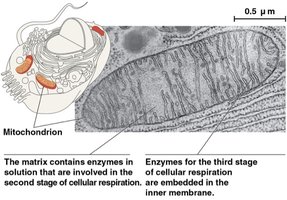
Enzyme compartmentalization within specific organelles or cellular regions helps organize and regulate metabolic pathways. For example, enzymes for different stages of cellular respiration are localized within mitochondria.
Additional info: Compartmentalization increases the efficiency of metabolic processes by concentrating substrates and enzymes and isolating incompatible reactions.
