 Indietro
Animal Behavior and Social Interactions in Ecology
Guida di studio - Note intelligenti
 Appunti personalizzati basati sui tuoi materiali, ampliati con definizioni chiave, esempi e contesto.
Animal Behavior and Social Interactions in Ecology
Social Behavior
Social behavior refers to the interactions among individuals, typically within the same species, that influence survival and reproductive success. These behaviors can provide significant benefits, such as increased protection, cooperative hunting, and improved care of offspring, but may also incur costs, such as increased competition for resources.
Benefits: Enhanced survival, efficient resource use, cooperative defense, and improved reproductive success.
Costs: Increased competition, risk of disease transmission, and potential for conflict within groups.
Habitat: The physical area where an organism lives, including all abiotic and biotic resources.
Niche: The role and activities of an organism within its habitat, encompassing all its needs and behaviors.
Interactions arise because resources are limited and organisms must compete or cooperate to survive and reproduce.
Predation
Predator-Prey Relationships
Predation is an interaction where one organism (the predator) hunts and consumes another (the prey). This relationship is a driving force in natural selection and population dynamics.
Predator: Organism that hunts and kills another for food.
Prey: Organism that is hunted and consumed.
Population Cycles: Predator and prey populations often fluctuate in response to each other over time.
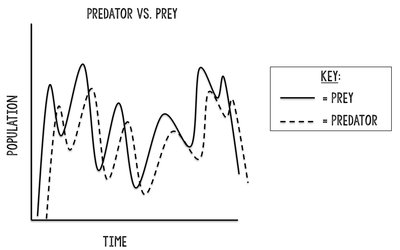
Keystone Species: A species that plays a critical role in maintaining the structure of an ecosystem. Predators are often keystone species because their presence regulates populations of other species, maintaining balance in the ecosystem.
Defensive Adaptations in Animals
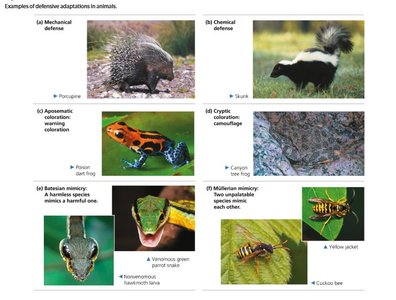
Prey species have evolved a variety of adaptations to avoid predation, including mechanical, chemical, and behavioral defenses.
Mechanical defenses: Physical structures like quills or shells.
Chemical defenses: Production of toxins or repellents.
Camouflage: Blending in with the environment to avoid detection.
Mimicry: Imitating the appearance of another species for protection.
Competition
Types of Competition
Competition occurs when two or more organisms vie for the same limited resource. It can be classified as:
Interspecific Competition: Competition between different species.
Intraspecific Competition: Competition within the same species.
Competitive Exclusion Principle: No two species can occupy the same niche in the same habitat at the same time. If two species compete for the same resources, one will outcompete the other, leading to the exclusion or niche differentiation of the less competitive species.
Symbiosis
Types of Symbiotic Relationships
Symbiosis is a close, long-term interaction between two different species, where at least one benefits. Types include:
Mutualism: Both species benefit from the relationship.
Parasitism: One species (the parasite) benefits at the expense of the other (the host).
Commensalism: One species benefits while the other is neither helped nor harmed.
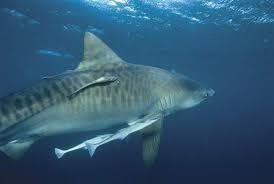
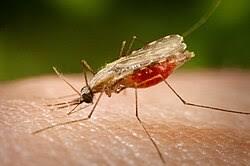
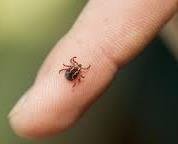
In parasitic relationships, it is crucial that the parasite does not kill the host quickly, as the parasite relies on the host for survival and reproduction.
Altruism and Kin Selection
Altruism in Animal Behavior
Altruism refers to behaviors that decrease an individual's own fitness while increasing the fitness of others. This can be explained by several evolutionary mechanisms:
Kin Selection: Favoring the reproductive success of relatives, even at a cost to oneself. This increases inclusive fitness, which is the sum of direct and indirect fitness.
Hamilton's Rule: Altruism is favored if , where r is genetic relatedness, B is the benefit to the recipient, and C is the cost to the actor.
Behavioral Manipulation: Parasites may manipulate host behavior for their own benefit.
Mutualism: Cooperation between individuals for mutual benefit.
Reciprocity: Unrelated individuals help each other with the expectation of future reciprocation.
Kin Selection and Eusociality
Kin selection is especially evident in eusocial animals, such as certain insects and mammals, where individuals may forgo reproduction to help relatives raise offspring.
Haplodiploidy: A genetic system in which males are haploid and females are diploid, leading to high relatedness among sisters (e.g., honeybees).
Caste System: Division of labor within a colony, with specific roles for queens, workers, and drones.
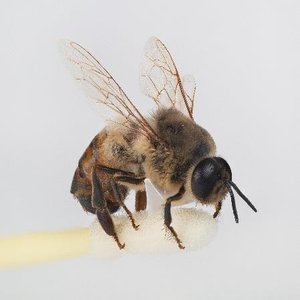
Eusociality is also found in mammals such as the naked mole rat, where a single queen reproduces and other colony members assist in raising the offspring.
Reciprocity and the Prisoner's Dilemma
Reciprocal Altruism
Reciprocal altruism occurs when unrelated individuals help each other with the expectation that the favor will be returned in the future. This is often modeled by the Prisoner's Dilemma, a game theory scenario where cooperation and defection yield different payoffs.
Strategies: Random, always defect, always cooperate, tit-for-tat (cooperate until betrayed, then retaliate).
Evolutionarily Stable Strategy (ESS): A strategy that, if adopted by a population, cannot be invaded by any alternative strategy.
Examples of apparent altruism include cooperative hunting, alarm calls, and food sharing among social animals.
Examples of Apparent Altruism
Mongooses support elderly or injured group members (reciprocity, mutualism).
Wolves and wild dogs share food with absent pack members (kin selection, mutualism).
Male baboons defend the group from predators (kin selection, mutualism).
Vampire bats share food with unsuccessful roost mates (reciprocity, kin selection).
Birds help raise offspring that are not their own (parental manipulation, kin selection).
Vervet monkeys give alarm calls to warn others of predators (kin selection, reciprocity, mutualism).
Dolphins support sick or injured individuals (mutualism, reciprocity).
