 Indietro
Animal Diversity: Body Plans, Symmetry, and Major Lineages
Guida di studio - Note intelligenti
 Appunti personalizzati basati sui tuoi materiali, ampliati con definizioni chiave, esempi e contesto.
Animal Diversity and Body Plans
Introduction to Animal Diversity
Animal diversity encompasses the vast range of structural and functional adaptations found in the animal kingdom. Understanding the diagnostic traits, body plans, and ecological roles of major animal lineages is fundamental to General Biology.
Synapomorphy: A shared, derived trait that defines a lineage on the phylogenetic tree.
Body Plan: The general structure and arrangement of organ systems, including symmetry, body cavity, segmentation, appendages, and nervous system development.
Ecological Role: The function of an organism within its environment, including feeding, reproduction, and interactions with humans.
Key Features of Animal Body Plans
Body Symmetry
Symmetry is a fundamental aspect of animal body plans, influencing movement and feeding strategies.
Bilateral Symmetry: A single plane divides the body into right and left halves, with distinct anterior (front), posterior (back), dorsal (top), and ventral (bottom) sides. Enables directional movement and cephalization (development of a head region).
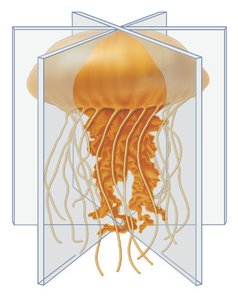
Radial Symmetry: Multiple planes divide the body around a central axis, typical of animals like jellyfish and sea anemones. Allows movement in multiple directions and efficient food gathering.
Asymmetry: No plane of symmetry, as seen in sponges.
Example: Crabs exhibit bilateral symmetry, while jellyfish display radial symmetry. 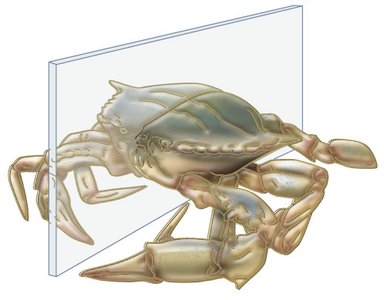
Body Cavity Structure
The presence and type of body cavity (coelom) is a key feature in animal classification.
Acoelomates: No cavity outside the digestive tract.
Pseudocoelomates: Body cavity partially lined with mesoderm.
Coelomates: True body cavity completely lined with mesoderm.
Additional info: The coelom provides space for organ development and acts as a hydrostatic skeleton in some animals.
Segmentation and Appendages
Segmentation: Repeated body units, as seen in annelids and arthropods, allow for specialized functions and efficient movement.
External Appendages: Structures such as legs, antennae, and tentacles aid in locomotion, feeding, and sensory perception.
Development of Nervous System
Nervous System Complexity: Ranges from diffuse nerve nets in cnidarians to centralized brains in bilaterians.
Cephalization: Concentration of sensory organs and nervous tissue at the anterior end, characteristic of bilaterally symmetric animals.
Major Animal Lineages and Their Diagnostic Traits
Porifera (Sponges)
Sponges are simple, sessile filter feeders with unique cellular organization.
Diagnostic Trait: Choanocytes (collar cells) that pump water and trap food.
Body Plan: No true tissues; cells embedded in a collagen matrix, stiffened by spicules; asymmetric or radial.
Ecological Role: Key reef community members; host rich microbiomes; source of antiviral compounds.

Ctenophora (Comb Jellies)
Comb jellies are gelatinous marine predators with distinctive locomotion.
Diagnostic Trait: Comb rows of fused cilia for swimming.
Body Plan: Radial symmetry; complete gut; diffuse nerve net.
Ecological Role: Many are bioluminescent; invasive species can disrupt fisheries.
Cnidaria (Jellyfish, Corals, Hydrozoans)
Cnidarians are diverse predators with specialized stinging cells.
Diagnostic Trait: Cnidocytes (stinging cells) that fire venom.
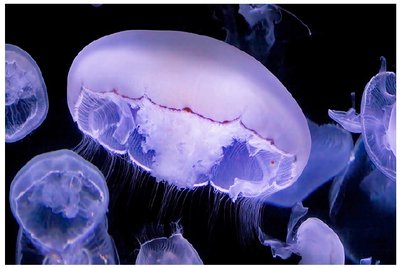
Body Plan: Radial symmetry; two forms (medusa and polyp); incomplete gut.
Ecological Role: Reef corals partner with dinoflagellates; jellyfish are models for regeneration and bioluminescence.

Bilateria: Protostomes vs Deuterostomes
Bilaterians are animals with bilateral symmetry and complex organ systems.
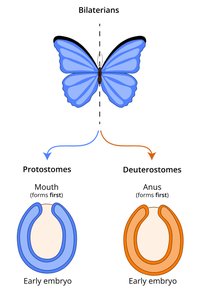
Protostomes: Mouth forms first in embryonic development (includes mollusks, annelids, arthropods).
Deuterostomes: Anus forms first (includes echinoderms and chordates).
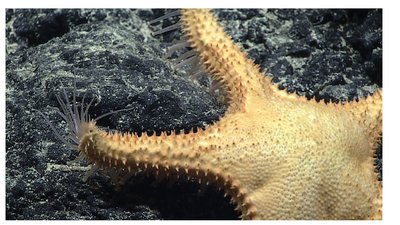
Echinodermata (Sea Stars, Urchins, Cucumbers)
Echinoderms are marine animals with unique water vascular systems.
Diagnostic Trait: Water vascular system and tube feet.
Body Plan: Bilateral larvae, pentaradial adults; calcium carbonate endoskeleton.
Ecological Role: Keystone predators; important in nutrient cycling.
Chordata (Tunicates & Lancelets)
Invertebrate chordates possess four key traits at some life stage.
Diagnostic Trait: Notochord, dorsal hollow nerve cord, post-anal tail, pharyngeal gill slits.
Body Plan: Traits may appear only in larva; tunicates are sessile filter feeders; lancelets are burrowing filter feeders.
Ecological Role: Tunicates yield promising drugs; lancelets are model organisms.
Platyhelminthes (Flatworms)
Flatworms are simple, thin-bodied animals with lost coelom and circulatory systems.
Diagnostic Trait: Flat, thin bodies.
Body Plan: Blind gut; free-living and parasitic forms.
Ecological Role: Planarians are regeneration models; flukes cause schistosomiasis.
Mollusca (Snails, Clams, Squid, Octopuses)
Mollusks are highly diverse with specialized feeding and locomotion structures.
Diagnostic Trait: Radula, muscular foot, visceral mass, mantle.
Body Plan: Radula for feeding; muscular foot for movement; organs in visceral mass.
Ecological Role: Major marine food source; bivalves filter water.
Annelida (Segmented Worms)
Segmented worms use their coelom as a hydrostatic skeleton.
Diagnostic Trait: Repeated body segments.
Body Plan: Segments with bristles; circular and longitudinal muscles.
Ecological Role: Aerate soil; medical leeches used in surgery.
Nematoda (Roundworms)
Roundworms are abundant decomposers and parasites.
Diagnostic Trait: Growth by molting; pseudocoelom.
Body Plan: Collagen-rich cuticle; longitudinal muscles.
Ecological Role: Abundant in soil; C. elegans is a model organism.
Arthropoda (Spiders, Insects, Crustaceans, Myriapods)
Arthropods are the most diverse animal phylum, characterized by jointed appendages and exoskeletons.
Diagnostic Trait: Jointed appendages; chitin exoskeleton.
Body Plan: Segmented bodies; specialized mouthparts; wings in insects.
Ecological Role: Dominant consumers; pollinators; disease vectors.
Phylogenetic Tree of Major Animal Lineages
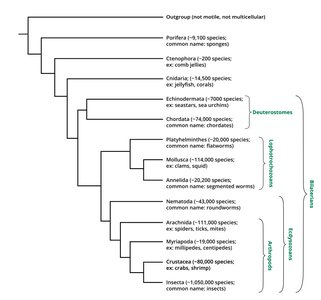
The phylogenetic tree illustrates evolutionary relationships and diagnostic traits among animal groups. 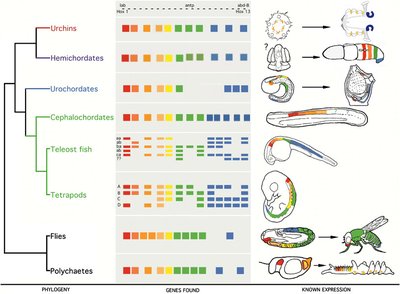
Summary Table: Diagnostic Traits of Major Invertebrate Lineages
Lineage | Diagnostic Trait (Synapomorphy) |
|---|---|
Porifera | Choanocytes (collar cells) |
Cnidaria | Cnidocytes (stinging cells) |
Mollusca | Radula + muscular foot |
Echinodermata | Water vascular system + tube feet |
Arthropoda | Jointed appendages + chitin exoskeleton |
Conclusion
Each animal lineage represents a distinct evolutionary solution to movement, feeding, and survival, marked by a diagnostic synapomorphy. Understanding these traits and their ecological roles is essential for studying animal diversity in General Biology. Additional info: The vertebrate story continues with innovations such as jaws, limbs, amniotic eggs, and endothermy, which will be covered in subsequent units.
