 Indietro
Ch. 33 Animal Diversity: Invertebrate Phyla and Evolutionary Relationships
Guida di studio - Note intelligenti
 Appunti personalizzati basati sui tuoi materiali, ampliati con definizioni chiave, esempi e contesto.
Overview of Animal Diversity
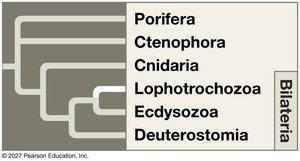
Phylogeny of Living Animals
The animal kingdom is characterized by a remarkable diversity of forms and evolutionary relationships. All animals share a common ancestor, and their evolutionary history can be traced through phylogenetic trees that group major lineages based on shared characteristics.
Poriferans (sponges) are the sister group to all other animals.
Eumetazoans possess true tissue layers.
Most animals are Bilaterians, exhibiting bilateral symmetry and three tissue layers.
Bilaterians include Deuterostomia, Lophotrochozoa, and Ecdysozoa.
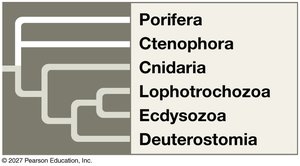
Major Animal Groups
Porifera
Ctenophora
Cnidaria
Lophotrochozoa
Ecdysozoa
Deuterostomia
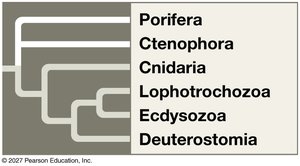
Highlighted Invertebrate Phyla
Phylum Porifera (Sponges)
Sponges are simple, multicellular animals lacking true tissues and organs. They are asymmetrical and possess a unique feeding system based on water flow through their porous bodies.
Tissues: Absent
Symmetry: Asymmetrical
Digestive System: None; intracellular digestion
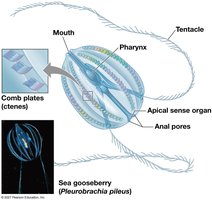
Phylum Ctenophora (Comb Jellies)
Ctenophores are marine invertebrates known for their rows of ciliary plates (ctenes) used for locomotion. They possess a simple digestive system and exhibit radial symmetry.
Tissues: Present
Symmetry: Radial
Digestive System: Complete, with mouth and anal pores
Special Features: Comb plates, tentacles, apical sense organ
Phylum Cnidaria
Cnidarians include jellyfish, corals, and sea anemones. They are characterized by radial symmetry, true tissues, and a gastrovascular cavity for digestion.
Tissues: Present
Symmetry: Radial
Digestive System: Gastrovascular cavity (incomplete)
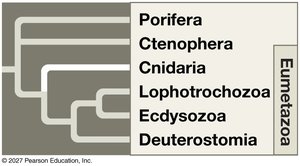
Bilaterian Animals
Bilaterians are animals with bilateral symmetry and three germ layers (triploblastic). This group includes Lophotrochozoa, Ecdysozoa, and Deuterostomia.
Phylum Mollusca
Classification and Diversity
Mollusca is the second most diverse animal phylum, with over 100,000 species. Members exhibit bilateral symmetry and possess specialized body structures.
Symmetry: Bilateral
Special Features: Foot, mantle, visceral mass
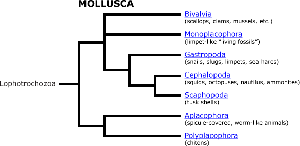
Major Classes: Bivalvia, Monoplacophora, Gastropoda, Cephalopoda, Scaphopoda, Aplacophora, Polyplacophora
Examples of Molluscs
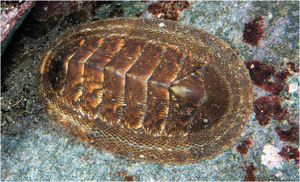
Polyplacophora: Chitons, characterized by eight-plated shells
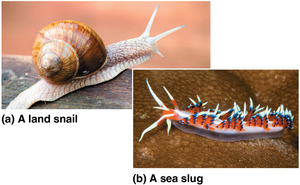
Gastropoda: Snails and slugs, diverse in form and habitat
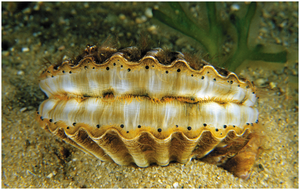
Bivalvia: Clams, oysters, mussels, with two-part shells
Evolutionary Trends in Kingdom Animalia
Key Features Unifying Animals
Animals are multicellular, heterotrophic eukaryotes that lack cell walls. They are classified within the supergroup Opisthokonta of Eukaryotes.
Multicellularity
Heterotrophy
Motility at some life stage
Complex tissue structure (except Porifera)
Evolutionary Significance of Derived Features
Symmetry: Transition from asymmetry (sponges) to radial (cnidarians, ctenophores) to bilateral (most animals)
Tissue Layers: Development of true tissues and organs
Body Cavities: Coelom formation in advanced groups
Segmentation: Seen in annelids, arthropods, chordates
Animalia in the Larger Phylogenetic Tree
Animals are part of the domain Eukarya and are grouped with fungi and choanoflagellates in the supergroup Opisthokonta. Their evolutionary relationships are depicted in phylogenetic trees, highlighting the divergence of major animal lineages.

Summary Table: Major Animal Groups and Their Features
Group | Tissues | Symmetry | Digestive System | Special Features |
|---|---|---|---|---|
Porifera | No | Asymmetrical | None | Porous body, filter feeding |
Ctenophora | Yes | Radial | Complete | Comb plates, tentacles |
Cnidaria | Yes | Radial | Gastrovascular cavity | Cnidocytes, stinging cells |
Mollusca | Yes | Bilateral | Complete | Foot, mantle, visceral mass |
Arthropoda | Yes | Bilateral | Complete | Exoskeleton, jointed appendages |
Echinodermata | Yes | Radial (adult) | Complete | Water vascular system |
Review Questions
What features unify organisms within the Animal Kingdom?
How are animals classified within the superphylogeny of Eukaryotes?
Describe the evolutionary significance of symmetry and tissue development in animals.
Place Kingdom Animalia in a larger phylogenetic tree with other Kingdoms and Domains.
Additional info: Academic context was added to clarify the evolutionary relationships, defining characteristics, and examples of major animal groups. The summary table was inferred to provide a comparative overview of key features.
