Indietro
Animal Diversity: Structure, Function, and Life Cycles
Guida di studio - Note intelligenti
 Appunti personalizzati basati sui tuoi materiali, ampliati con definizioni chiave, esempi e contesto.
Animal Diversity
Animal Traits
Animals are a diverse group of multicellular organisms characterized by unique structural and functional traits. Unlike plants and fungi, animals lack cell walls and exhibit movement during development. Digestion typically occurs inside the body, often within a digestive tract, although some exceptions exist (e.g., sponges and certain parasites).
Multicellularity: All animals are composed of multiple cells, allowing for specialized tissues and organs.
No cell walls: Animal cells are bounded by flexible plasma membranes, not rigid cell walls.
Movement during development: Cells migrate and differentiate to form tissues and organs.
Internal digestion: Most animals digest food within a digestive tract; some, like starfish, have unique digestive adaptations.
Exceptions: Sponges lack true tissues and digestive tracts; some parasites have no digestive system.
Digestive Tracts
Animals capture food in various ways and possess different types of digestive tracts. The structure of the digestive tract influences the efficiency and specialization of digestion.
Blind digestive tract: A single opening serves as both mouth and anus (e.g., cnidarians).
Complete digestive tract: Separate mouth and anus allow for continuous and specialized digestion.
Advantage of complete tract: Enables simultaneous ingestion and digestion, increasing efficiency and specialization.
Symmetry and Cephalization
Animal body symmetry is closely linked to the development of a head (cephalization), which provides advantages in sensory perception and movement.
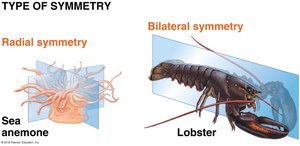
Radial symmetry: Body parts arranged around a central axis; common in sessile or slow-moving animals (e.g., sea anemones).
Bilateral symmetry: Body divided into left and right halves; associated with active movement and cephalization (e.g., lobsters).
Cephalization: Concentration of sensory organs and nervous tissue at the anterior end, facilitating directional movement and environmental interaction.
Circulatory Systems
Animals transport nutrients, gases, and wastes via circulatory systems, which vary in complexity and structure.
Absent: Some animals lack circulatory systems (e.g., sponges).
Open circulatory system: Hemolymph bathes organs directly; found in arthropods and some mollusks.
Closed circulatory system: Blood is confined to vessels; found in annelids, cephalopods, and vertebrates.
Human circulatory system: Two connected closed circuits: systemic (heart-body-heart) and pulmonary (heart-lungs-heart).
Respiratory Systems
Gas exchange is essential for animal survival and occurs across moist surfaces. Adaptations increase surface area for efficient exchange while minimizing water loss.
Gas exchange: Oxygen in, carbon dioxide out; must occur across moist membranes.
Surface area: Increased surface area enhances gas exchange but also increases drying rate.
Respiratory structures: Body surface, gills, lungs, tracheae.
Gills: Supported by water, external or internal, water flows over gills.
Lungs: Internal, vascularized pouches for air exchange.
Book lungs: Gills inside lungs (e.g., spiders, scorpions).
Tracheae: Tubular system for gas exchange (e.g., insects).
Skeletons
Skeletons provide structural support and facilitate movement. Muscles contract to move skeletons, and complementary muscle groups allow repeated contraction.
Endoskeleton: Internal skeleton (e.g., vertebrates).
Exoskeleton: External skeleton (e.g., arthropods).
Hydrostatic skeleton: Fluid-filled cavity provides support (e.g., worms).
Primary function: Movement; muscles contract and skeletons stretch muscles for repeated action.
Methods of Reproduction
Animals reproduce via various methods, ranging from external fertilization to internal gestation and live birth.
Spawning: Sperm and eggs released into the environment for external fertilization.
Copulation: Internal fertilization; sperm deposited inside female.
Internal gestation: Embryos develop inside female.
Live birth: Offspring born alive after internal development.
Typical Animal Life Cycle
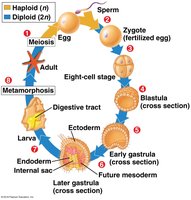
Most animals undergo a complex life cycle involving fertilization, embryonic development, and metamorphosis. The cycle includes both haploid and diploid stages, with specialized embryonic structures and tissue layers.
Fertilization: Sperm and egg unite to form a zygote.
Embryonic stages: Includes blastula, gastrula, and formation of ectoderm and endoderm.
Metamorphosis: Transition from larval to adult form.
Meiosis: Produces haploid gametes for sexual reproduction.
Animal Classification and Evolutionary Relationships
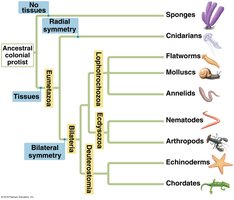
Animals are classified based on the presence of tissues, symmetry, and developmental patterns. Evolutionary relationships reveal major groups and their characteristics.
No tissues: Sponges are the only animals without true tissues.
Radial symmetry: Cnidarians and some other groups exhibit radial symmetry.
Bilateral symmetry: Most animal phyla exhibit bilateral symmetry and complex tissues.
Major groups: Includes Lophotrochozoa, Ecdysozoa, and Deuterostomia.
Embryonic Development
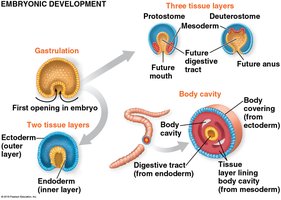
Embryonic development in animals involves the formation of tissue layers and body cavities. The process of gastrulation leads to the establishment of ectoderm and endoderm, and in more complex animals, mesoderm and body cavities.
Gastrulation: Formation of the first opening in the embryo.
Two tissue layers: Ectoderm (outer) and endoderm (inner).
Three tissue layers: Addition of mesoderm in more complex animals.
Body cavity: Coelom forms between tissue layers, providing space for organ development.
Protostome vs. Deuterostome: In protostomes, the first opening becomes the mouth; in deuterostomes, it becomes the anus.