 Indietro
AP Biology Unit 1: Chemistry of Life Study Guidance
Guida di studio - Note intelligenti
 Appunti personalizzati basati sui tuoi materiali, ampliati con definizioni chiave, esempi e contesto.
Q1. What is the basic structure of water?
Background
Topic: Water Chemistry
This question tests your understanding of the molecular structure of water and how its arrangement leads to unique properties.
Key Terms:
Water molecule (): Consists of two hydrogen atoms and one oxygen atom.
Covalent bond: A bond formed by sharing electrons between atoms.
Step-by-Step Guidance
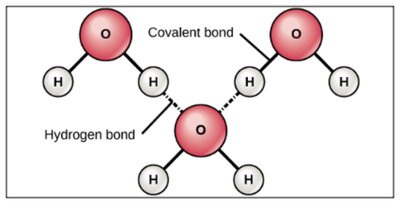
Recall that a water molecule is made up of two hydrogen atoms and one oxygen atom.
Consider how the atoms are connected: hydrogen atoms are bonded to the oxygen atom via covalent bonds.
Think about the shape of the molecule—water has a bent or V-shaped structure due to the arrangement of its atoms.
Try solving on your own before revealing the answer!
Final Answer:
The basic structure of water is a bent molecule consisting of two hydrogen atoms covalently bonded to one oxygen atom. The oxygen atom is more electronegative, creating a partial negative charge, while the hydrogens have partial positive charges. This structure allows water molecules to form hydrogen bonds with each other.
Q2. Why is water a polar molecule?
Background
Topic: Water Chemistry
This question tests your understanding of polarity and how the distribution of electrons in water leads to its unique properties.
Key Terms:
Polarity: Uneven distribution of charge within a molecule.
Electronegativity: The tendency of an atom to attract electrons.
Step-by-Step Guidance
Consider the electronegativity difference between oxygen and hydrogen atoms.
Think about how electrons are shared in the covalent bonds—oxygen pulls electrons closer, creating a partial negative charge.
Recall that the bent shape of water means the charges are not evenly distributed, resulting in a polar molecule.
Try solving on your own before revealing the answer!
Final Answer:
Water is a polar molecule because the oxygen atom is more electronegative than the hydrogen atoms, causing an uneven distribution of electrons. This results in a partial negative charge near the oxygen and partial positive charges near the hydrogens, making the molecule polar.
Q3. How does water form hydrogen bonds?
Background
Topic: Water Chemistry
This question tests your understanding of intermolecular forces and how water molecules interact with each other.
Key Terms:
Hydrogen bond: A weak attraction between a hydrogen atom (with partial positive charge) and an electronegative atom (like oxygen) in another molecule.
Step-by-Step Guidance
Recall that water molecules are polar, with partial positive and negative charges.
Think about how the hydrogen atom of one water molecule can be attracted to the oxygen atom of another water molecule.
Consider the role of hydrogen bonds in giving water its unique properties, such as cohesion and high specific heat.
Try solving on your own before revealing the answer!
Final Answer:
Water forms hydrogen bonds when the partial positive charge of a hydrogen atom in one water molecule is attracted to the partial negative charge of an oxygen atom in another water molecule. These bonds are responsible for many of water's unique properties.
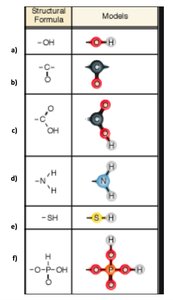
Q10. Identify the functional groups in the table to the right. For each functional group, identify a molecule where this functional group can be found.
Background
Topic: Functional Groups of Organic Compounds
This question tests your ability to recognize common functional groups and relate them to biological molecules.
Key Terms:
Functional group: A specific group of atoms within a molecule responsible for characteristic reactions.
Step-by-Step Guidance
Examine each structural formula and model in the table.
Recall the names and properties of common functional groups: hydroxyl, carbonyl, carboxyl, amino, sulfhydryl, phosphate.
Think about examples of molecules where each functional group is found (e.g., alcohols, amino acids, nucleotides).
Try solving on your own before revealing the answer!
Final Answer:
a) Hydroxyl group (–OH): Found in alcohols like ethanol. b) Carboxyl group (–COOH): Found in amino acids and fatty acids. c) Carbonyl group (–C=O): Found in ketones and aldehydes. d) Amino group (–NH2): Found in amino acids. e) Sulfhydryl group (–SH): Found in cysteine (an amino acid). f) Phosphate group (–PO4): Found in nucleotides (ATP, DNA).
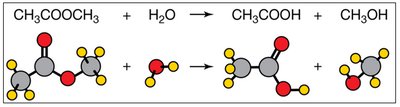
Q12. Which process is illustrated below? How can you tell?
Background
Topic: Dehydration Synthesis and Hydrolysis
This question tests your ability to distinguish between dehydration synthesis and hydrolysis based on chemical equations and models.
Key Terms:
Dehydration synthesis: Process of joining two molecules by removing water.
Hydrolysis: Process of breaking a molecule by adding water.
Step-by-Step Guidance
Examine the chemical equation and model shown.
Identify whether water is being added or removed in the reaction.
Recall that hydrolysis involves breaking bonds by adding water, while dehydration synthesis involves forming bonds by removing water.
Try solving on your own before revealing the answer!
Final Answer:
The process illustrated is hydrolysis. You can tell because water () is added to break a larger molecule into two smaller molecules.
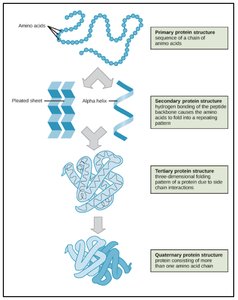
Q19. Describe the steps to protein folding below: a) Primary b) Secondary c) Tertiary d) Quaternary
Background
Topic: Protein Structure and Folding
This question tests your understanding of the four levels of protein structure and how they contribute to protein function.
Key Terms:
Primary structure: Sequence of amino acids.
Secondary structure: Local folding (alpha helix, beta sheet).
Tertiary structure: 3D folding due to side chain interactions.
Quaternary structure: Multiple polypeptide chains forming a functional protein.
Step-by-Step Guidance
Start by describing the primary structure as the linear sequence of amino acids.
Explain how secondary structure forms through hydrogen bonding, creating alpha helices and beta sheets.
Discuss how tertiary structure arises from interactions between side chains, resulting in a three-dimensional shape.
Consider quaternary structure, which involves the assembly of multiple polypeptide chains.
Try solving on your own before revealing the answer!
Final Answer:
a) Primary: Sequence of amino acids. b) Secondary: Formation of alpha helices and beta sheets via hydrogen bonds. c) Tertiary: 3D folding due to side chain interactions. d) Quaternary: Combination of multiple polypeptide chains.
Q20. How do enzymes work?
Background
Topic: Enzymes
This question tests your understanding of enzyme function and how they catalyze biological reactions.
Key Terms:
Enzyme: Protein that speeds up chemical reactions.
Activation energy: Energy required to start a reaction.
Step-by-Step Guidance
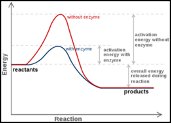
Recall that enzymes are biological catalysts that lower the activation energy of reactions.
Think about how enzymes bind to substrates at their active site.
Consider the induced fit model, where the enzyme changes shape to facilitate the reaction.
Enzymes are not consumed in the reaction and can be reused.
Try solving on your own before revealing the answer!
Final Answer:
Enzymes work by lowering the activation energy required for a reaction, allowing it to proceed faster. They bind to substrates, facilitate the conversion to products, and are not consumed in the process.
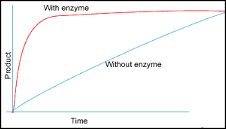
Q21. Describe the trends observed in the enzyme graph to the right. Why does the line with an enzyme level off?
Background
Topic: Enzyme Kinetics
This question tests your ability to interpret enzyme activity graphs and understand reaction rates.
Key Terms:
Reaction rate: Speed at which products are formed.
Saturation: Point where all enzyme active sites are occupied.
Step-by-Step Guidance
Examine the graph showing product formation over time with and without enzyme.
Notice that the line with enzyme rises quickly and then levels off.
Consider why the reaction rate slows down—enzyme active sites become saturated, and substrate is depleted.
Try solving on your own before revealing the answer!
Final Answer:
The line with enzyme levels off because the enzyme becomes saturated and all active sites are occupied. Once the substrate is depleted, the reaction rate slows and product formation plateaus.
