 Indietro
Atomic Structure and Quantum Mechanics: Mini-Study Guide
Guida di studio - Note intelligenti
 Appunti personalizzati basati sui tuoi materiali, ampliati con definizioni chiave, esempi e contesto.
Atomic Structure and Periodicity
Introduction to Quantum Mechanics
Quantum mechanics is a fundamental branch of physics that describes the behavior of subatomic particles, such as electrons, using mathematical principles. Unlike classical physics, quantum mechanics accounts for the wave-like properties of matter and the probabilistic nature of particle locations.
Bohr’s Model: Introduced the concept of quantized energy levels for electrons in atoms, but only accurately describes one-electron systems (e.g., hydrogen).
Wave-Particle Duality: Photons exhibit both wave and particle properties; quantum mechanics extends this duality to all matter.
de Broglie Relation: Suggests that particles with mass have an associated wavelength, given by , where is Planck’s constant, is mass, and is velocity.
Wave Properties of Electrons: Electrons have wavelengths on the order of picometers, making their wave nature observable under certain conditions.
Electron Diffraction: Demonstrated experimentally, forming the basis for technologies like the electron microscope.
Heisenberg’s Uncertainty Principle: It is impossible to know both the exact position and velocity of a particle simultaneously. The principle is mathematically expressed as .
Energy Levels and Photon Emission
Electrons in atoms occupy discrete energy levels. Transitions between these levels result in the absorption or emission of photons, with energy corresponding to the difference between initial and final states.
Energy of a Photon:
Energy Change:
Photon Emission: Negative indicates emission; positive $\Delta E$ indicates absorption.
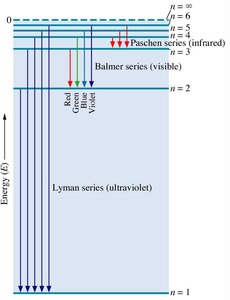
Image 1: Diagram showing the Lyman, Balmer, and Paschen series for hydrogen, illustrating electron transitions and corresponding photon emissions in ultraviolet, visible, and infrared regions.
Electromagnetic Spectrum
The electromagnetic spectrum encompasses all types of electromagnetic radiation, classified by wavelength and frequency. Visible light is only a small portion of the spectrum.
Gamma rays, X-rays, Ultraviolet: Short wavelengths, high frequencies.
Visible Light: Wavelengths from about 400 nm (violet) to 700 nm (red).
Infrared, Microwave, Radio: Longer wavelengths, lower frequencies.

Image 2: The electromagnetic spectrum, showing the range of wavelengths and frequencies for different types of radiation.
Wave Properties of Electrons
Electrons exhibit wave-like behavior, which can be observed in phenomena such as electron diffraction. This property is utilized in electron microscopes to visualize cellular structures at high resolution.
Electron Diffraction: Electrons can be diffracted by crystals, similar to X-rays.
Electron Microscopy: Allows visualization of subcellular structures, such as renal epithelial cells.

Image 3: Electron microscope images of renal epithelial cells, demonstrating the practical application of electron wave properties.
Schrödinger Wave Equation and Atomic Orbitals
The Schrödinger equation describes the quantum state of a particle, such as an electron in an atom. The solution yields a wave function (), whose square gives the probability of finding the electron in a particular region of space.
Schrödinger Equation:
Wave Function (): Contains information about the electron’s position.
Probability Density: gives the likelihood of finding an electron at a specific location.
Quantum Numbers and Atomic Orbitals
Quantum numbers describe the properties and locations of electrons in atoms. There are four quantum numbers: principal (), angular momentum (), magnetic (), and spin ().
Principal Quantum Number (): Indicates the shell number; higher means larger and higher-energy orbitals.
Angular Momentum Quantum Number (): Defines the subshell and shape of the orbital; ranges from 0 to .
Magnetic Quantum Number (): Specifies the orientation of the orbital; ranges from to .
Spin Quantum Number (): Indicates the spin direction of the electron; values are or .
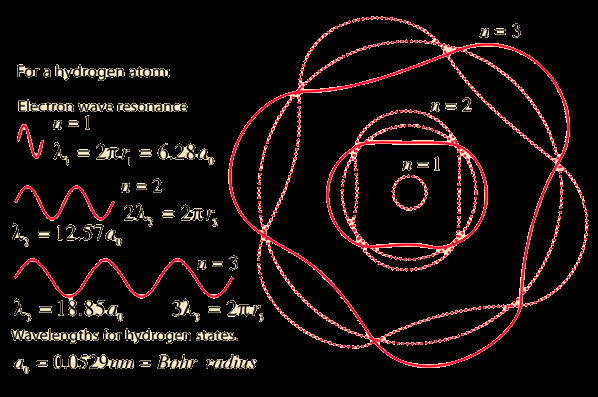
Image 4: Visualization of electron wave resonance for hydrogen atom, showing quantized orbits and wavelengths.
Permissible Values of Quantum Numbers
The quantum numbers determine the possible subshells and orbitals within each shell. The number of orbitals in a subshell is given by .
n | l | m_l | Subshell Notation | Number of Orbitals in the Subshell |
|---|---|---|---|---|
1 | 0 | 0 | 1s | 1 |
2 | 0 | 0 | 2s | 1 |
2 | 1 | -1, 0, +1 | 2p | 3 |
3 | 0 | 0 | 3s | 1 |
3 | 1 | -1, 0, +1 | 3p | 3 |
3 | 2 | -2, -1, 0, +1, +2 | 3d | 5 |
4 | 0 | 0 | 4s | 1 |
4 | 1 | -1, 0, +1 | 4p | 3 |
4 | 2 | -2, -1, 0, +1, +2 | 4d | 5 |
4 | 3 | -3, -2, -1, 0, +1, +2, +3 | 4f | 7 |
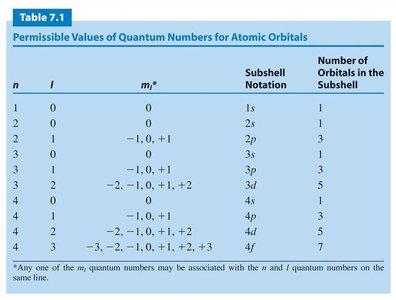
Image 5: Table summarizing permissible values of quantum numbers for atomic orbitals, subshell notation, and number of orbitals per subshell.
Summary of Key Equations
Speed of Light:
Photon Energy:
Energy Change:
de Broglie Wavelength:
Heisenberg Uncertainty Principle:
Example Applications
Electron Diffraction: Used in electron microscopy to study cell structures.
Quantum Numbers: Predict the arrangement of electrons in atoms, which determines chemical properties.
Photon Emission: Explains atomic spectra and the color of light emitted by elements.
