 Indietro
Atoms, Ions, and Periodicity: Foundations for General Biology
Guida di studio - Note intelligenti
 Appunti personalizzati basati sui tuoi materiali, ampliati con definizioni chiave, esempi e contesto.
Atoms
Definition and Properties
Atoms are the fundamental units of matter, forming the basis of all substances in planetary environments. Nearly all matter is composed of atoms, which are extremely small particles. There are 92 naturally occurring kinds of atoms found in Earth's crust, with 26 additional kinds synthesized in nuclear reactions, totaling 118 atoms in the periodic table.
Matter: Anything that has mass and volume.
Atoms: Smallest units of matter, each with unique properties.
Chemical Reactions: New substances are produced by recombining atoms; no new atoms are created.
Example Reaction:
Atomic Structure
Nucleus and Subatomic Particles
The atomic nucleus is a tiny cluster at the center of an atom, containing protons and neutrons. The volume of an atom is determined by the region where electrons are most likely found.
Protons: Positively charged particles in the nucleus.
Neutrons: Neutral particles in the nucleus.
Electrons: Negatively charged particles outside the nucleus.
Atomic Mass Unit (amu):
Particle | Location | Mass (amu) | Relative Charge |
|---|---|---|---|
Proton | Nucleus | 1.00727 | +1 |
Neutron | Nucleus | 1.00866 | 0 |
Electron | Outside nucleus | 0.00055 | -1 |
Electrons are the only subatomic particles that can be gained or lost during chemical reactions. The charge of a proton and an electron are equal in magnitude but opposite in sign. A neutral atom contains equal numbers of protons and electrons.

Elements and the Periodic Table
Organization and Naming
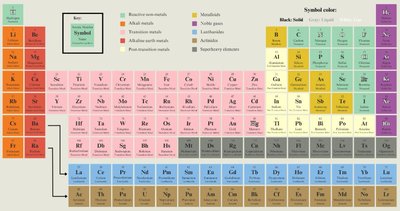
Each atom has a name and a one- or two-letter symbol, often derived from Latin. The atomic number, which is the number of protons, determines the atom's position in the periodic table.
Atomic Number: Number of protons in the nucleus.
Element Symbol: First letter uppercase, second letter lowercase.
Periodic Table: Arranged by increasing atomic number.
Ions
Cations and Anions
Ions are atoms or molecules with a net charge, formed by gaining or losing electrons. Cations have a positive charge, while anions have a negative charge.
Cations: Formed by losing electrons; fewer electrons than protons (e.g., Li+, Mg2+).
Anions: Formed by gaining electrons; more electrons than protons (e.g., F-, O2-).
Charge Calculation: Net charge = (number of protons) + (−1) × (number of electrons)
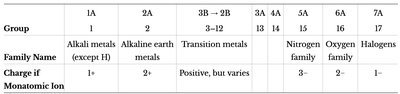
Group | Family Name | Charge if Monatomic Ion |
|---|---|---|
1A | Alkali metals (except H) | 1+ |
2A | Alkaline earth metals | 2+ |
3B–2B | Transition metals | Positive, but varies |
5A | Nitrogen family | 3− |
6A | Oxygen family | 2− |
7A | Halogens | 1− |
Isotopes and Nuclides
Definitions and Properties
Isotopes are atoms of the same element with different numbers of neutrons. Each combination of protons and neutrons is called a nuclide. The mass number identifies the isotope.
Isotope: Same number of protons, different number of neutrons.
Nuclide Symbol: Mass number as superscript before atom symbol (e.g., 35Cl).
Nuclide Name: Atom name hyphen mass number (e.g., chlorine-35).
Mass Number: Number of protons + number of neutrons.
Stable nuclei have not changed in billions of years, while radioactive nuclei decay at a constant rate. All atoms with 43, 61, and 83–92 protons are radioactive; atoms with 93 or more protons are synthetic and radioactive.
Atomic Mass
Calculation and Examples
Atomic mass is the weighted average of all isotopes of an element. It is calculated using the formula:
Example: Chlorine has two isotopes: 75% 35Cl (35.0 amu) and 25% 37Cl (37.0 amu).
Elements and Compounds
Classification and Properties
An element is a substance composed of one kind of atom. Elements can exist as monatomic, diatomic, or polyatomic forms. Compounds consist of two or more different kinds of atoms held together by chemical bonds.
Monatomic Elements: Noble gases (He, Ne, Ar, Kr, Xe, Rn).
Diatomic Elements: O2, H2, N2, F2, Cl2.
Polyatomic Elements: P4, S8.
Compounds: NaCl, CO, CaSO4.
Physical, Chemical, and Nuclear Changes
Types of Changes
Physical changes do not alter the identity of substances (e.g., melting, boiling). Chemical reactions recombine atoms by rearranging valence electrons, producing new substances. Nuclear reactions involve changes in the nucleus, producing new nuclides and releasing much more energy than chemical reactions.
Physical Change: No change in substance identity.
Chemical Reaction: Atoms recombine; identity changes.
Nuclear Reaction: Nucleus changes; new nuclides formed.
The Periodic Table and Periodicity
Structure and Families
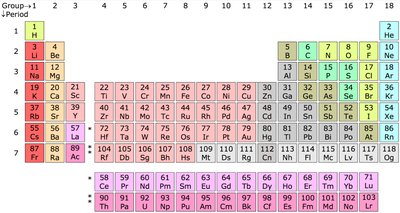
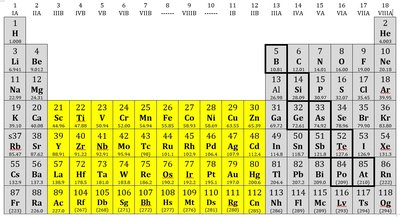
The periodic table groups atoms into families based on similar chemical properties, determined by the number of valence electrons. Atoms are arranged in increasing atomic numbers in rows (periods) and columns (groups).
Periods: Horizontal rows; 7 periods.
Groups/Families: Vertical columns; atoms in the same group have similar properties.
Main Group Elements: Groups 1–2, 13–18.
Transition Metals: Groups 3–12.
Common Families and Their Properties
Alkali Metals, Alkaline Earth Metals, Halogens, Noble Gases
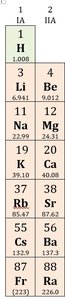
Group 1A: Alkali metals (except H)
Group 2A: Alkaline earth metals
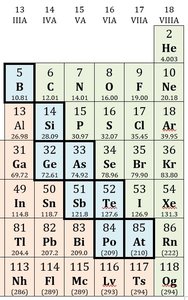
Group 7A: Halogens
Group 8A: Noble gases
Metals, Metalloids, and Nonmetals
Classification and Properties
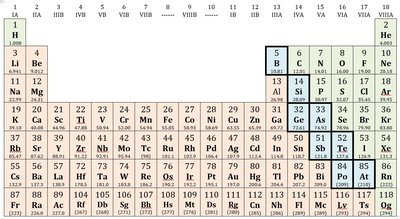
Elements are classified as metals, metalloids, or nonmetals based on their physical and chemical properties.
Metals: Conduct electricity, shiny, malleable, mostly solids.
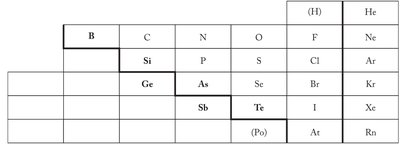
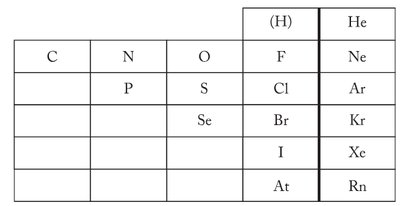
Metalloids: Border the staircase line; have properties between metals and nonmetals; semiconductors.
Nonmetals: 18 atoms, mostly gases or solids; hydrogen is a nonmetal.
Summary Table: Families and Ionic Charges
Group | Family Name | Charge if Monatomic Ion |
|---|---|---|
1A | Alkali metals (except H) | 1+ |
2A | Alkaline earth metals | 2+ |
3B–2B | Transition metals | Positive, but varies |
5A | Nitrogen family | 3− |
6A | Oxygen family | 2− |
7A | Halogens | 1− |
Practice and Application
Identifying Elements, Compounds, and Families
Practice identifying elements, compounds, and their classification as monatomic, diatomic, or polyatomic.
Sort particles into categories: anion, number of protons, elemental substance, compound, diatomic, monatomic.
Identify changes as physical, chemical, or nuclear reactions.
State the family name for given atoms (e.g., iodine, cesium, gold, neon, strontium, uranium).
Additional info: This chapter provides foundational chemistry concepts essential for understanding biological molecules, cell structure, and metabolic processes in General Biology.
