 Indietro
Bacteria and Archaea: Diversity, Structure, and Function
Guida di studio - Note intelligenti
 Appunti personalizzati basati sui tuoi materiali, ampliati con definizioni chiave, esempi e contesto.
Bacteria and Archaea: Diversity, Structure, and Function (Part 2)
Introduction
Bacteria and Archaea are two of the three domains of life, representing the most ancient and diverse forms of cellular life. They are prokaryotic, meaning they lack a membrane-bound nucleus, and are found in virtually every environment on Earth. Their diversity in morphology, metabolism, and ecological roles makes them essential to understanding biology and the history of life.
How Do Biologists Study Bacteria and Archaea?
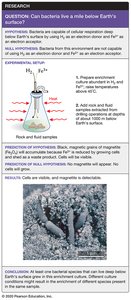
Enrichment Cultures
Enrichment cultures are laboratory techniques used to isolate and grow large populations of microorganisms under specific conditions. This method has led to the discovery of unique organisms, such as thermophiles ("heat-lovers"), by providing environments that mimic their natural habitats.
Definition: Enrichment cultures select for organisms with specific metabolic capabilities.
Application: Used to discover bacteria and archaea from extreme environments.
Example: Isolation of thermophilic bacteria from hot springs.
Metagenomics
Metagenomics involves sequencing DNA directly from environmental samples, allowing scientists to identify and characterize organisms without the need for culturing. This approach has revolutionized the study of microbial diversity and function.
Definition: The study of genetic material recovered directly from environmental samples.
Application: Rapid identification of new species and metabolic pathways.
Example: Discovery of novel bacteria in ocean water using metagenomic sequencing.
Investigating the Human Microbiome
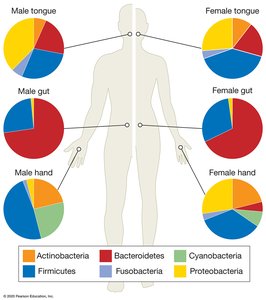
The human microbiome is the community of microbes that inhabit various parts of the human body. These microbes play crucial roles in health and disease, particularly in the gut, where they aid digestion and influence immune function.
Gut Microbiome: Contains about 100 trillion bacteria and archaea.
Health Impacts: Changes in the gut microbiome are linked to diseases such as inflammatory bowel disease and obesity.
Molecular Phylogenetics
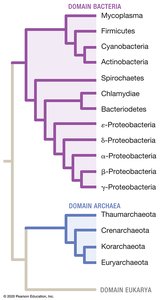
Molecular phylogenetics uses genetic information, particularly from ribosomal RNA (rRNA), to reconstruct evolutionary relationships. Carl Woese's comparison of 16S and 18S rRNA led to the recognition of three domains of life: Bacteria, Archaea, and Eukarya.
Key Molecules: 16S rRNA (prokaryotes), 18S rRNA (eukaryotes).
Tree of Life: Revealed major evolutionary divisions among living organisms.
Themes in the Diversification of Bacteria and Archaea
Genetic Variation through Gene Transfer
Bacteria and archaea exhibit genetic diversity through lateral gene transfer, which allows them to acquire new traits beyond those inherited from parent cells. Major mechanisms include transformation, transduction, and conjugation.
Transformation: Uptake of free DNA from the environment.
Transduction: Transfer of DNA by viruses (bacteriophages).
Conjugation: Direct transfer of DNA between cells via cell-to-cell contact, often involving plasmids.
Morphological Diversity
Bacteria and archaea display a wide range of shapes, sizes, and arrangements. Common forms include filaments, spheres (cocci), rods (bacilli), chains, and spirals. Motility is often achieved through flagella or gliding mechanisms.
Cell Wall Composition: Gram-positive bacteria have thick peptidoglycan layers; Gram-negative bacteria have thin peptidoglycan and an outer membrane.
Metabolic Diversity
Bacteria and archaea are metabolically diverse, using various energy and carbon sources. They can be classified based on how they obtain energy (phototrophs, chemoorganotrophs, chemolithotrophs) and carbon (autotrophs, heterotrophs).
Phototrophs: Use light energy to produce ATP.
Chemoorganotrophs: Oxidize organic molecules for energy.
Chemolithotrophs: Oxidize inorganic molecules for energy.
Autotrophs: Synthesize organic compounds from CO2 or CH4.
Heterotrophs: Obtain organic compounds from other organisms.
Energy Source | Carbon Source | Example |
|---|---|---|
Photoautotroph | CO2 | Cyanobacteria |
Photoheterotroph | Organic compounds | Heliobacteria |
Chemoorganoautotroph | CO2 | Methylomonas |
Chemoorganoheterotroph | Organic compounds | Escherichia coli |
Chemolithoautotroph | CO2 | Nitrosopumilus maritimus |
Chemolithoheterotroph | Organic compounds | Beggiatoa |
ATP Production: Cellular Respiration and Fermentation
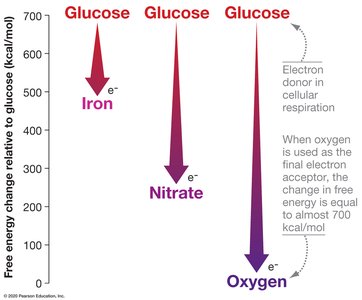
ATP can be produced via cellular respiration or fermentation. Cellular respiration involves electron transport chains (ETCs), where electrons are transferred from donors to acceptors, generating a proton gradient used by ATP synthase to produce ATP. Fermentation is less efficient and does not use ETCs.
Electron Donors: Organic or inorganic molecules.
Electron Acceptors: Oxygen (in eukaryotes), or other compounds (in prokaryotes).
Fermentation: ATP produced without external electron acceptors; important in anaerobic environments.
Ecological Diversity and Global Impacts
Bacteria and archaea are found in extreme environments and play vital roles in global biogeochemical cycles. Their metabolic activities drive processes such as the nitrogen cycle and the oxygenation of Earth's atmosphere.
Oxygen Revolution: Cyanobacteria were the first to perform oxygenic photosynthesis, leading to the accumulation of oxygen in the atmosphere.
Nitrogen Fixation: Certain bacteria and archaea convert atmospheric nitrogen (N2) into ammonia (NH3), making nitrogen available to living organisms.
Key Lineages of Bacteria
Lineage | Morphology | Metabolism | Relevance |
|---|---|---|---|
Actinobacteria | Rods or filaments, some form mycelia | Chemoheterotrophs, some fix nitrogen | Produce antibiotics, cause diseases like tuberculosis |
Chlamydiae | Spherical, very small, clusters | Chemoheterotrophs, obligate intracellular parasites | Cause chlamydia, can lead to infertility |
Cyanobacteria | Filaments, spheres, spirals | Photoautotrophs, nitrogen fixation | Origin of oxygen-rich atmosphere, algal blooms |
Firmicutes | Rods or spheres, chains or clusters | Chemoheterotrophs, some fix nitrogen | Cause diseases, used in food production |
Proteobacteria | Diverse: rods, spheres, spirals | Heterotrophs or chemoautotrophs | Includes E. coli, pathogens, nitrogen cycling |
Spirochaetes | Corkscrew-shaped, individual cells | Chemoheterotrophs, fermentation | Cause syphilis, Lyme disease |
Key Lineages of Archaea
Lineage | Morphology | Metabolism | Relevance |
|---|---|---|---|
Crenarchaeota | Rods, spheres, filaments, discs | Chemoheterotrophs, chemolithoautotrophs | Thrive in hot, acidic, high-pressure environments |
Euryarchaeota | Rods, spheres, filaments, spirals, discs | Chemoheterotrophs, chemolithoautotrophs | Produce methane, found in diverse habitats |
Thaumarchaeota | Rod-shaped | Chemolithoautotrophs (ammonia oxidation) | Abundant in oceans, important in nitrogen cycle |
Summary
Bacteria and Archaea are fundamental to life on Earth, exhibiting remarkable diversity in form, metabolism, and ecological function. Their study provides insights into the origins of life, the evolution of metabolic pathways, and the processes that sustain ecosystems.
