 Indietro
Bacteria, Archaea, and Protists: Structure, Function, and Diversity
Guida di studio - Note intelligenti
 Appunti personalizzati basati sui tuoi materiali, ampliati con definizioni chiave, esempi e contesto.
Prokaryotes: Bacteria and Archaea
Overview of Prokaryotic Diversity
Prokaryotes, which include Bacteria and Archaea, are the most genetically diverse and abundant organisms on Earth. They thrive in a wide range of environments, including extreme conditions that are inhospitable to most other life forms. Despite their microscopic size, prokaryotes play essential roles in ecological processes and nutrient cycling.
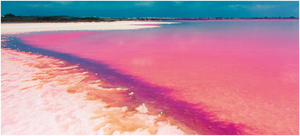
Habitats: Found in soil, water, extreme heat, acidity, and salinity.
Abundance: Billions can be found in a handful of soil.
Genetic Diversity: Exhibit remarkable genetic and metabolic diversity.
Size: Typically 0.5–5 µm, smaller than most eukaryotic cells.
Prokaryotic Cell Structure and Morphology
Prokaryotic cells are structurally simpler than eukaryotic cells but display a variety of shapes and surface features that contribute to their ecological success.
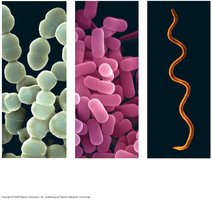
Shapes: The three most common shapes are:
Cocci: Spherical
Bacilli: Rod-shaped
Spirilla: Spiral-shaped
Cell-Surface Structures
The cell wall is a defining feature of prokaryotes, providing shape, protection, and preventing lysis in hypotonic environments. The composition of the cell wall differs between Bacteria and Archaea.
Bacterial Cell Walls: Contain peptidoglycan, a polymer of sugars and amino acids.
Archaeal Cell Walls: Contain polysaccharides and proteins, but lack peptidoglycan.
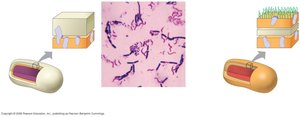
Gram Stain: Used to classify bacteria based on cell wall structure:
Gram-positive: Thick peptidoglycan layer, stains purple, more susceptible to antibiotics targeting cell wall synthesis.
Gram-negative: Thin peptidoglycan layer, outer membrane with lipopolysaccharides, stains pink/red, often more resistant to antibiotics.
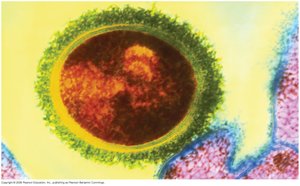
Capsule: A sticky polysaccharide or protein layer outside the cell wall that aids in attachment and protection from the immune system.
Fimbriae: Hair-like appendages that help cells adhere to surfaces or each other.
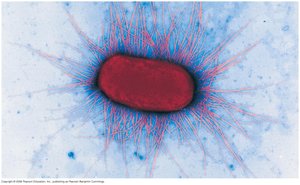
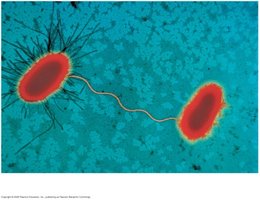
Sex Pilus: Longer than fimbriae, used for DNA exchange during conjugation.
Motility
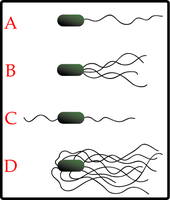
Many prokaryotes are motile, moving primarily by means of flagella. Prokaryotic flagella differ structurally and functionally from those of eukaryotes. Bacteria can move toward or away from stimuli, a behavior known as taxis.
Internal and Genomic Organization
Prokaryotic cells lack membrane-bound organelles but may have specialized infoldings of the plasma membrane for metabolic functions. Their genetic material is organized differently from eukaryotes.
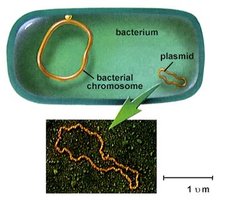
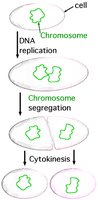
Genome: Usually a single circular DNA molecule located in the nucleoid region.
Plasmids: Small, independently replicating DNA molecules that often carry advantageous genes (e.g., antibiotic resistance).
Reproduction and Adaptation
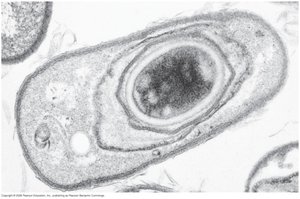
Prokaryotes reproduce rapidly by binary fission, producing genetically identical offspring. Some can form endospores, dormant structures that survive harsh conditions for long periods.
Genetic Diversity in Prokaryotes
Mechanisms Promoting Genetic Variation
Despite asexual reproduction, prokaryotes exhibit high genetic diversity due to rapid reproduction, mutation, and genetic recombination.
Rapid Reproduction: Short generation times allow mutations to accumulate quickly.
Mutation: Although rare per division, the large population sizes and rapid reproduction make mutations a significant source of variation.
Genetic Recombination: DNA can be exchanged between cells by:
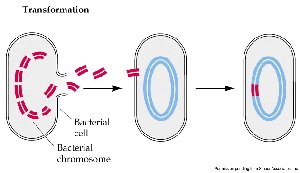
Transformation: Uptake of foreign DNA from the environment.
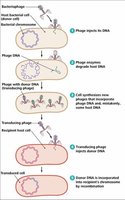
Transduction: Transfer of DNA by bacteriophages (viruses that infect bacteria).
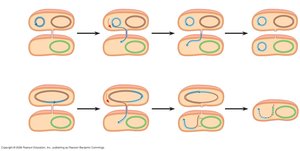
Conjugation: Direct transfer of DNA between cells via a sex pilus.
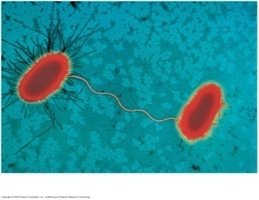
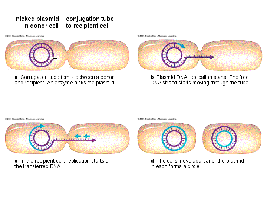
F Factor: A DNA segment required for the formation of sex pili and conjugation. Can exist as a plasmid (F plasmid) or integrated into the chromosome (Hfr cell).
R Plasmids: Carry genes for antibiotic resistance, contributing to the spread of resistant strains.
Diversity of Prokaryotic Metabolism
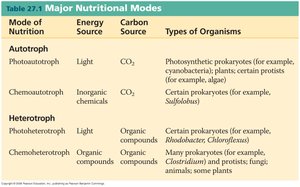
Major Nutritional Modes
Prokaryotes display diverse metabolic strategies, classified by their energy and carbon sources.
Mode of Nutrition | Energy Source | Carbon Source | Types of Organisms |
|---|---|---|---|
Photoautotroph | Light | CO2 | Photosynthetic prokaryotes (e.g., cyanobacteria), plants, some protists |
Chemoautotroph | Inorganic chemicals | CO2 | Certain prokaryotes (e.g., Sulfolobus) |
Photoheterotroph | Light | Organic compounds | Certain prokaryotes (e.g., Rhodobacter) |
Chemoheterotroph | Organic compounds | Organic compounds | Many prokaryotes, fungi, animals, some plants |
Oxygen Requirements:
Obligate aerobes: Require O2 for respiration.
Obligate anaerobes: Poisoned by O2; use fermentation or anaerobic respiration.
Facultative anaerobes: Can survive with or without O2.
Nitrogen Metabolism: Some prokaryotes fix atmospheric nitrogen (N2) into ammonia (NH3), making it available to other organisms.
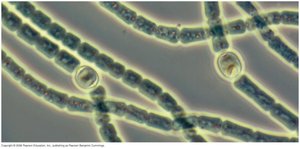
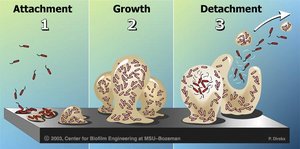
Metabolic Cooperation: Prokaryotes may form colonies (biofilms) or specialized cells (e.g., heterocytes in cyanobacteria) to share metabolic products.
Prokaryotic Phylogeny and Classification
Molecular Systematics and Domains
Molecular techniques have revealed the evolutionary relationships among prokaryotes, leading to the recognition of three domains: Bacteria, Archaea, and Eukarya. Archaea share features with both bacteria and eukaryotes and include many extremophiles.
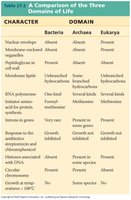
Character | Bacteria | Archaea | Eukarya |
|---|---|---|---|
Nuclear envelope | Absent | Absent | Present |
Membrane-enclosed organelles | Absent | Absent | Present |
Peptidoglycan in cell wall | Present | Absent | Absent |
Membrane lipids | Unbranched hydrocarbons | Some branched hydrocarbons | Unbranched hydrocarbons |
RNA polymerase | One kind | Several kinds | Several kinds |
Response to antibiotics | Growth inhibited | Growth not inhibited | Growth not inhibited |
Histones associated with DNA | Absent | Present in some genes | Present |
Circular chromosome | Present | Present | Absent |
Growth at >100°C | Some species | Some species | Absent |
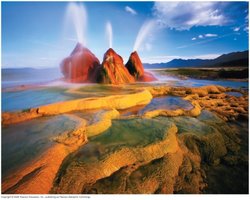
Archaea: Include extremophiles such as extreme halophiles (salt lovers), extreme thermophiles (heat lovers), and methanogens (produce methane in anaerobic environments).
Major Groups of Bacteria
Proteobacteria
This large and diverse group of Gram-negative bacteria includes photoautotrophs, chemoautotrophs, and heterotrophs. Subgroups include Alpha, Beta, Gamma, Delta, and Epsilon proteobacteria, each with unique ecological roles.
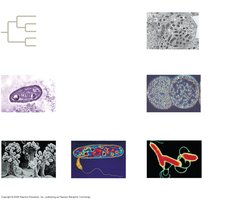
Alpha: Often associated with eukaryotic hosts (e.g., Rhizobium in legumes).
Beta: Important in nitrogen cycling (e.g., Nitrosomonas).
Gamma: Includes sulfur bacteria and pathogens (e.g., Escherichia coli).
Delta: Includes myxobacteria and bacterial predators.
Epsilon: Includes many pathogens (e.g., Helicobacter pylori).
Other Major Bacterial Groups
Chlamydias: Intracellular parasites of animal cells.
Spirochetes: Helical heterotrophs, some are pathogens (e.g., Borrelia burgdorferi causes Lyme disease).
Cyanobacteria: Photoautotrophs that generate O2; ancestors of plant chloroplasts.
Gram-Positive Bacteria: Includes decomposers, pathogens, and the smallest known cells (mycoplasmas).
Ecological and Human Importance of Prokaryotes
Roles in Ecosystems
Decomposers: Break down dead organic matter, recycling nutrients.
Nitrogen Fixation: Convert atmospheric nitrogen into forms usable by plants.
Symbiosis: Prokaryotes form mutualistic, commensal, or parasitic relationships with other organisms.
Prokaryotes and Human Health
Pathogens: Cause diseases by producing exotoxins (secreted) or endotoxins (released upon cell death).
Beneficial Uses: Biotechnology, bioremediation, production of antibiotics, vitamins, and hormones.
Protists: The First Eukaryotes
Introduction to Protists
Protists are a diverse group of mostly unicellular eukaryotes. They are more structurally and functionally complex than prokaryotes and exhibit a wide range of nutritional strategies and life cycles.
Nutrition: Photoautotrophs, heterotrophs, and mixotrophs.
Reproduction: Both asexual and sexual (meiosis and fertilization).
Endosymbiosis and Eukaryotic Evolution
Endosymbiosis played a key role in the evolution of eukaryotes. Mitochondria and plastids originated from engulfed prokaryotes, leading to the diversity of protists and other eukaryotes.
Primary Endosymbiosis: Engulfment of an aerobic prokaryote (mitochondria) or a photosynthetic cyanobacterium (plastids).
Secondary Endosymbiosis: Engulfment of a eukaryotic algal cell by another eukaryote, leading to further diversification.
Major Protist Supergroups
Excavata: Characterized by a feeding groove and modified mitochondria (e.g., Giardia, Trichomonas).
SAR: Includes Stramenopiles (e.g., diatoms, brown algae), Alveolates (e.g., dinoflagellates, ciliates, apicomplexans), and Rhizarians (e.g., forams, radiolarians).
Archaeplastida: Includes red algae, green algae, and land plants.
Unikonta: Includes amoebozoans (e.g., slime molds, tubulinids) and opisthokonts (animals, fungi, and related protists).
Ecological Roles of Protists
Producers: Photosynthetic protists are major producers in aquatic ecosystems.
Symbionts: Some protists form mutualistic or parasitic relationships with other organisms (e.g., Plasmodium causes malaria).
Key Terms and Concepts
Alternation of Generations: Life cycle alternating between multicellular haploid (gametophyte) and diploid (sporophyte) forms.
Haploid (n): One set of chromosomes.
Diploid (2n): Two sets of chromosomes.
Meiosis: Cell division producing haploid cells from diploid cells.
Fertilization: Fusion of haploid gametes to form a diploid zygote.
