 Indietro
BIO 100 Exam 2 Concept Review – Guided Study Notes
Guida di studio - Note intelligenti
 Appunti personalizzati basati sui tuoi materiali, ampliati con definizioni chiave, esempi e contesto.
Q1. Match cell part to function and indicate if the structure is found in prokaryotic, eukaryotic, or both cell types.
Background
Topic: Cell Structure and Function
This question tests your understanding of the major organelles and structures found in prokaryotic and eukaryotic cells, as well as their functions.
Key Terms:
Organelle: Specialized structure within a cell that performs a specific function.
Prokaryotic cell: Cell without a nucleus or membrane-bound organelles (e.g., bacteria).
Eukaryotic cell: Cell with a nucleus and membrane-bound organelles (e.g., plants, animals).
Step-by-Step Guidance
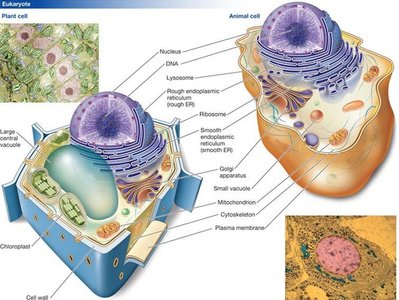
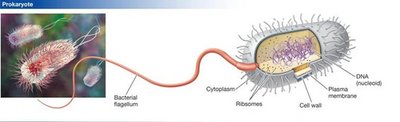
Review the diagrams of prokaryotic and eukaryotic cells to identify the labeled structures.
For each cell part listed (e.g., vacuole, ribosome, nucleus), recall its primary function (e.g., vacuole stores material, ribosome synthesizes proteins).
Determine whether each structure is found in prokaryotic cells, eukaryotic cells, or both. For example, ribosomes are found in both, while mitochondria are only in eukaryotes.
Match each function to the correct cell part and indicate the cell type(s) where it is found.
Try solving on your own before revealing the answer!
Final Answer:
Stores material within the cell: Vacuole (Eukaryotic, especially plant cells)
Protein synthesis: Ribosome (Both)
Organelle that manages cell functions: Nucleus (Eukaryotic)
Digests excess/worn-out parts: Lysosome (Eukaryotic)
Surrounds nucleus: Nuclear envelope/membrane (Eukaryotic)
Firm, protective structure: Cell wall (Both, but in plants and some prokaryotes)
Produces ATP: Mitochondrion (Eukaryotic)
Packages proteins: Golgi apparatus (Eukaryotic)
Provides support/controls entry: Plasma membrane (Both)
Hollow tubes for support: Cytoskeleton (Eukaryotic)
Jelly-like fluid: Cytoplasm (Both)
Modifies proteins, has ribosomes: Rough ER (Eukaryotic)
Synthesizes lipids: Smooth ER (Eukaryotic)
These matches are based on the functions and cell types shown in the diagrams and descriptions.
Q2. Given the figure of the cell membrane, answer questions about transport events.
Background
Topic: Membrane Transport
This question tests your understanding of how substances move across the cell membrane, including active and passive transport, and the difference between simple and facilitated diffusion.
Key Terms and Formulas:
Active transport: Movement of substances against their concentration gradient, requires energy (ATP).
Passive transport: Movement of substances down their concentration gradient, does not require energy.
Simple diffusion: Movement of small, nonpolar molecules directly across the membrane.
Facilitated diffusion: Movement of larger or polar molecules via transport proteins, no energy required.
Step-by-Step Guidance
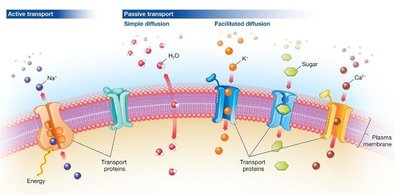
Examine the diagram to identify the different types of transport across the membrane.
Recall the definitions of active and passive transport, and note which direction substances move relative to their concentration gradient.
Compare simple diffusion (direct movement through the lipid bilayer) with facilitated diffusion (movement via transport proteins).
Use the word bank to match definitions to transport events (e.g., liposome, gene, DNA, virus).
Try solving on your own before revealing the answer!
Final Answer:
Main difference: Active transport requires energy and moves substances against the gradient; passive transport does not require energy and moves substances down the gradient.
Simple diffusion: Small, nonpolar molecules move directly across the membrane.
Facilitated diffusion: Larger or polar molecules move via transport proteins.
Word bank matches: Liposome (a), Gene (b), DNA (c), Virus (d).
The diagram visually reinforces the differences between these transport mechanisms.
Q4. Where does energy entering ecosystems originate? Explain the role of producers and predict what happens if producers disappear.
Background
Topic: Energy Flow in Ecosystems
This question tests your understanding of the source of energy in ecosystems and the critical role of producers (autotrophs).
Key Terms:
Producers: Organisms (like plants and algae) that convert solar energy into chemical energy via photosynthesis.
Consumers: Organisms that obtain energy by eating other organisms.
Energy flow: The movement of energy through an ecosystem from producers to consumers.
Step-by-Step Guidance
Recall that energy entering most ecosystems originates from the sun.
Describe how producers capture solar energy and convert it into chemical energy (glucose).
Predict the consequences for the ecosystem if producers were removed (e.g., collapse of food chains).
Try solving on your own before revealing the answer!
Final Answer:
Energy originates from the sun.
Producers capture solar energy via photosynthesis, making it available to consumers.
If producers disappear, primary consumers starve, leading to collapse of higher trophic levels and the ecosystem.
Producers are essential for energy flow and ecosystem stability.
Q5. How does ATP release energy? Why do cells continuously regenerate ATP?
Background
Topic: Cellular Energy and ATP
This question tests your understanding of ATP as the cell's energy currency and why it must be regenerated.
Key Terms and Formulas:
ATP (Adenosine Triphosphate): Molecule used by cells to store and transfer energy.
ADP (Adenosine Diphosphate): Formed when ATP loses a phosphate group.
ATP hydrolysis:
Step-by-Step Guidance
Recall the structure of ATP and how it stores energy in its phosphate bonds.
Describe what happens when ATP is hydrolyzed (breaks off its third phosphate group).
Explain why cells cannot store ATP and must continuously regenerate it from ADP.
Try solving on your own before revealing the answer!
Final Answer:
ATP releases energy by breaking its third phosphate group, forming ADP and a free phosphate.
Cells must continuously regenerate ATP because it is used constantly and cannot be stored.
ATP is recharged via cellular respiration to meet ongoing energy demands.
Q6. Write the overall equation for photosynthesis. What are the reactants and products?
Background
Topic: Photosynthesis
This question tests your ability to recall the chemical equation for photosynthesis and identify its reactants and products.
Key Terms and Formulas:
Photosynthesis equation:
Reactants: Carbon dioxide, water, sunlight
Products: Glucose, oxygen
Step-by-Step Guidance
Recall the balanced chemical equation for photosynthesis.
Identify the reactants (inputs) and products (outputs) in the equation.
Explain the role of sunlight in driving the reaction.
Try solving on your own before revealing the answer!
Final Answer:
Reactants: Carbon dioxide, water, sunlight
Products: Glucose, oxygen
This equation summarizes the process by which plants convert solar energy into chemical energy.
Q7. During the light reactions, water splits. What happens to oxygen produced and H⁺ ions? Where does this occur in the chloroplast?
Background
Topic: Photosynthesis – Light Reactions
This question tests your understanding of the fate of products from water splitting during the light-dependent reactions of photosynthesis.
Key Terms:
Photolysis: Splitting of water by light energy.
Thylakoid membrane: Site of light reactions in the chloroplast.
Oxygen (O2): Byproduct released into the atmosphere.
H⁺ ions: Contribute to proton gradient for ATP synthesis.
Step-by-Step Guidance
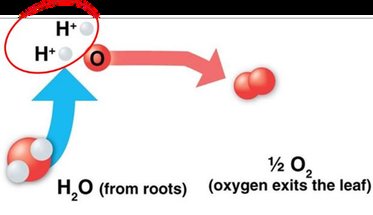
Recall that water is split during the light reactions, producing O2 and H⁺ ions.
Describe what happens to the oxygen (released as a byproduct).
Explain the role of H⁺ ions in creating a proton gradient for ATP synthesis.
Identify the location in the chloroplast where this occurs (thylakoid membrane/lumen).
Try solving on your own before revealing the answer!
Final Answer:
Oxygen is released as a byproduct into the atmosphere through the leaf’s stomata.
H⁺ ions accumulate in the thylakoid lumen, creating a proton gradient for ATP synthesis, and are eventually transferred to NADP⁺ to form NADPH.
This occurs in the thylakoid membrane/lumen of the chloroplast.
Water splitting is essential for generating both oxygen and the proton gradient needed for ATP production.
Q8. Calvin Cycle: What molecules enter from the atmosphere? What molecules from the light reactions are used? Identify reactants and products. Where in the chloroplast does photosynthesis occur? Which wavelengths of light contribute most?
Background
Topic: Photosynthesis – Calvin Cycle and Light Absorption
This question tests your understanding of the Calvin Cycle, its inputs and outputs, and the role of light wavelengths in photosynthesis.
Key Terms and Formulas:
Calvin Cycle: Light-independent reactions that fix carbon dioxide into glucose.
Reactants: CO2 (from atmosphere), ATP and NADPH (from light reactions).
Products: Glucose (C6H12O6), ADP, NADP⁺.
Location: Stroma (Calvin Cycle), Thylakoid membrane (light reactions).
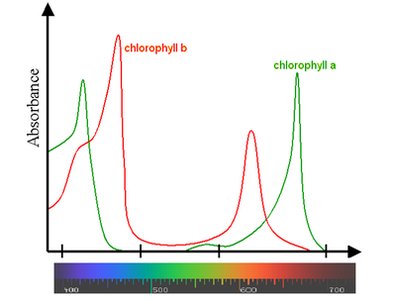
Light wavelengths: Blue (~430–450 nm) and Red (~640–680 nm) are most effective.
Step-by-Step Guidance
Recall which molecules enter the Calvin Cycle from the atmosphere (CO2).
Identify which molecules from the light reactions are used (ATP and NADPH).
List the reactants and products of the Calvin Cycle.
Describe where in the chloroplast these processes occur (stroma for Calvin Cycle, thylakoid for light reactions).
Examine the absorbance spectrum to determine which wavelengths of light are most effective for photosynthesis.
Try solving on your own before revealing the answer!
Final Answer:
Molecules entering from atmosphere: CO2
Molecules used from light reactions: ATP and NADPH
Reactants: CO2, ATP, NADPH; Products: Glucose, ADP, NADP⁺
Photosynthesis occurs in the thylakoid membrane (light reactions) and stroma (Calvin Cycle)
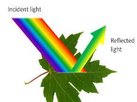
Blue and red wavelengths contribute most to photosynthesis; green is reflected
Chlorophyll absorbs blue and red light most efficiently, driving photosynthesis.
Q9. Describe how photosynthesis and cellular respiration are related.
Background
Topic: Relationship between Photosynthesis and Cellular Respiration
This question tests your understanding of how these two processes are interconnected and reciprocal.
Key Terms:
Photosynthesis: Converts CO2 and H2O into glucose and O2 using sunlight.
Cellular respiration: Converts glucose and O2 into CO2, H2O, and ATP.
Step-by-Step Guidance
Recall the products of photosynthesis (glucose and O2).
Recall the products of cellular respiration (CO2 and H2O).
Explain how the products of one process serve as the reactants for the other.
Try solving on your own before revealing the answer!
Final Answer:
Photosynthesis and cellular respiration are complementary processes. The products of photosynthesis (glucose and O2) are the reactants for cellular respiration, while the products of cellular respiration (CO2 and H2O) are the reactants for photosynthesis.
This reciprocal relationship maintains the balance of energy and matter in living systems.
Q10. Do plants perform cellular respiration? Explain your answer.
Background
Topic: Cellular Respiration in Plants
This question tests your understanding of whether plants use cellular respiration and why.
Key Terms:
Cellular respiration: Process by which cells break down glucose to produce ATP.
ATP: Energy currency of the cell.
Step-by-Step Guidance
Recall that plants produce glucose via photosynthesis.
Explain why plants need to break down glucose to generate ATP.
Discuss when plants perform cellular respiration (e.g., at night or when energy is needed).
Try solving on your own before revealing the answer!
Final Answer:
Yes, plants perform cellular respiration. They break down glucose produced during photosynthesis to generate ATP for growth, maintenance, and transport, especially when light is unavailable.
Cellular respiration is essential for energy production in all living cells, including plants.
Q11. A cell begins breaking down glucose. Where does glycolysis occur? Does glycolysis require oxygen? What molecules are produced at the end of glycolysis? Why does glycolysis occur in both aerobic and anaerobic conditions?
Background
Topic: Glycolysis
This question tests your understanding of the location, requirements, and products of glycolysis, as well as its role in cellular metabolism.
Key Terms and Formulas:
Glycolysis: First step in cellular respiration, breaks down glucose into pyruvate.
Location: Cytoplasm
Anaerobic: Does not require oxygen
Products: 2 pyruvate, 2 ATP (net), 2 NADH
Step-by-Step Guidance
Recall where glycolysis occurs in the cell (cytoplasm).
Determine whether glycolysis requires oxygen (it does not).
List the molecules produced at the end of glycolysis.
Explain why glycolysis can occur in both aerobic and anaerobic conditions.
Try solving on your own before revealing the answer!
Final Answer:
Glycolysis occurs in the cytoplasm.
It does not require oxygen (anaerobic).
Produces 2 pyruvate, 2 ATP (net), and 2 NADH.
Glycolysis occurs in both aerobic and anaerobic conditions because it does not involve oxygen and relies only on cytoplasmic enzymes.
Glycolysis is a universal pathway for energy extraction from glucose.
Q12. Bread dough rises during baking. What gas causes the dough to rise? What type of fermentation occurs? What happens to alcohol produced during baking? Why is yeast used in bread making?
Background
Topic: Fermentation and Yeast
This question tests your understanding of fermentation, the role of yeast, and the chemistry behind bread rising.
Key Terms:
Fermentation: Anaerobic process by which cells produce energy.
Alcoholic fermentation: Produces ethanol and CO2.
Yeast: Microorganism used in bread making.
Step-by-Step Guidance
Recall which gas is produced during fermentation and causes dough to rise (CO2).
Identify the type of fermentation (alcoholic/ethanol fermentation).
Explain what happens to the alcohol produced during baking (evaporates).
Describe why yeast is used in bread making (produces CO2 bubbles).
Try solving on your own before revealing the answer!
Final Answer:
CO2 gas causes the dough to rise.
Alcoholic (ethanol) fermentation occurs.
Alcohol evaporates due to high baking temperatures.
Yeast metabolizes sugars, releasing CO2 bubbles that get trapped in the dough, causing it to expand.
Yeast is essential for leavening bread through fermentation.
