 Indietro
BIO 121 Chapter 8: Metabolism – Energy, Enzymes, and Cellular Work
Guida di studio - Note intelligenti
 Appunti personalizzati basati sui tuoi materiali, ampliati con definizioni chiave, esempi e contesto.
Metabolism: The Chemical Reactions of Life
Overview of Metabolism
Metabolism encompasses all chemical reactions occurring within living organisms, enabling them to extract, store, and utilize energy for cellular work. These reactions are organized into metabolic pathways, where each step is catalyzed by a specific enzyme.
Metabolic Pathways: A series of chemical reactions transforming a starting molecule into a product, with each step facilitated by a unique enzyme.
Catabolic Pathways: Break down complex molecules into simpler ones, releasing energy.
Anabolic Pathways: Build complex molecules from simpler ones, consuming energy.
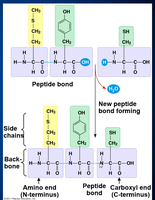
Example: The conversion of amino acids into a peptide bond is an anabolic process. 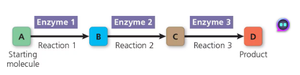
Forms of Energy in Biological Systems
Types of Energy
Energy is the capacity to cause change and exists in several forms relevant to biology:
Kinetic Energy: Energy of motion, including thermal energy (random movement of atoms and molecules).
Potential Energy: Stored energy due to position or structure, such as chemical energy in bonds.
Chemical Energy: Potential energy available for release in chemical reactions, often stored in covalent bonds.
Example: Food molecules store chemical energy, which is released during cellular respiration.
Thermodynamics and Biological Systems
Laws of Thermodynamics
Thermodynamics governs energy transformations in biological systems.
First Law: Energy can be transferred or transformed, but not created or destroyed (Principle of Conservation of Energy).
Second Law: Every energy transfer increases the disorder (entropy) of the system.
System vs. Surroundings:
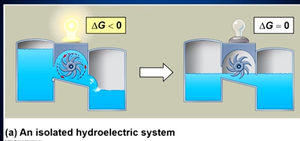
Closed System: No exchange of energy or matter with surroundings.
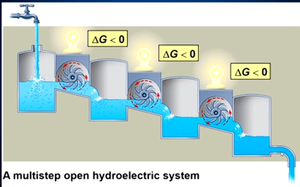
Open System: Energy and matter are exchanged with surroundings (cells are open systems).
Free Energy and Spontaneity
Free Energy Change (ΔG)
Free energy (G) is the portion of a system’s energy available to do work. The change in free energy () determines whether a process is spontaneous.
Formula: Where:
= Change in free energy
= Change in total energy (enthalpy)
= Change in entropy
= Absolute temperature (Kelvin)
Spontaneous Process: Occurs without input of energy; is negative.
Nonspontaneous Process: Requires energy input; is positive.
Exergonic and Endergonic Reactions
Energy Changes in Reactions
Exergonic Reaction: Releases energy; is negative; spontaneous.
Endergonic Reaction: Consumes energy; is positive; nonspontaneous.
Example: Breakdown of glucose is exergonic; synthesis of complex molecules is endergonic. 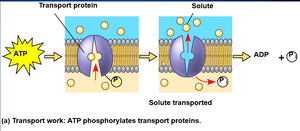
Equilibrium and Metabolism
Metabolic Equilibrium
In a closed system, reactions reach equilibrium () and no work can be done.
Cells are open systems, constantly using products and maintaining a negative .
Metabolism never reaches equilibrium; otherwise, the cell would die.
ATP: The Energy Currency of the Cell
Structure and Function of ATP
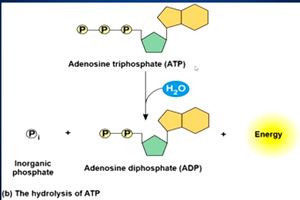
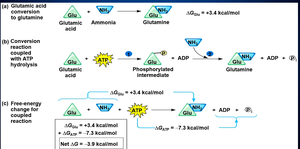
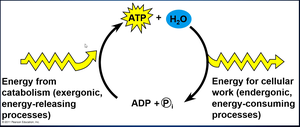
ATP (adenosine triphosphate) stores energy in its phosphate bonds, especially the terminal phosphate. Hydrolysis of ATP releases energy ( kcal/mol), which is used to drive cellular work.
ATP Hydrolysis: ATP + H2O → ADP + Pi + Energy
ATP Powers Cellular Work
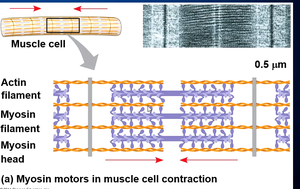
ATP is used in three main types of cellular work:
Chemical Work: Drives endergonic reactions, such as peptide bond formation.
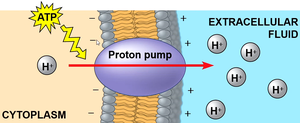
Transport Work: Powers active transport of ions across membranes.
Mechanical Work: Enables muscle contraction and movement.
Energy Coupling
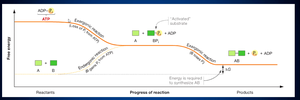
Exergonic reactions (energy-releasing) are coupled with endergonic reactions (energy-consuming) to drive cellular processes.
ATP hydrolysis is often paired with endergonic reactions to make them energetically favorable.
Regeneration of ATP
ATP is regenerated from ADP and inorganic phosphate through cellular respiration, maintaining energy supply for cellular work.
Activation Energy and Enzymes
Activation Energy Barrier
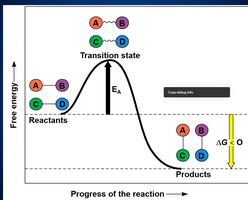
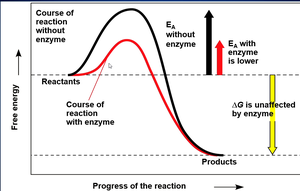
Even spontaneous reactions require an initial input of energy (activation energy, EA) to proceed.
Enzymes: Biological catalysts that lower the activation energy, speeding up reactions without affecting .
Enzyme Function and Mechanisms
Enzymes facilitate reactions by:
Orienting substrates correctly
Straining substrate bonds
Providing a favorable microenvironment
Covalently bonding to substrates
Example: Sucrase catalyzes the hydrolysis of sucrose into glucose and fructose. 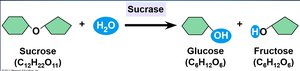
Enzyme Specificity and Regulation
Enzymes are proteins whose activity depends on their three-dimensional structure.
Environmental factors such as pH and temperature affect enzyme function.
Cofactors (e.g., vitamins) may be required for enzyme activity.
Example: Stomach enzymes function optimally at pH 2, intestinal enzymes at pH 8.
Summary Table: Exergonic vs. Endergonic Reactions
Reaction Type | ΔG | Spontaneity | Energy Flow |
|---|---|---|---|
Exergonic | Negative | Spontaneous | Energy released |
Endergonic | Positive | Nonspontaneous | Energy consumed |
Key Terms and Definitions
Metabolism: All chemical reactions in an organism.
Catabolic Pathway: Energy-releasing breakdown of molecules.
Anabolic Pathway: Energy-consuming synthesis of molecules.
ATP: Main energy carrier in cells.
Enzyme: Protein catalyst that lowers activation energy.
Activation Energy (EA): Energy required to start a reaction.
Free Energy (G): Energy available to do work.
ΔG: Change in free energy.
Exergonic Reaction: Energy-releasing, spontaneous reaction.
Endergonic Reaction: Energy-consuming, nonspontaneous reaction.
Additional info:
Enzyme activity can be regulated by inhibitors, activators, and environmental conditions.
ATP is continuously regenerated in cells to maintain energy supply.
