 Indietro
BIO181 Exam 3 Study Guide – Photosynthesis & Cellular Respiration
Guida di studio - Note intelligenti
 Appunti personalizzati basati sui tuoi materiali, ampliati con definizioni chiave, esempi e contesto.
Q1. What are the parts of ATP?
Background
Topic: ATP Structure
This question tests your understanding of the molecular structure of ATP (adenosine triphosphate), which is a key energy carrier in cells.
Key Terms:
ATP: Adenosine triphosphate
Adenine: Nitrogenous base
Ribose: Five-carbon sugar
Phosphate groups: Three phosphate units
Step-by-Step Guidance
Identify the three main components of ATP: a nitrogenous base, a sugar, and phosphate groups.
Recall that the nitrogenous base in ATP is adenine.
The sugar present is ribose, which is a pentose (five-carbon) sugar.
ATP contains three phosphate groups attached in a chain.
Try solving on your own before revealing the answer!
Final Answer:
The parts of ATP are: adenine (a nitrogenous base), ribose (a five-carbon sugar), and three phosphate groups.
Q2. What are the reactants and products for photosynthesis?
Background
Topic: Photosynthesis Equation
This question tests your knowledge of the chemical equation for photosynthesis and the substances involved.
Key Terms & Formula:
Reactants: Substances consumed in the reaction
Products: Substances produced by the reaction
Step-by-Step Guidance
Recall the general equation for photosynthesis.
Identify the reactants: carbon dioxide, water, and light energy.
Identify the products: glucose and oxygen.
Make sure you understand the role of each reactant and product in the process.
Try solving on your own before revealing the answer!
Final Answer:
Reactants: carbon dioxide (CO2), water (H2O), and light energy. Products: glucose (C6H12O6) and oxygen (O2).
Q3. Describe the structure of the chloroplast and explain what reactions take place in which parts of chloroplast (Granum, Thylakoids, Stroma, intermembrane space etc)
Background
Topic: Chloroplast Structure & Function
This question tests your understanding of the anatomy of the chloroplast and the localization of photosynthetic reactions.
Key Terms:
Granum: Stack of thylakoids
Thylakoid: Membrane-bound compartment
Stroma: Fluid-filled space outside thylakoids
Intermembrane space: Space between outer and inner membranes
Step-by-Step Guidance
Identify the main structural components of the chloroplast: outer membrane, inner membrane, intermembrane space, stroma, thylakoids, and grana.
Recall that light-dependent reactions occur in the thylakoid membranes.
Remember that the Calvin cycle (light-independent reactions) occurs in the stroma.
Understand the role of the intermembrane space and grana in organizing the thylakoids.
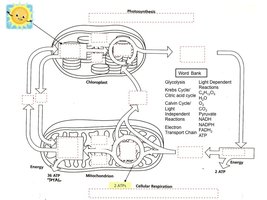
Try solving on your own before revealing the answer!
Final Answer:
The chloroplast has an outer and inner membrane, with an intermembrane space between them. Inside, the stroma is a fluid-filled area where the Calvin cycle occurs. Thylakoids are membrane-bound compartments arranged in stacks called grana; light-dependent reactions take place in the thylakoid membranes.
Q4. Describe the chlorophyll
Background
Topic: Chlorophyll Structure & Function
This question tests your understanding of the pigment responsible for absorbing light energy during photosynthesis.
Key Terms:
Chlorophyll: Green pigment in plants
Porphyrin ring: Structure that binds magnesium
Light absorption: Captures energy from sunlight
Step-by-Step Guidance
Recall that chlorophyll is a pigment found in the thylakoid membranes.
Understand that chlorophyll has a porphyrin ring structure with a central magnesium ion.
Chlorophyll absorbs light most efficiently in the blue and red wavelengths.
It plays a key role in converting light energy to chemical energy during photosynthesis.
Try solving on your own before revealing the answer!
Final Answer:
Chlorophyll is a green pigment located in the thylakoid membranes. It has a porphyrin ring structure with a central magnesium ion and absorbs light energy, especially in the blue and red wavelengths, to drive photosynthesis.
Q5. Describe light dependent reaction----Where the reaction takes place, PhotosystemII, photosystem I, ATP synthase, what molecules are used and what molecule (gas) are produced during reaction.
Background
Topic: Light-Dependent Reactions of Photosynthesis
This question tests your understanding of the location, components, and products of the light-dependent reactions.
Key Terms:
Photosystem II & I: Protein complexes in thylakoid membrane
ATP synthase: Enzyme that synthesizes ATP
Reactants: Water, light
Products: Oxygen (gas), ATP, NADPH
Step-by-Step Guidance
Recall that light-dependent reactions occur in the thylakoid membranes.
Understand that water is split (photolysis) to provide electrons, producing oxygen gas as a byproduct.
Electrons move through Photosystem II and Photosystem I, generating ATP and NADPH.
ATP synthase uses the proton gradient to synthesize ATP from ADP and inorganic phosphate.
Try solving on your own before revealing the answer!
Final Answer:
Light-dependent reactions occur in the thylakoid membranes. Water and light are used; oxygen gas is produced, along with ATP and NADPH. Photosystem II and I are involved, and ATP synthase generates ATP.
Q6. Describe ATP synthase
Background
Topic: ATP Synthase Function
This question tests your understanding of the enzyme responsible for ATP production during photosynthesis and cellular respiration.
Key Terms:
ATP synthase: Enzyme complex
Proton gradient: Drives ATP synthesis
ADP + Pi: Substrates for ATP formation
Step-by-Step Guidance
Recall that ATP synthase is located in the thylakoid membrane (chloroplast) and inner mitochondrial membrane.
Understand that it uses the energy from a proton gradient to convert ADP and inorganic phosphate (Pi) into ATP.
Protons flow through ATP synthase, causing it to rotate and catalyze ATP formation.
Try solving on your own before revealing the answer!
Final Answer:
ATP synthase is an enzyme that uses the energy from a proton gradient to synthesize ATP from ADP and inorganic phosphate. It is found in the thylakoid membrane and inner mitochondrial membrane.
Q7. Describe Calvin cycle (light independent cycle)- Where the reaction takes place, Rubisco enzyme, what molecules are used and what molecules are produced after reaction.
Background
Topic: Calvin Cycle (Light-Independent Reactions)
This question tests your understanding of the location, key enzyme, reactants, and products of the Calvin cycle.
Key Terms:
Calvin cycle: Light-independent reactions
Stroma: Location in chloroplast
Rubisco: Key enzyme
Reactants: CO2, ATP, NADPH
Products: Glucose (or G3P)
Step-by-Step Guidance
Recall that the Calvin cycle occurs in the stroma of the chloroplast.
Rubisco enzyme catalyzes the fixation of CO2 to RuBP.
ATP and NADPH (from light-dependent reactions) are used to convert CO2 into G3P (a precursor to glucose).
Understand that the cycle regenerates RuBP for continued carbon fixation.
Try solving on your own before revealing the answer!
Final Answer:
The Calvin cycle occurs in the stroma. Rubisco fixes CO2 to RuBP. ATP and NADPH are used, and G3P (which can become glucose) is produced.
Q8. What is photorespiration?
Background
Topic: Photorespiration
This question tests your understanding of the process that competes with photosynthesis, especially in C3 plants.
Key Terms:
Photorespiration: Process where O2 is used instead of CO2
Rubisco: Enzyme involved
Energy loss: Reduces photosynthetic efficiency
Step-by-Step Guidance
Recall that photorespiration occurs when Rubisco binds O2 instead of CO2.
Understand that this process leads to the consumption of energy and release of CO2 without producing sugars.
Photorespiration is more common in hot, dry conditions.
Try solving on your own before revealing the answer!
Final Answer:
Photorespiration is a process where Rubisco binds O2 instead of CO2, leading to energy loss and reduced sugar production. It occurs mainly in C3 plants under hot, dry conditions.
Q9. Compare C3, C4 and CAM plants.
Background
Topic: Types of Photosynthetic Pathways
This question tests your understanding of the adaptations plants have for photosynthesis in different environments.
Key Terms:
C3 plants: Standard Calvin cycle
C4 plants: Spatial separation of steps
CAM plants: Temporal separation of steps
Step-by-Step Guidance
Recall that C3 plants use the Calvin cycle directly and are susceptible to photorespiration.
C4 plants fix CO2 in mesophyll cells and transfer it to bundle sheath cells, reducing photorespiration.
CAM plants fix CO2 at night and store it for use during the day, minimizing water loss.
Try solving on your own before revealing the answer!
Final Answer:
C3 plants use the Calvin cycle and are prone to photorespiration. C4 plants separate CO2 fixation spatially to reduce photorespiration. CAM plants fix CO2 at night and use it during the day, conserving water.
Q10. Draw the picture of process of photosynthesis in chloroplast (light dependent and light independent-Calvin cycle). Write the equation for cellular respiration.
Background
Topic: Photosynthesis & Cellular Respiration
This question tests your ability to visualize the processes and understand the chemical equation for cellular respiration.
Key Terms & Formula:
Photosynthesis: Occurs in chloroplast
Cellular respiration: Occurs in mitochondria
Step-by-Step Guidance
Draw or review a diagram showing the chloroplast with thylakoids (light-dependent reactions) and stroma (Calvin cycle).
Label the flow of energy and molecules between chloroplast and mitochondria.
Write the equation for cellular respiration, which is essentially the reverse of photosynthesis.
Try solving on your own before revealing the answer!
Final Answer:
The diagram should show light-dependent reactions in thylakoids and the Calvin cycle in the stroma. The equation for cellular respiration is:
Q11. What is an important difference between light-dependent and light independent reactions of photosynthesis?
Background
Topic: Photosynthesis Reactions
This question tests your understanding of the distinction between the two main stages of photosynthesis.
Key Terms:
Light-dependent: Requires light, produces ATP/NADPH
Light-independent: Uses ATP/NADPH, fixes carbon
Step-by-Step Guidance
Recall that light-dependent reactions require sunlight and occur in the thylakoid membranes.
Light-independent reactions (Calvin cycle) do not require light and occur in the stroma.
Understand that light-dependent reactions produce ATP and NADPH, which are used in the Calvin cycle.
Try solving on your own before revealing the answer!
Final Answer:
Light-dependent reactions require light and produce ATP/NADPH. Light-independent reactions use ATP/NADPH to fix carbon and do not require light.
Q12. The end products of the light-dependent reactions of photosynthesis are
Background
Topic: Light-Dependent Reaction Products
This question tests your knowledge of what is produced during the light-dependent stage of photosynthesis.
Key Terms:
ATP: Energy carrier
NADPH: Electron carrier
Oxygen: Byproduct
Step-by-Step Guidance
Recall that water is split during light-dependent reactions, releasing oxygen.
ATP and NADPH are produced and used in the Calvin cycle.
Try solving on your own before revealing the answer!
Final Answer:
The end products are ATP, NADPH, and oxygen (O2).
Q13. In which compartment of the plant cell do the light independent reactions of photosynthesis take place?
Background
Topic: Calvin Cycle Location
This question tests your knowledge of where the Calvin cycle occurs in the chloroplast.
Key Terms:
Stroma: Fluid-filled space in chloroplast
Step-by-Step Guidance
Recall the structure of the chloroplast.
Identify the stroma as the location for the Calvin cycle.
Try solving on your own before revealing the answer!
Final Answer:
The light-independent reactions (Calvin cycle) take place in the stroma of the chloroplast.
Q14. What is the carbon fixation in photosynthesis?
Background
Topic: Carbon Fixation
This question tests your understanding of the process by which inorganic carbon is converted to organic molecules.
Key Terms:
Carbon fixation: Incorporation of CO2 into organic molecules
Rubisco: Enzyme catalyzing fixation
Step-by-Step Guidance
Recall that carbon fixation is the first step of the Calvin cycle.
Rubisco attaches CO2 to RuBP, forming 3-phosphoglycerate (3-PGA).
Try solving on your own before revealing the answer!
Final Answer:
Carbon fixation is the process where CO2 is incorporated into organic molecules by Rubisco during the Calvin cycle.
Q15. What wavelength (What color) does chlorophyll absorb most and what wavelength (What color) does chlorophyll not absorb (reject)?
Background
Topic: Light Absorption by Chlorophyll
This question tests your understanding of the absorption spectrum of chlorophyll.
Key Terms:
Absorption spectrum: Range of wavelengths absorbed
Chlorophyll: Pigment absorbing light
Step-by-Step Guidance
Recall that chlorophyll absorbs light most strongly in the blue (~430 nm) and red (~660 nm) regions.
Chlorophyll reflects green light (~500–550 nm), which is why plants appear green.
Try solving on your own before revealing the answer!
Final Answer:
Chlorophyll absorbs blue and red wavelengths most, and does not absorb (rejects) green wavelengths.
Q16. What is the function of RuBisCo enzyme in Calvin cycle?
Background
Topic: RuBisCo Function
This question tests your understanding of the key enzyme in carbon fixation.
Key Terms:
RuBisCo: Ribulose-1,5-bisphosphate carboxylase/oxygenase
Carbon fixation: Attaches CO2 to RuBP
Step-by-Step Guidance
Recall that RuBisCo catalyzes the first step of the Calvin cycle.
It attaches CO2 to RuBP, forming 3-PGA.
Try solving on your own before revealing the answer!
Final Answer:
RuBisCo catalyzes the fixation of CO2 to RuBP, forming 3-phosphoglycerate in the Calvin cycle.
