Indietro
Biochemistry Foundations: Chemical Context, Water, Carbon, and Macromolecules
Guida di studio - Note intelligenti
 Appunti personalizzati basati sui tuoi materiali, ampliati con definizioni chiave, esempi e contesto.
Chapter 2: The Chemical Context of Life
Electronegativity and Chemical Bonds
Atoms form chemical bonds by sharing or transferring electrons, and the type of bond depends on the difference in electronegativity between the atoms involved.
Electronegativity: An atom’s attraction for shared electrons in a bond. Oxygen (O) and nitrogen (N) are more electronegative than carbon (C) and hydrogen (H).
Covalent Bonds: Atoms share electron pairs. Single bonds involve one pair, double bonds two pairs. Covalent bonds are strong and form the backbone of biological molecules.
Ionic Bonds: Formed when one atom transfers an electron to another, creating oppositely charged ions (e.g., Na+ and Cl− in NaCl). The bond is the electrostatic attraction between ions.
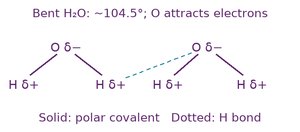
Nonpolar vs. Polar Covalent Bonds: Nonpolar bonds (e.g., H–H, C–H) share electrons equally; polar bonds (e.g., O–H) have unequal sharing, resulting in partial charges (δ− and δ+).
Hydrogen Bonds: Weak attractions between a hydrogen atom covalently bonded to an electronegative atom (O or N) and another electronegative atom. They stabilize water, DNA, and proteins.
Chapter 3: Water and the Fitness of the Environment
Structure and Properties of Water
Water’s unique properties arise from its polar covalent bonds and ability to form hydrogen bonds.
Bent Shape: Water has a bond angle of ~104.5°, making it polar.
Hydrogen Bonding: Each water molecule can form up to four hydrogen bonds, leading to cohesion and high surface tension.
Cohesion, Adhesion, and Surface Tension
Cohesion: Water molecules stick to each other, supporting water transport in plants and surface tension.
Adhesion: Water molecules stick to other polar substances, aiding capillary action in plants.
Thermal Properties of Water
High Specific Heat: Water resists temperature changes, stabilizing environments and organisms.
High Heat of Vaporization: Evaporation of water cools surfaces (e.g., sweating, transpiration).
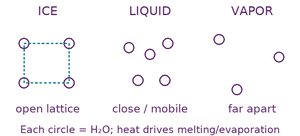
Density of Ice: Ice is less dense than liquid water due to its open hydrogen-bonded lattice, allowing it to float and insulate aquatic habitats.
Solutions, Dissociation, and pH
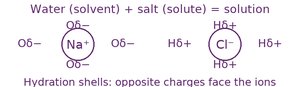
Solvent Properties: Water dissolves many ionic and polar substances, facilitating biological reactions and transport.
Hydrophilic vs. Hydrophobic: Hydrophilic substances interact with water; hydrophobic substances do not, influencing membrane and protein structure.
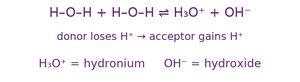
Dissociation of Water: Water can dissociate into hydronium (H3O+) and hydroxide (OH−) ions.
pH and Buffers
pH Scale: pH = −log10[H+]; lower pH is more acidic, higher pH is more basic. Pure water has pH 7.
Buffers: Mixtures of weak acids and bases that resist changes in pH. The bicarbonate buffer system maintains blood pH near 7.4.

Chapter 4: Carbon and the Molecular Diversity of Life
Carbon Skeletons and Functional Groups
Carbon’s four valence electrons allow it to form diverse molecules with various shapes and functional groups.
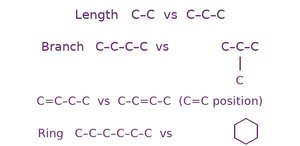
Carbon Skeletons: Can vary in length, branching, double bond position, and ring formation.
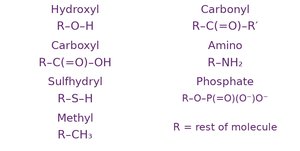
Functional Groups: Specific groups of atoms that confer characteristic chemical properties to organic molecules.
Chapter 5: The Structure and Function of Macromolecules
Macromolecule Formation: Dehydration and Hydrolysis
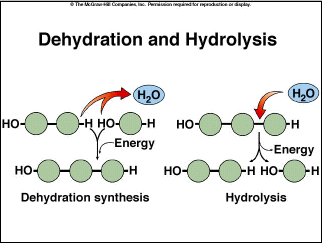
Macromolecules are polymers built from monomers by dehydration synthesis and broken down by hydrolysis.
Dehydration Synthesis: Joins monomers by removing water.
Hydrolysis: Breaks polymers into monomers by adding water.
Carbohydrates
Carbohydrates serve as fuel and structural materials. They include monosaccharides, disaccharides, and polysaccharides.
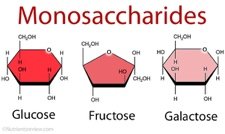
Monosaccharides: Simple sugars (e.g., glucose, fructose, galactose) with the formula (CH2O)n.
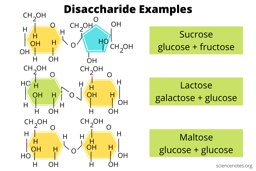
Disaccharides: Formed by dehydration of two monosaccharides (e.g., sucrose, lactose, maltose).
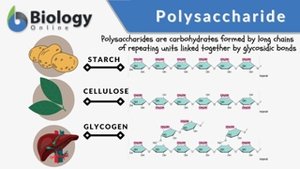
Polysaccharides: Long chains of monosaccharides; include starch (plant storage), glycogen (animal storage), cellulose (plant cell walls), and chitin (fungal walls, exoskeletons).
Lipids
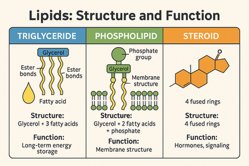
Lipids are hydrophobic molecules that include fats, phospholipids, and steroids. They are important for energy storage, membrane structure, and signaling.
Triglycerides: Glycerol + 3 fatty acids; store energy.
Phospholipids: Glycerol + 2 fatty acids + phosphate; form cell membranes.
Steroids: Four fused carbon rings; include cholesterol and hormones.
Proteins
Proteins are polymers of amino acids with diverse functions, including catalysis, transport, structure, and signaling.
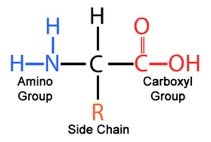
Amino Acid Structure: Central carbon bonded to an amino group, carboxyl group, hydrogen, and variable R group.
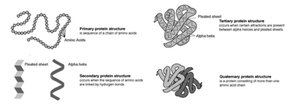
Protein Structure:
Primary: Sequence of amino acids.
Secondary: Alpha helices and beta sheets stabilized by hydrogen bonds.
Tertiary: Overall 3D shape stabilized by R group interactions.
Quaternary: Association of multiple polypeptides.
Nucleic Acids: DNA and RNA
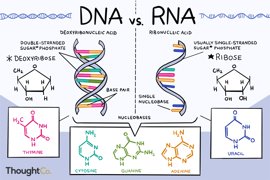
Nucleic acids store and transmit genetic information. DNA is double-stranded; RNA is usually single-stranded.
Nucleotides: Monomers with a phosphate group, five-carbon sugar, and nitrogenous base.
DNA: Deoxyribose sugar; bases A, T, C, G; double helix.
RNA: Ribose sugar; bases A, U, C, G; single-stranded, can fold into complex shapes.