 Indietro
Biogeography, Climate, and the Distribution of Terrestrial Biomes
Guida di studio - Note intelligenti
 Appunti personalizzati basati sui tuoi materiali, ampliati con definizioni chiave, esempi e contesto.
Patterns in the Distribution of Organisms Across Space
Climate Patterns and Their Influence
Climate is a primary determinant of the distribution of organisms across the planet. Key climate factors include seasonality, precipitation, temperature, ocean currents, and geological features. These factors interact to create distinct environmental conditions that influence where species can survive and reproduce.
Seasonality: Refers to the regular changes in climate throughout the year, affecting temperature and precipitation.
Precipitation: The amount and timing of rainfall or snowfall, which determines water availability.
Temperature: Influences metabolic rates and physiological tolerances of organisms.
Ocean Currents: Affect coastal climates and can transport nutrients and organisms.
Geological Features: Mountains, valleys, and other landforms can act as barriers or corridors for species movement.
These factors are used in analytical approaches to predict species occurrence in the future based on current data.
Biomes and Terrestrial Ecosystems
Definition and Classification of Biomes
Biomes are major groupings of plant and animal communities defined by their dominant vegetation type and a distinctive set of abiotic conditions. The most important abiotic factors are the average annual temperature and precipitation, as well as their annual variation.
Dominant Vegetation: Determines the structure and function of the biome.
Abiotic Conditions: Include temperature and precipitation averages and variability.
For example, tropical wet forests (rain forests) occur globally around the equator and are characterized by consistently warm temperatures and high, but seasonally variable, precipitation.
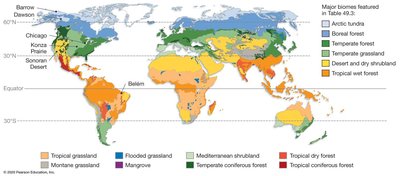
Major Biomes of Earth
Biomes are distributed globally based on climate patterns. Understanding the relationship between climate and biome distribution allows prediction of where different biomes might be found.
Temperate Grasslands: Found in continental interiors with moderate seasonality, temperature, and precipitation.
Boreal Forests: Located at higher latitudes (~60 degrees), characterized by cold and wet conditions.

Featured Terrestrial Biomes
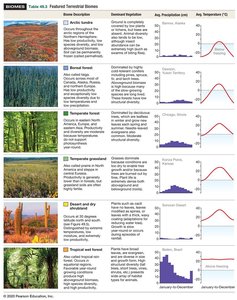
Biomes can be compared based on their dominant vegetation, average precipitation, and average temperature.
Biome | Dominant Vegetation | Avg Precipitation (mm) | Avg Temperature (°C) |
|---|---|---|---|
Arctic Tundra | Low shrubs, mosses | Low | Very cold |
Boreal Forest | Coniferous trees | Moderate | Cold |
Temperate Grassland | Grasses | Moderate | Moderate |
Desert | Sparse vegetation | Very low | Hot |
Tropical Wet Forest | Diverse trees | High | Warm |
Abiotic and Biotic Factors Influencing Species Distribution
Interactions Between Abiotic and Biotic Factors
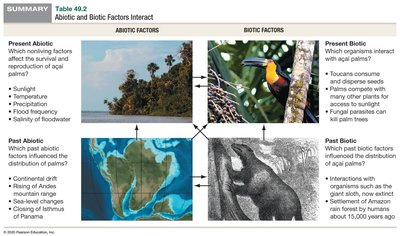
The distribution of species is determined by both abiotic (non-living) and biotic (living) factors, which can be present or historical. Abiotic factors include sunlight, temperature, and water availability, while biotic factors include interactions with other organisms such as pollinators, competitors, and predators.
Factor | Present | Past |
|---|---|---|
Abiotic | Sunlight, temperature, floodwater | Rising and falling continents, sea level changes |
Biotic | Pollinators, competitors | Extinct species, historical interactions |
Biogeographic Regions
Definition and Importance
Biogeographic regions are areas within which organisms have evolved in relative isolation over long periods, separated by geographic features such as oceans, deserts, and mountain ranges. These regions are recognized by unique assemblages of species and are important for understanding patterns of species richness and endemism.
Barriers: Oceans, deserts, mountain ranges
Isolation: Leads to unique evolutionary histories
Theory of Island Biogeography
MacArthur and Wilson's Model
The Theory of Island Biogeography explains the relationship between habitat size, distance from source, and species richness. The number of species on an island depends on immigration and extinction rates, which are influenced by island size and proximity to the mainland.
Immigration: Arrival of new species decreases as the number of species increases.
Extinction: Loss of species increases as the number of species increases.
Equilibrium: The predicted number of species is where immigration and extinction rates intersect.
Rates of immigration and extinction depend on:
Island Size: Larger islands support more species and have lower extinction rates.
Distance from Source: Islands closer to the mainland have higher immigration rates and lower extinction rates.
Mathematically, the equilibrium number of species () can be represented as:
where is the immigration rate and is the extinction rate.
Biogeography: The Study of Species Distribution
Geographic Patterns in Species Richness
Biogeography is the study of how species and populations are distributed geographically and through geologic time. It considers both historical and current interactions between biology and geography, including habitat area, latitude, and connections between habitats.
Species Richness: The number of different species present in a region.
Habitat Area: Larger areas tend to support more species.
Habitat Connections: Corridors and barriers affect migration and gene flow.
Understanding biogeography is essential for conservation and predicting the effects of environmental change on biodiversity.
