 Indietro
BIOL& 211 Majors Cellular Syllabus and Course Structure Study Guide
Guida di studio - Note intelligenti
 Appunti personalizzati basati sui tuoi materiali, ampliati con definizioni chiave, esempi e contesto.
Course Overview
Introduction to Cellular Biology
This course, BIOL& 211 Majors Cellular, is designed for college students pursuing majors in biology and related fields. It covers fundamental principles of cellular biology, including the chemical composition of living systems, cellular structure and function, genetics, molecular biology, and biotechnology. The course is a prerequisite for advanced biology courses and emphasizes both theoretical understanding and practical laboratory skills.

Course Structure and Schedule
Weekly Topics and Laboratory Activities
The course is organized into weekly modules, each focusing on a specific aspect of cellular biology. Students are expected to complete reading assignments, attend lectures (both in-person and virtual), and participate in laboratory sessions. The schedule ensures comprehensive coverage of key topics in general biology.
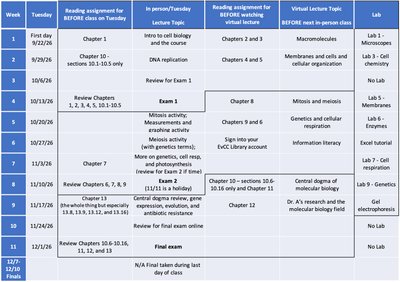
Week 1: Introduction to cell biology and course overview; Lab: Microscopes
Week 2: DNA replication; Lab: No lab
Week 3: Macromolecules; Membranes and cellular organization; Lab: Membranes and cellular organization
Week 4: Mitosis and meiosis; Genetics and cellular organization; Lab: Genetics and cellular organization
Week 5: Genetics; Information literacy; Lab: Excel tutorial
Week 6: Central dogma of molecular biology; Lab: Genetics
Week 7: Biotechnology, viruses, cancer; Lab: Gel electrophoresis
Week 8: Evolutionary basis of biology; Lab: No lab
Week 9-11: Review and final exam preparation; Lab: No lab
Required Materials
Textbook and Online Resources
The primary textbook for the course is Campbell Biology: Concepts & Connections, 10th Edition by Pearson. Students must purchase access to Mastering Biology, which provides online homework and study resources. The textbook covers all major topics listed in the course schedule and aligns with the learning objectives.
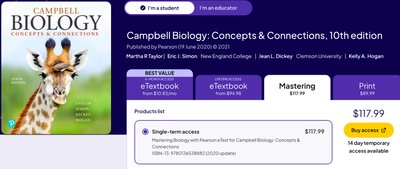
ISBN: 9780136538882
Publisher: Pearson
Edition: 10th
Mastering Biology Access: Required for homework and online assignments
Student Learning Objectives
Core Competencies and Outcomes
By the end of the course, students will be able to:
Observe, measure, record, and analyze data using scientific instrumentation and methods.
Apply course concepts in laboratory settings and report results in standard scientific format.
Describe the chemical composition of living systems and recognize the four types of macromolecules in cells.
Discuss enzymes and their structural and functional properties.
Explain energy exchange and utilization, including aerobic respiration and photosynthesis.
Use basic principles of genetics to solve genetics problems.
Describe DNA replication, transcription, translation, and prokaryotic gene regulation.
List the phases of mitosis and meiosis and describe major events in each phase.
Describe cell parts and their functions, as well as the structure and function of biological membranes.
Discuss applications of biotechnology, molecular biology, viruses, and cancer.
Describe the evolutionary basis of biology.
Assessment and Grading
Evaluation Methods
Student performance is assessed through lecture exams, laboratory work, attendance and participation, and homework assignments completed via Mastering Biology. The grading scale is as follows:
Letter Grade | Standard | % of Points | GPA |
|---|---|---|---|
A | High degree of excellence | 93-100 | 4.0 |
A- | 90-92.9 | 3.7 | |
B+ | Better than average achievement | 87-89.9 | 3.3 |
B | 83-86.9 | 3.0 | |
B- | 80-82.9 | 2.7 | |
C+ | Average achievement | 77-79.9 | 2.3 |
C | Minimum grade to move on | 73-76.9 | 2.0 |
C- | 70-72.9 | 1.7 | |
D+ | Low standard of achievement | 67-69.9 | 1.3 |
D | 65-66.9 | 1.0 | |
F | Failure | 0-64.9 | 0.0 |
Academic Integrity and Course Policies
Expectations and Support
Students are expected to submit their own work and avoid plagiarism. Academic integrity is strictly enforced, and violations may result in disciplinary action. The course also provides support for students facing academic, emotional, or personal challenges, and accommodations are available for those with disabilities.
Attendance: Required; more than one absence may result in automatic failure.
Late Work: Accepted only at instructor's discretion.
Support Services: Counseling, accessibility, and basic needs assistance are available.
Summary of Major Biology Topics Covered
Alignment with General Biology Curriculum
The syllabus and schedule indicate coverage of the following major topics, which align with the General Biology college course:
Exploring Life and the Scientific Method
The Chemical Basis of Life
The Molecules of Cells
A Tour of the Cell
The Working Cell
How Cells Harvest Chemical Energy
Photosynthesis
The Cellular Basis of Reproduction and Inheritance
Patterns of Inheritance
Molecular Biology of the Gene
Gene Regulation
DNA Technology and Genomics
Evolutionary Biology
Example: Students will learn about the structure and function of macromolecules, the phases of mitosis and meiosis, and the mechanisms of DNA replication and gene expression, all of which are foundational concepts in cellular and molecular biology.
Additional info: The course also emphasizes laboratory skills, scientific communication, and critical thinking, preparing students for advanced study in biology and related fields.
