 Indietro
Biological Macromolecules and Carbohydrates: Structure, Function, and Diversity
Guida di studio - Note intelligenti
 Appunti personalizzati basati sui tuoi materiali, ampliati con definizioni chiave, esempi e contesto.
Biological Macromolecules and Lipids
Introduction to Biological Macromolecules
Biological macromolecules are large, complex molecules essential for life. They are primarily built upon carbon skeletons, which allow for a vast diversity of molecular structures and functions. The four major classes of biological macromolecules are carbohydrates, lipids, proteins, and nucleic acids. The unique properties of these molecules arise from the specific arrangement of their atoms.
Organic chemistry is the study of carbon-containing compounds.
Carbon's ability to form four covalent bonds leads to a variety of molecular shapes and sizes.
Abiotic synthesis of organic molecules is hypothesized to have played a role in the origin of life.
Macromolecules: Polymers and Monomers
Most biological macromolecules (except lipids) are polymers, long chains made from repeating units called monomers. The diversity of life is reflected in the variety of macromolecules constructed from a relatively small set of monomers.
Polymer: A long molecule consisting of many similar or identical building blocks (monomers) linked by covalent bonds.
Monomer: The subunit that serves as the building block of a polymer.
Carbohydrates, proteins, and nucleic acids are polymers; lipids are not.
Synthesis and Breakdown of Polymers
Polymers are assembled and disassembled by specific chemical reactions, often catalyzed by enzymes.
Dehydration reaction: Two monomers are covalently bonded with the loss of a water molecule, forming a polymer.
Hydrolysis: Polymers are broken down into monomers by the addition of a water molecule, reversing the dehydration reaction.
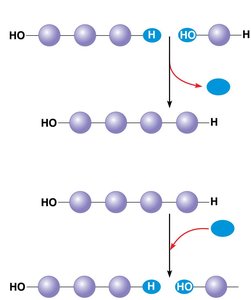
Diversity of Polymers
Cells contain thousands of different macromolecules, which vary among cells, species, and higher taxa. The diversity of polymers is analogous to the diversity of words formed from a limited alphabet.
Biological polymers are constructed from about 40–50 common monomers.
The sequence and arrangement of monomers determine the structure and function of each macromolecule.
Isomers and Functional Groups
Isomers
Isomers are compounds with the same molecular formula but different structures and properties. The three main types are:
Structural isomers: Differ in the covalent arrangement of atoms.
Cis-trans (geometric) isomers: Have the same covalent bonds but differ in spatial arrangement around a double bond.
Enantiomers: Mirror images of each other, differing in spatial arrangement around an asymmetric carbon.
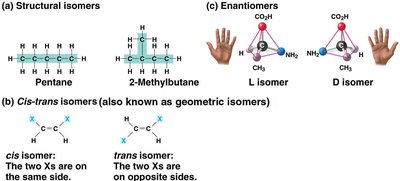
Functional Groups
Functional groups are specific groups of atoms within molecules that are responsible for the characteristic chemical reactions of those molecules. The number and arrangement of functional groups give each molecule its unique properties.
Estradiol and testosterone are both steroids with a common carbon skeleton but differ in the functional groups attached, resulting in different biological activities.
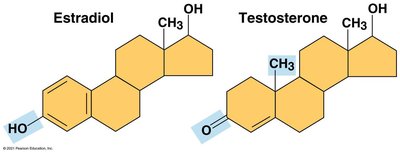
Carbohydrates
Overview of Carbohydrates
Carbohydrates are organic molecules that serve as fuel and building material. They include sugars and polymers of sugars. The simplest carbohydrates are monosaccharides (simple sugars), while carbohydrate macromolecules are polysaccharides (polymers of sugars).
General formula for monosaccharides: (CH2O)n
Monosaccharides are classified by the location of their carbonyl group (aldose or ketose) and the number of carbons in the skeleton.
Classification of Monosaccharides
Monosaccharides can be classified based on the position of the carbonyl group and the length of the carbon chain.
Type | Example |
|---|---|
Aldose (Aldehyde sugar) | Glucose, Glyceraldehyde, Ribose |
Ketose (Ketone sugar) | Fructose, Dihydroxyacetone, Ribulose |
Triose (3C) | Glyceraldehyde, Dihydroxyacetone |
Pentose (5C) | Ribose, Ribulose |
Hexose (6C) | Glucose, Galactose, Fructose |
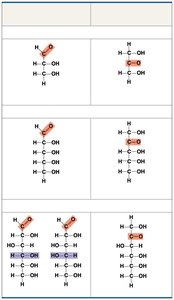
Stereoisomers of Glucose
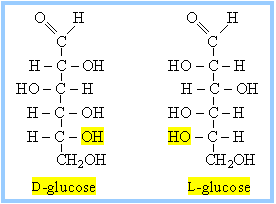
Glucose exists as two enantiomers: D-glucose and L-glucose, which are mirror images of each other. In biological systems, D-glucose is the predominant form.
Ring Formation of Monosaccharides
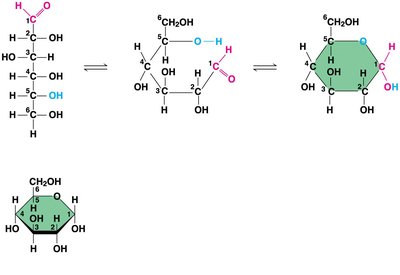
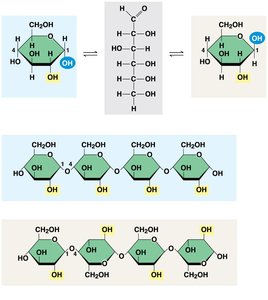
In aqueous solutions, many monosaccharides form ring structures, which are more stable than linear forms. This is especially true for five- and six-carbon sugars.
Disaccharides and Glycosidic Linkages
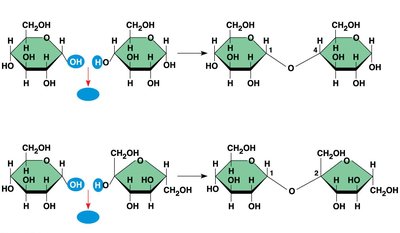
A disaccharide is formed when two monosaccharides are joined by a dehydration reaction, creating a covalent bond known as a glycosidic linkage. Common disaccharides include maltose (glucose + glucose) and sucrose (glucose + fructose).
Polysaccharides: Structure and Function
Polysaccharides are large polymers of sugars with storage or structural roles. Their properties depend on the types of monomers and the positions of glycosidic linkages.
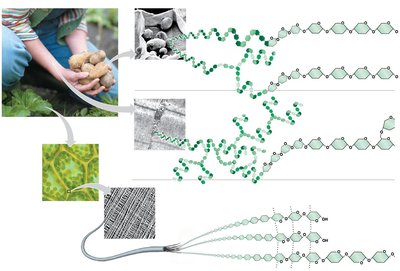
Storage polysaccharides: Starch (plants) and glycogen (animals) store energy.
Structural polysaccharides: Cellulose (plants) and chitin (arthropods, fungi) provide structural support.
Storage Polysaccharides
Starch: A plant storage polysaccharide composed of glucose monomers. Stored in plastids such as chloroplasts. Exists as amylose (unbranched) and amylopectin (branched).
Glycogen: An animal storage polysaccharide, highly branched, stored in liver and muscle cells.
Structural Polysaccharides
Cellulose: A major component of plant cell walls. Composed of β-glucose monomers linked by β-1,4 glycosidic bonds, forming straight, unbranched chains that hydrogen bond to form strong fibers.
Enzymes that digest starch (α-linkages) cannot digest cellulose (β-linkages), making cellulose an insoluble fiber in the human diet.
Some microbes can digest cellulose, enabling herbivores to utilize it via symbiotic relationships.
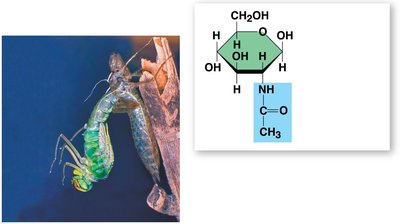
Chitin: A structural polysaccharide found in the exoskeleton of arthropods and the cell walls of fungi. Composed of modified glucose monomers (N-acetylglucosamine).
Additional info: The notes above expand on the provided lecture content with definitions, examples, and academic context to ensure a comprehensive, self-contained study guide for General Biology students.
