 Indietro
Biological Macromolecules and Cell Structure: Study Notes for General Biology
Guida di studio - Note intelligenti
 Appunti personalizzati basati sui tuoi materiali, ampliati con definizioni chiave, esempi e contesto.
Chapter 5: The Structure and Function of Large Biological Molecules
Polymers and Monomers
Biological macromolecules are often polymers, which are long chains made from repeating monomer units. The formation and breakdown of these polymers are central to cellular function.
Polymer: A molecule consisting of many similar or identical monomers linked by covalent bonds.
Dehydration Reaction: Joins monomers by removing a water molecule, forming a covalent bond. Essential for polymerization.
Hydrolysis: Breaks covalent bonds between monomers by adding water, disassembling polymers into monomers.
Carbohydrates
Carbohydrates are organic compounds made of carbon, hydrogen, and oxygen. They serve as energy sources and structural materials.
Monosaccharides: Single sugar units (e.g., glucose, fructose, galactose). Immediate energy and building blocks.
Disaccharides: Two monosaccharides linked by a glycosidic bond (e.g., sucrose, lactose, maltose). Transportable energy.
Polysaccharides: Many monosaccharides linked (e.g., starch, glycogen, cellulose). Energy storage and structural support.
Glycosidic Linkage: Covalent bond between monosaccharides formed by dehydration reaction.
Lipids
Lipids are hydrophobic molecules including fats, phospholipids, and steroids. They are essential for energy storage, membrane structure, and signaling.
Triacylglycerol (Triglyceride): Glycerol + 3 fatty acids. Main energy storage lipid.
Phospholipid: Glycerol + 2 fatty acids + phosphate group. Key component of cell membranes.
Steroid: Four fused carbon rings (e.g., cholesterol, hormones). Membrane integrity and hormone synthesis.
Ester Linkage: Bond between glycerol and fatty acids in fats.
Structure of Phospholipids
Phospholipids have a hydrophilic head and two hydrophobic fatty acid tails, one of which may be unsaturated (bent) and one saturated (straight). This amphipathic nature is crucial for membrane formation.
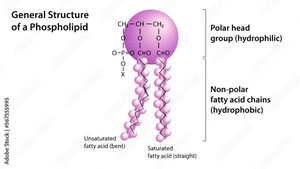
Saturated vs. Unsaturated Fatty Acids
Saturated: All single C–C bonds, straight chains, tightly packed, solid at room temperature.
Unsaturated: One or more C=C double bonds, bent chains, loosely packed, liquid at room temperature.
Proteins
Proteins are polymers of amino acids, folded into specific three-dimensional structures for diverse functions.
Polypeptide: Single chain of amino acids linked by peptide bonds.
Protein: One or more polypeptides folded into a functional shape.
Amino Acid: Monomer unit with amino group, carboxyl group, hydrogen, and variable R group.
Peptide Bond: Covalent bond between amino acids formed by dehydration reaction.
Protein Structure Levels
Primary: Linear sequence of amino acids.
Secondary: Local folding (α-helix, β-sheet) stabilized by hydrogen bonds.
Tertiary: Overall 3D shape from R-group interactions.
Quaternary: Assembly of multiple polypeptide chains.
Nucleic Acids
Nucleic acids (DNA and RNA) are polymers of nucleotides, storing and transmitting genetic information.
Nucleotide: Monomer with phosphate group, pentose sugar (ribose or deoxyribose), and nitrogenous base (A, G, C, T/U).
Phosphodiester Linkage: Covalent bond connecting nucleotides in DNA/RNA.
DNA: Double-stranded, long-term genetic blueprint.
RNA: Single-stranded, involved in protein synthesis and gene expression.
Chapter 6: A Tour of the Cell
Cell Organelles and Their Functions
Nucleus: Stores and protects DNA, regulates gene expression, organizes chromosomes, produces ribosomal components, controls transport.
Nuclear Envelope: Protects nucleus, regulates transport, provides structural support, connects to cytoskeleton, role in cell division.
Nucleolus: Site of ribosome biogenesis, rRNA synthesis and processing, cell cycle regulation.
Ribosome: Synthesizes proteins, quality control, co-translational folding, stress response.
Endoplasmic Reticulum (ER): Rough ER synthesizes and modifies proteins; Smooth ER synthesizes lipids, detoxifies, stores calcium.
Vesicle: Transports, stores, digests, detoxifies, removes waste, communicates, supports metabolism.
Golgi Apparatus: Modifies, sorts, packages proteins and lipids, forms lysosomes, prepares for secretion.
Lysosome: Digests macromolecules, recycles components, defends cell, supports homeostasis.
Vacuole: Stores substances, disposes waste, maintains turgor, regulates pH, aids digestion, osmoregulation, supports growth.
Mitochondria: Produces ATP, stores calcium, generates heat, regulates growth and death, integrates metabolism, biosynthesis, signaling.
Chloroplast: Performs photosynthesis, supports synthesis, defense, signaling.
Peroxisome: Oxidative reactions, fatty acid breakdown, detoxification, lipid biosynthesis.
Cytoskeleton: Maintains shape, supports movement, transports, divides, organizes organelles, signals.
Endomembrane System
The endomembrane system is a network of organelles that synthesize, modify, package, and transport proteins and lipids.
Nuclear envelope
Endoplasmic reticulum (rough and smooth)
Golgi apparatus
Lysosomes
Endosomes
Vesicles
Vacuoles
Plasma membrane
Cytoskeletal Elements
Microfilaments: Actin filaments for movement and shape.
Intermediate Filaments: Rope-like, stable structures for mechanical support.
Microtubules: Hollow tubules for transport, organization, division.
Cilia and Flagella
The ultrastructure of cilia and flagella enables motility and sensory functions through microtubule arrangement and motor proteins.
Plant Cell Wall
Plant cell walls have multiple layers (middle lamella, primary, secondary) composed of cellulose, hemicellulose, pectin, lignin, and glycoproteins, providing structural support and communication.
Extracellular Matrix (ECM) in Animal Cells
The ECM is a network of fibrous proteins (collagen, elastin, fibronectin, laminins) and proteoglycans, providing structural support, adhesion, signaling, and tissue organization.
Intercellular Junctions
Tight Junctions: Impermeable seals between cells.
Gap Junctions: Channels for direct communication.
Adherens Junctions: Mechanical stability via actin linkage.
Desmosomes: Strong anchoring via intermediate filaments.
Plasmodesmata (plants): Channels for communication and transport.
Chapter 7: Membrane Structure and Function
Fluid-Mosaic Model of Membrane Structure
The fluid-mosaic model describes membranes as flexible, dynamic bilayers of lipids, proteins, and carbohydrates, with lateral movement and diverse arrangement.
Phospholipids: Form bilayer, hydrophilic heads outward, hydrophobic tails inward.
Proteins: Integral and peripheral, for transport, signaling, structure.
Glycolipids/Glycoproteins: Carbohydrate chains for recognition and adhesion.
Cholesterol: Regulates fluidity and stability.
Amphipathic Nature and Membrane Formation
Amphipathic molecules (phospholipids) self-assemble into bilayers in water, with hydrophilic heads facing water and hydrophobic tails hidden, forming a stable, semi-permeable membrane.
Fatty Acids and Membrane Fluidity
Saturated fatty acids: Tight packing, rigid membranes.
Unsaturated fatty acids: Kinks, loose packing, fluid membranes.
Cholesterol: Fluidity buffer, prevents extremes.
Integral Membrane Proteins
Integral proteins have hydrophobic segments embedded in the bilayer and hydrophilic domains exposed, essential for transport and signaling.
Glycolipids and Glycoproteins
Glycoproteins are proteins with carbohydrate chains; glycolipids are lipids with carbohydrate chains. Both are on the extracellular surface, forming the glycocalyx for recognition and adhesion.
Extracellular Matrix (ECM) Attachment
The ECM outside the plasma membrane is anchored by integrins, providing structural support, adhesion, signaling, and protection.
Membrane Synthesis
New membrane sections are synthesized in the ER, processed in the Golgi, and delivered to the plasma membrane by vesicular transport, with continuous recycling and turnover.
Functions of the Plasma Membrane
Protective barrier
Selective transport
Communication and signal reception
Cell recognition and adhesion
Structural support
Transport mechanisms (passive, active, bulk)
Diffusion and Osmosis
Diffusion: Net movement from high to low concentration, passive.
Facilitated Diffusion: Passive movement via transport proteins.
Osmosis: Movement of water across a semipermeable membrane.
Tonicity and Cell Response
Hypertonic: Water leaves cell; animal cells shrink (crenation), plant cells plasmolyze.
Hypotonic: Water enters cell; animal cells burst (lysis), plant cells become turgid.
Isotonic: No net water movement; cells stable.
Active Transport
Active transport moves substances against concentration gradients, requiring energy (ATP).
Bulk Transport: Exocytosis and Endocytosis
Exocytosis: Golgi vesicle fuses with membrane, releases contents outside.
Endocytosis: Cell takes in materials via vesicles.
Phagocytosis: Engulfs large particles.
Pinocytosis: Takes in fluid and solutes.
Receptor-mediated endocytosis: Specific uptake via receptors.
Solution Type | Animal Cell Outcome | Plant Cell Outcome |
|---|---|---|
Hypotonic | Lysis (burst) | Turgid (healthy) |
Hypertonic | Crenation (shrink) | Plasmolysis |
Isotonic | Normal | Flaccid |
