 Indietro
Biological Macromolecules: Proteins – Structure and Function
Guida di studio - Note intelligenti
 Appunti personalizzati basati sui tuoi materiali, ampliati con definizioni chiave, esempi e contesto.
Biological Macromolecules
Overview of Biological Macromolecules
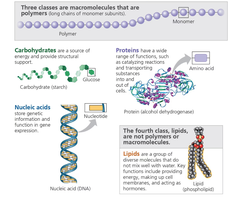
Biological macromolecules are large, complex molecules essential for life. There are four major classes: carbohydrates, proteins, nucleic acids, and lipids. Three of these classes—carbohydrates, proteins, and nucleic acids—are polymers, meaning they are composed of long chains of monomer subunits. Lipids, while vital, are not true polymers.
Polymer Formation and Breakdown
Polymers are synthesized and degraded by specific chemical reactions:
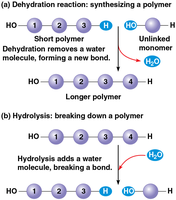
Dehydration Synthesis: Monomers are joined together by covalent bonds through the removal of a water molecule.
Hydrolysis: Polymers are broken down into monomers by the addition of a water molecule, breaking the covalent bond.
Proteins
Structure and Function of Proteins
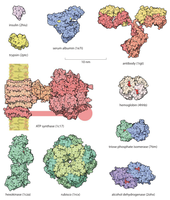
Proteins are the most structurally and functionally diverse macromolecules in living organisms. They perform a wide range of functions, including catalysis, transport, structural support, signaling, defense, movement, and storage.
Type | Examples | Functions |
|---|---|---|
Digestive Enzymes | Amylase, lipase, pepsin, trypsin | Help in food by catabolizing nutrients into monomeric units |
Transport | Hemoglobin, albumin | Carry substances in the blood or lymph throughout the body |
Structural | Actin, tubulin, keratin | Construct different structures, like the cytoskeleton |
Hormones | Insulin, thyroxine | Coordinate different body systems' activity |
Defense | Immunoglobulins | Protect the body from foreign pathogens |
Contractile | Actin, myosin | Effect muscle contraction |
Storage | Legume storage proteins, egg white (albumin) | Provide nourishment in early embryo development and the seedling |
Protein Building Blocks: Amino Acids
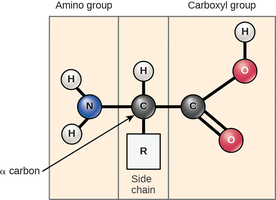
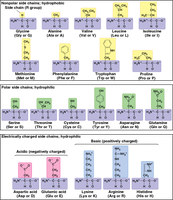
The monomers of proteins are amino acids. Each amino acid contains a central (alpha) carbon atom bonded to an amino group, a carboxyl group, a hydrogen atom, and a variable side chain (R group) that determines its properties.
Classes of Amino Acids
Amino acids are classified based on the properties of their R groups:
Nonpolar (hydrophobic)
Polar (hydrophilic)
Electrically charged (acidic or basic)
Building Proteins: Peptide Bonds
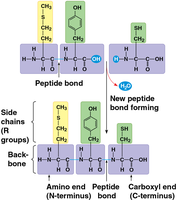
Proteins are formed by linking amino acids together via peptide bonds in a dehydration synthesis reaction. The resulting chain is called a polypeptide. Once folded into a functional shape, it is referred to as a protein.
Levels of Protein Structure
Primary Structure
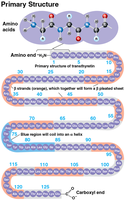
The primary structure of a protein is the unique sequence of amino acids in its polypeptide chain. This sequence determines all higher levels of structure and ultimately the protein's function.
Secondary Structure
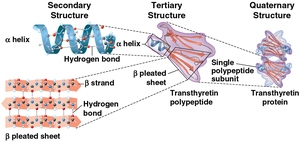
The secondary structure is formed by hydrogen bonds between the backbone atoms (carbonyl and amino groups) of the polypeptide. Common secondary structures include the alpha helix and beta pleated sheet.
Tertiary Structure
The tertiary structure is the overall three-dimensional shape of a single polypeptide chain, stabilized by interactions between R groups, including hydrogen bonds, ionic bonds, hydrophobic interactions, and disulfide bridges.
Quaternary Structure
The quaternary structure exists in proteins with more than one polypeptide chain (subunit). The arrangement and interactions of these subunits form the functional protein complex.
Protein Folding and Denaturation
Protein folding is driven by the amino acid sequence and stabilized by noncovalent interactions. The environment (pH, salt concentration, temperature) can affect folding. Extreme conditions can cause denaturation, where the protein loses its functional shape. Some proteins require chaperone proteins to fold correctly.
Summary
Proteins are polymers of amino acids, joined by peptide bonds.
They have four levels of structure: primary, secondary, tertiary, and quaternary.
Their function depends on their three-dimensional shape, which is determined by their amino acid sequence and environmental conditions.
