 Indietro
Biological Molecules: Structure, Function, and Diversity
Guida di studio - Note intelligenti
 Appunti personalizzati basati sui tuoi materiali, ampliati con definizioni chiave, esempi e contesto.
Chapter 3 – Biological Molecules
Introduction
Biological molecules are essential to life, forming the structure and function of all living organisms. This chapter explores the chemistry of carbon, the synthesis and breakdown of macromolecules, and the four major classes of biological molecules: carbohydrates, proteins, nucleic acids, and lipids.
Why Is Carbon So Important in Biological Molecules?
Properties of Carbon
Organic molecules contain carbon and usually hydrogen and oxygen. They are synthesized by living organisms and are more complex than inorganic molecules.
Inorganic molecules generally lack carbon and are simpler in structure.
Biological molecules are all molecules produced by living things, and nearly all are organic.
Carbon's four outer shell electrons allow it to form up to four covalent bonds, enabling a diversity of stable and complex molecules.
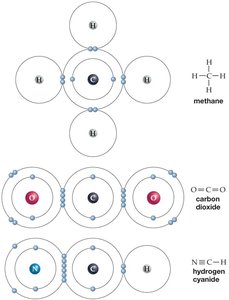
Bonding Patterns of Key Elements
Carbon, hydrogen, oxygen, and nitrogen are the most common elements in biological molecules.
Each element forms a characteristic number of bonds, contributing to molecular diversity.
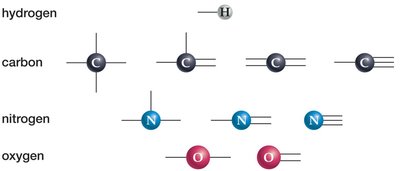
Functional Groups
Functional groups are specific groups of atoms attached to the carbon backbone, influencing the chemical properties and reactivity of molecules.
Common functional groups include hydroxyl, carbonyl, carboxyl, amino, sulfhydryl, phosphate, and methyl groups.
Group | Structure | Properties | Found In |
|---|---|---|---|
Hydroxyl | –OH | Polar; forms hydrogen bonds | Sugars, nucleic acids, alcohols |
Carbonyl | –C=O | Polar; increases solubility | Sugars, proteins |
Carboxyl | –COOH | Polar, acidic | Amino acids, fatty acids |
Amino | –NH2 | Polar, basic | Amino acids, nucleic acids |
Sulfhydryl | –SH | Nonpolar; forms disulfide bonds | Proteins |
Phosphate | –PO4 | Polar, acidic | Nucleic acids, ATP |
Methyl | –CH3 | Nonpolar | Steroids, DNA |
How Are Large Biological Molecules Synthesized?
Monomers and Polymers
Large biological molecules are polymers, formed by joining smaller subunits called monomers.
Examples: Monosaccharides (carbohydrates), amino acids (proteins), nucleotides (nucleic acids).
Dehydration Synthesis and Hydrolysis
Dehydration synthesis joins monomers by removing a water molecule, forming a covalent bond.
Hydrolysis breaks polymers into monomers by adding water, important in digestion and cellular metabolism.


Four Principal Classes of Biological Molecules
Carbohydrates
Proteins
Nucleic acids
Lipids
Name | Subunit | Types | Examples | Function |
|---|---|---|---|---|
Carbohydrates | Monosaccharide | Monosaccharides, Disaccharides, Polysaccharides | Glucose, Sucrose, Starch, Cellulose | Energy storage, structural support |
Proteins | Amino acid | Peptides, Polypeptides | Insulin, Hemoglobin, Keratin | Enzymes, structure, transport |
Nucleic acids | Nucleotide | DNA, RNA | DNA, mRNA, tRNA | Genetic information, protein synthesis |
Lipids | Varied | Fats, Oils, Waxes, Phospholipids, Steroids | Triglycerides, Cholesterol | Energy storage, membranes, hormones |
What Are Carbohydrates?
Structure and Types
Composed of carbon, hydrogen, and oxygen in a 1:2:1 ratio (C:H:O).
Types: Monosaccharides (single sugars), Disaccharides (two sugars), Polysaccharides (many sugars).
General formula:
Monosaccharides
Simple sugars with three to seven carbon atoms.
Examples: Glucose (main energy source), fructose (plant energy storage), galactose (milk sugar), ribose and deoxyribose (nucleic acids).




Disaccharides
Formed by dehydration synthesis of two monosaccharides.
Examples: Sucrose (glucose + fructose), lactose (glucose + galactose), maltose (glucose + glucose).
Used for short-term energy storage in plants.

Polysaccharides
Long chains of monosaccharides; generally insoluble in water.
Examples:
Starch: Energy storage in plants; branched chains of glucose.
Glycogen: Energy storage in animals; highly branched glucose chains.
Cellulose: Structural support in plant cell walls; most abundant organic molecule.
Chitin: Structural support in arthropod exoskeletons and fungal cell walls; contains nitrogen groups.


What Are Proteins?
Structure and Function
Proteins are polymers of amino acids, joined by peptide bonds.
Functions include enzymes, structural support, movement, defense, storage, signaling, and catalysis.
Function | Example(s) |
|---|---|
Structural | Keratin, silk |
Movement | Actin, myosin |
Defense | Antibodies, venoms |
Storage | Albumin |
Signaling | Insulin |
Catalysis | Amylase |
Amino Acid Structure
Each amino acid has a central carbon, a hydrogen atom, an amino group (–NH2), a carboxyl group (–COOH), and a variable R group.
R groups determine the properties and function of each amino acid.
Protein Structure Levels
Primary structure: Sequence of amino acids.
Secondary structure: Hydrogen bonding forms alpha helices or beta sheets.
Tertiary structure: Overall 3D shape due to interactions among R groups.
Quaternary structure: Multiple polypeptide chains interact.
Protein function depends on its structure; denaturation disrupts function.
What Are Nucleotides and Nucleic Acids?
Nucleotide Structure and Function
Nucleotides consist of a five-carbon sugar (ribose or deoxyribose), a phosphate group, and a nitrogenous base (adenine, guanine, cytosine, thymine, or uracil).
Functions: Energy carriers (ATP), intracellular messengers, and as subunits of nucleic acids.
Nucleic Acids
DNA: Double helix of deoxyribose nucleotides; stores genetic information.
RNA: Single strand of ribose nucleotides; involved in protein synthesis.
What Are Lipids?
Structure and Types
Lipids are hydrophobic molecules, not true polymers, and are insoluble in water.
Major types: Fats, oils, waxes, phospholipids, steroids.
Fats, Oils, and Waxes
Composed of fatty acids and glycerol (triglycerides).
Fats: Solid at room temperature, saturated fatty acids (single bonds).
Oils: Liquid at room temperature, unsaturated fatty acids (double bonds).
Waxes: Highly saturated, water-repellent, structural roles in plants and animals.
Phospholipids
Contain two fatty acid tails (hydrophobic) and a phosphate-nitrogen head (hydrophilic).
Major component of cell membranes, forming bilayers.
Steroids
Composed of four fused carbon rings with various functional groups.
Examples: Cholesterol (membrane component), estrogen, testosterone (hormones).
Additional info: This summary integrates textbook content, figures, and tables to provide a comprehensive overview of biological molecules, their structure, synthesis, and function, suitable for college-level General Biology students.
