 Indietro
Biology 189 Unit 2 Study Guide: Macromolecules, Nucleic Acids, and Cells
Guida di studio - Note intelligenti
 Appunti personalizzati basati sui tuoi materiali, ampliati con definizioni chiave, esempi e contesto.
Q1. What are the 4 polymers (macromolecules) that all living things require? And what are the monomers (building blocks) that make up those polymers?
Background
Topic: Biological Macromolecules
This question tests your understanding of the four major classes of macromolecules essential for life, and the specific monomers that compose each type.
Key Terms:
Polymer: A large molecule made up of repeating subunits (monomers).
Monomer: The basic building block of a polymer.
Macromolecule: A very large molecule, typically formed by polymerization.
Step-by-Step Guidance
Recall the four main types of biological macromolecules found in all living organisms.
For each macromolecule, identify its specific monomer (building block).
Think about examples of each macromolecule and their monomers (e.g., proteins and amino acids).
Organize your answer by listing each macromolecule and its corresponding monomer.
Try solving on your own before revealing the answer!
Final Answer:
Carbohydrates: Monomer = monosaccharides (simple sugars)
Proteins: Monomer = amino acids
Nucleic acids: Monomer = nucleotides
Lipids: Monomer = fatty acids and glycerol (note: not always true polymers, but often grouped here)
These four macromolecules are essential for life, and each is built from its own specific type of monomer.
Q2. What are the biological roles of carbohydrates?
Background
Topic: Carbohydrates
This question is about the functions that carbohydrates serve in living organisms.
Key Terms:
Carbohydrate: Organic molecule made of carbon, hydrogen, and oxygen.
Biological role: The function or purpose in living systems.
Step-by-Step Guidance
Think about the main functions of carbohydrates in cells and organisms.
Consider both energy-related and structural roles.
Recall examples of carbohydrates and their specific functions (e.g., glucose for energy).
List at least two major roles that carbohydrates play in biology.
Try solving on your own before revealing the answer!
Final Answer:
Carbohydrates provide energy (e.g., glucose is used in cellular respiration).
Carbohydrates serve as structural components (e.g., cellulose in plant cell walls).
They can also be involved in cell recognition and signaling (e.g., glycoproteins).
Carbohydrates are versatile molecules with multiple roles in living systems.
Q3. Carbohydrates are composed of what 3 atoms mainly?
Background
Topic: Carbohydrate Chemistry
This question tests your knowledge of the elemental composition of carbohydrates.
Key Terms:
Atom: The basic unit of a chemical element.
Carbohydrate: Organic molecule with a specific ratio of elements.
Step-by-Step Guidance
Recall the general formula for carbohydrates (e.g., ).
Identify the three main elements present in this formula.
Think about the names of these elements and their chemical symbols.
Try solving on your own before revealing the answer!
Final Answer:
Carbohydrates are mainly composed of carbon (C), hydrogen (H), and oxygen (O).
The ratio of these atoms is typically 1:2:1 in simple carbohydrates.
Q4. What is a simple sugar called?
Background
Topic: Carbohydrate Classification
This question is about the terminology used for the simplest form of carbohydrates.
Key Terms:
Simple sugar: The most basic carbohydrate unit.
Monomer: Single molecule that can join with others to form polymers.
Step-by-Step Guidance
Recall the term used for a single sugar molecule.
Think about examples like glucose or fructose.
Identify the scientific name for this class of molecules.
Try solving on your own before revealing the answer!
Final Answer:
A simple sugar is called a monosaccharide.
Monosaccharides are the building blocks of carbohydrates.
Q5. What are the building blocks of carbohydrates?
Background
Topic: Carbohydrate Structure
This question tests your understanding of the monomers that make up carbohydrate polymers.
Key Terms:
Monomer: Basic unit of a polymer.
Carbohydrate: Organic molecule made of sugar units.
Step-by-Step Guidance
Recall the term for the simplest carbohydrate unit.
Think about how these units join to form larger carbohydrates.
List the name of the monomer for carbohydrates.
Try solving on your own before revealing the answer!
Final Answer:
The building blocks of carbohydrates are monosaccharides.
Monosaccharides join together to form disaccharides and polysaccharides.
Q6. If a simple sugar contains 2 carbons, what is it called? If it contains 3 sugars? 4? 5? 6? 7?
Background
Topic: Carbohydrate Nomenclature
This question is about the naming conventions for monosaccharides based on the number of carbon atoms.
Key Terms:
Monosaccharide: Simple sugar.
Nomenclature: Naming system.
Step-by-Step Guidance
Recall the prefixes used for the number of carbons (e.g., di-, tri-, tetra-, penta-, hexa-, hepta-).
Apply these prefixes to the word 'ose' to name each sugar.
List the names for sugars with 2, 3, 4, 5, 6, and 7 carbons.
Try solving on your own before revealing the answer!
Final Answer:
2 carbons: diose
3 carbons: triose
4 carbons: tetrose
5 carbons: pentose
6 carbons: hexose
7 carbons: heptose
These names are based on the number of carbon atoms in the monosaccharide.
Q7. What are some examples of simple sugars?
Background
Topic: Monosaccharides
This question asks for examples of monosaccharides found in nature.
Key Terms:
Monosaccharide: Simple sugar.
Example: Specific molecule.
Step-by-Step Guidance
Recall common monosaccharides used in metabolism.
Think about sugars found in fruits and other foods.
List at least two examples.
Try solving on your own before revealing the answer!
Final Answer:
Glucose
Fructose
Galactose
These are common monosaccharides found in many foods.
Q8. If 2 simple sugars link together, what is it called? What reaction linked them? What is the linkage called?
Background
Topic: Disaccharides and Chemical Bonds
This question tests your understanding of how monosaccharides join to form disaccharides, the type of reaction involved, and the name of the bond.
Key Terms:
Disaccharide: Two monosaccharides joined together.
Dehydration synthesis: Reaction that removes water to form a bond.
Glycosidic linkage: The bond formed between sugars.
Step-by-Step Guidance
Recall the term for a molecule made of two monosaccharides.
Identify the reaction that forms this bond (removal of water).
Name the specific bond formed between the sugars.
Try solving on your own before revealing the answer!
Final Answer:
Two simple sugars linked together form a disaccharide.
The reaction is called dehydration synthesis (or condensation reaction).
The bond is called a glycosidic linkage.
This process is fundamental in forming larger carbohydrate molecules.
Q9. What is it called when a few simple sugars are linked together? When many are linked together?
Background
Topic: Oligosaccharides and Polysaccharides
This question is about the terminology for carbohydrates with different numbers of sugar units.
Key Terms:
Oligosaccharide: A carbohydrate with a few (3–10) monosaccharide units.
Polysaccharide: A carbohydrate with many (hundreds or thousands) monosaccharide units.
Step-by-Step Guidance
Recall the prefixes for 'few' and 'many' in carbohydrate terminology.
Apply these terms to describe molecules with different numbers of sugar units.
List the names for each type.
Try solving on your own before revealing the answer!
Final Answer:
Few simple sugars linked together: oligosaccharide
Many simple sugars linked together: polysaccharide
These terms describe the size and complexity of carbohydrate molecules.
Q10. Give 3 examples of polysaccharides and where they occur?
Background
Topic: Polysaccharides
This question asks for examples of large carbohydrate molecules and their locations in nature.
Key Terms:
Polysaccharide: Large carbohydrate made of many monosaccharides.
Example: Specific molecule and its occurrence.
Step-by-Step Guidance
Recall common polysaccharides found in plants, animals, and fungi.
Think about their biological roles and where they are found.
List three examples and their locations.
Try solving on your own before revealing the answer!
Final Answer:
Starch: Found in plants, used for energy storage.
Glycogen: Found in animals, used for energy storage.
Cellulose: Found in plant cell walls, provides structural support.
These polysaccharides are essential for energy and structure in living organisms.
Q11. Can we digest cellulose? Why or why not?
Background
Topic: Carbohydrate Digestion
This question tests your understanding of human digestive capabilities regarding plant polysaccharides.
Key Terms:
Cellulose: Structural polysaccharide in plants.
Digest: Break down into absorbable units.
Step-by-Step Guidance
Recall the structure of cellulose and the type of bond it contains.
Think about the enzymes required to break down cellulose.
Consider whether humans have these enzymes.
Try solving on your own before revealing the answer!
Final Answer:
Humans cannot digest cellulose because we lack the enzyme cellulase needed to break its β-glycosidic bonds.
Cellulose passes through our digestive system as fiber.
Q12. Where would you find the following and what is the functional role of each? Glycogen, Starch, Cellulose, Chitin, Peptidoglycan
Background
Topic: Polysaccharide Functions
This question is about the location and function of various polysaccharides in living organisms.
Key Terms:
Glycogen: Animal energy storage.
Starch: Plant energy storage.
Cellulose: Plant structure.
Chitin: Fungal and arthropod structure.
Peptidoglycan: Bacterial cell wall.
Step-by-Step Guidance
Recall where each polysaccharide is found (animal, plant, fungus, bacteria).
Identify the main biological role of each.
List the location and function for each polysaccharide.
Try solving on your own before revealing the answer!
Final Answer:
Glycogen: Found in animals (liver and muscles); stores energy.
Starch: Found in plants; stores energy.
Cellulose: Found in plant cell walls; provides structural support.
Chitin: Found in fungal cell walls and arthropod exoskeletons; provides structure.
Peptidoglycan: Found in bacterial cell walls; provides structural support.
Each polysaccharide has a unique role in its respective organism.
Q13. Can you recognize a carbohydrate if you see a chemical structure? How would you recognize the structure of a carbohydrate?
Background
Topic: Carbohydrate Structure Recognition
This question tests your ability to identify carbohydrates based on their chemical structure.
Key Terms:
Chemical structure: Arrangement of atoms in a molecule.
Carbohydrate: Molecule with a specific ratio of C, H, and O.
Step-by-Step Guidance
Recall the general formula for carbohydrates ().
Look for ring structures or straight chains with multiple hydroxyl (–OH) groups.
Identify the presence of carbonyl groups (aldehyde or ketone).
Try solving on your own before revealing the answer!
Final Answer:
Carbohydrates typically have a ratio of 1:2:1 for C:H:O.
They often appear as ring structures or straight chains with many –OH groups.
Presence of a carbonyl group (aldehyde or ketone) is also a clue.
These features help distinguish carbohydrates from other biomolecules.
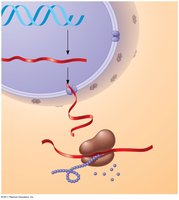
Q14. Describe transcription and translation.
Background
Topic: Central Dogma of Molecular Biology
This question is about the processes by which genetic information is transferred from DNA to RNA (transcription) and from RNA to protein (translation).
Key Terms and Concepts:
Transcription: The process of copying DNA into RNA.
Translation: The process of converting RNA into a protein.
Central Dogma: The flow of genetic information from DNA to RNA to protein.
Step-by-Step Guidance
Recall that transcription occurs in the nucleus (in eukaryotes) and involves making an RNA copy of a DNA sequence.
Understand that translation occurs in the cytoplasm, where ribosomes read the RNA sequence and assemble amino acids into a protein.
Think about the roles of mRNA, tRNA, and ribosomes in translation.
Visualize the sequence: DNA → RNA → Protein.
Try solving on your own before revealing the answer!
Final Answer:
Transcription: DNA is used as a template to synthesize messenger RNA (mRNA) in the nucleus.
Translation: mRNA is read by ribosomes in the cytoplasm, and the sequence is used to assemble a protein from amino acids.
This is the central dogma: genetic information flows from DNA to RNA to protein.
