 Indietro
Biology: The Study of Life – Chapter 1 Study Notes
Guida di studio - Note intelligenti
 Appunti personalizzati basati sui tuoi materiali, ampliati con definizioni chiave, esempi e contesto.
Biology: The Study of Life
Introduction to Biology
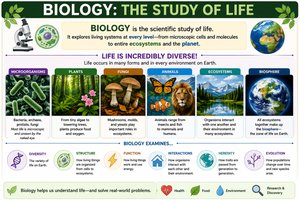
Biology is the scientific study of life, encompassing living systems at every level—from microscopic cells and molecules to entire ecosystems and the planet. It explores the diversity, structure, function, and interactions of living organisms, helping us understand life and solve real-world problems.
Diversity of Life
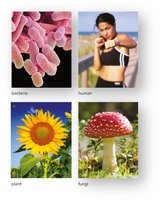
Life is incredibly diverse, ranging from bacteria and fungi to plants and animals. This diversity is observed in the variety of forms, functions, and adaptations that organisms exhibit in different environments.
Levels of Biological Organization
Organizational Hierarchy
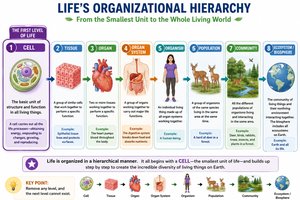
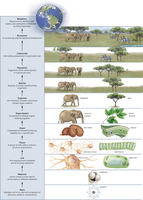
Life is organized in a hierarchical manner, starting from the smallest unit—the cell—and building up step by step to create the incredible diversity of living things on Earth. Each level represents a higher degree of complexity and integration.
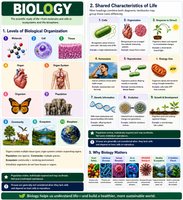
Cell: The basic unit of structure and function in all living things.
Tissue: Groups of similar cells performing a specific function.
Organ: Structures composed of different tissues working together.
Organ System: Groups of organs that perform major body functions.
Organism: An individual living being.
Population: A group of organisms of the same species in a given area.
Community: All populations of different species in a given area.
Ecosystem: The community plus the physical environment.
Biosphere: All ecosystems on Earth.
Characteristics of Life
Shared Features of Living Organisms
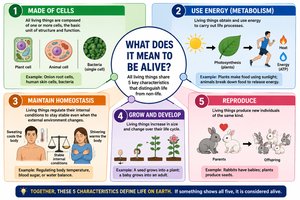
All living organisms share certain characteristics that distinguish them from nonliving things. These features define what it means to be alive.
Made of Cells: The smallest unit of life.
Use Energy (Metabolism): Acquire and use energy to carry out life processes.
Maintain Homeostasis: Regulate internal conditions to remain stable despite environmental changes.
Grow and Develop: Increase in size and complexity over time.
Reproduce: Produce new individuals, passing genetic information to offspring.
Respond to Environment: React to stimuli and adapt to changes.
Acquire and Use Information: DNA functions as the genetic material of life.
Change Over Time: Populations evolve, leading to improved survival.
Unicellular vs. Multicellular Organisms
Cellular Organization
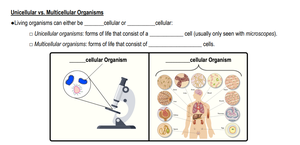
Living organisms can be unicellular (consisting of a single cell) or multicellular (composed of many cells). Unicellular organisms include bacteria and some protists, while multicellular organisms include plants, animals, and fungi.
Three Major Theories of Biology
Foundational Concepts
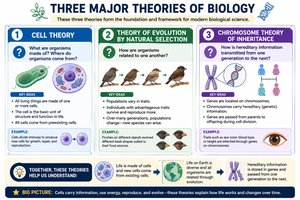
Three major theories form the foundation and framework for modern biological science:
Cell Theory: All living things are composed of cells; cells are the basic unit of life; new cells arise from preexisting cells.
Theory of Evolution by Natural Selection: Species are related by common ancestry and change over time through natural selection.
Chromosome Theory of Inheritance: Genes are located on chromosomes and are passed from one generation to the next.
Life's Organizational Hierarchy
Levels of Organization
From the smallest unit to the whole living world, life is organized in a hierarchical manner. This structure allows for increasing complexity and specialization at each level.
Why Biology Matters
Applications and Importance
Biology helps us understand life and build a healthier, more sustainable world. It is essential for medicine, environmental science, agriculture, and biotechnology.
Medicine: Understanding diseases, genetics, and treatments.
Ecology: Studying ecosystems and conservation.
Biotechnology: Developing new technologies and products.
Summary Table: Levels of Biological Organization
Level | Description | Example |
|---|---|---|
Cell | Basic unit of life | Neuron, muscle cell |
Tissue | Group of similar cells | Muscle tissue |
Organ | Structure with specific function | Heart, leaf |
Organ System | Group of organs | Circulatory system |
Organism | Individual living being | Human, tree |
Population | Group of same species | Elephants in savanna |
Community | All populations in area | Forest community |
Ecosystem | Community + environment | Rainforest ecosystem |
Biosphere | All ecosystems on Earth | Earth |
Key Terms and Definitions
Biology: The scientific study of life.
Cell: The smallest unit of life.
Homeostasis: Maintenance of internal stability.
Metabolism: All chemical reactions in an organism.
Evolution: Change in populations over time.
Natural Selection: Process by which traits that improve survival and reproduction become more common.
Chromosome: Structure carrying genetic information.
Gene: Segment of DNA that determines traits.
