 Indietro
Biomolecule Identification and Classification Study Guide
Guida di studio - Note intelligenti
 Appunti personalizzati basati sui tuoi materiali, ampliati con definizioni chiave, esempi e contesto.
Q1. Identify the biomolecule shown in image 1.
Background
Topic: Carbohydrates
This question tests your ability to recognize and classify monosaccharides based on their structural formula.
Key Terms:
Monosaccharide: The simplest form of carbohydrate, consisting of a single sugar molecule.
Aldose: A monosaccharide with an aldehyde group.
Hexose: A six-carbon sugar.
Step-by-Step Guidance
Examine the carbon skeleton and count the number of carbon atoms present.
Identify the functional groups attached to the carbon atoms (e.g., aldehyde, hydroxyl).
Determine if the molecule is an aldose or ketose based on the position of the carbonyl group.
Compare the structure to common monosaccharides such as glucose, galactose, or fructose.
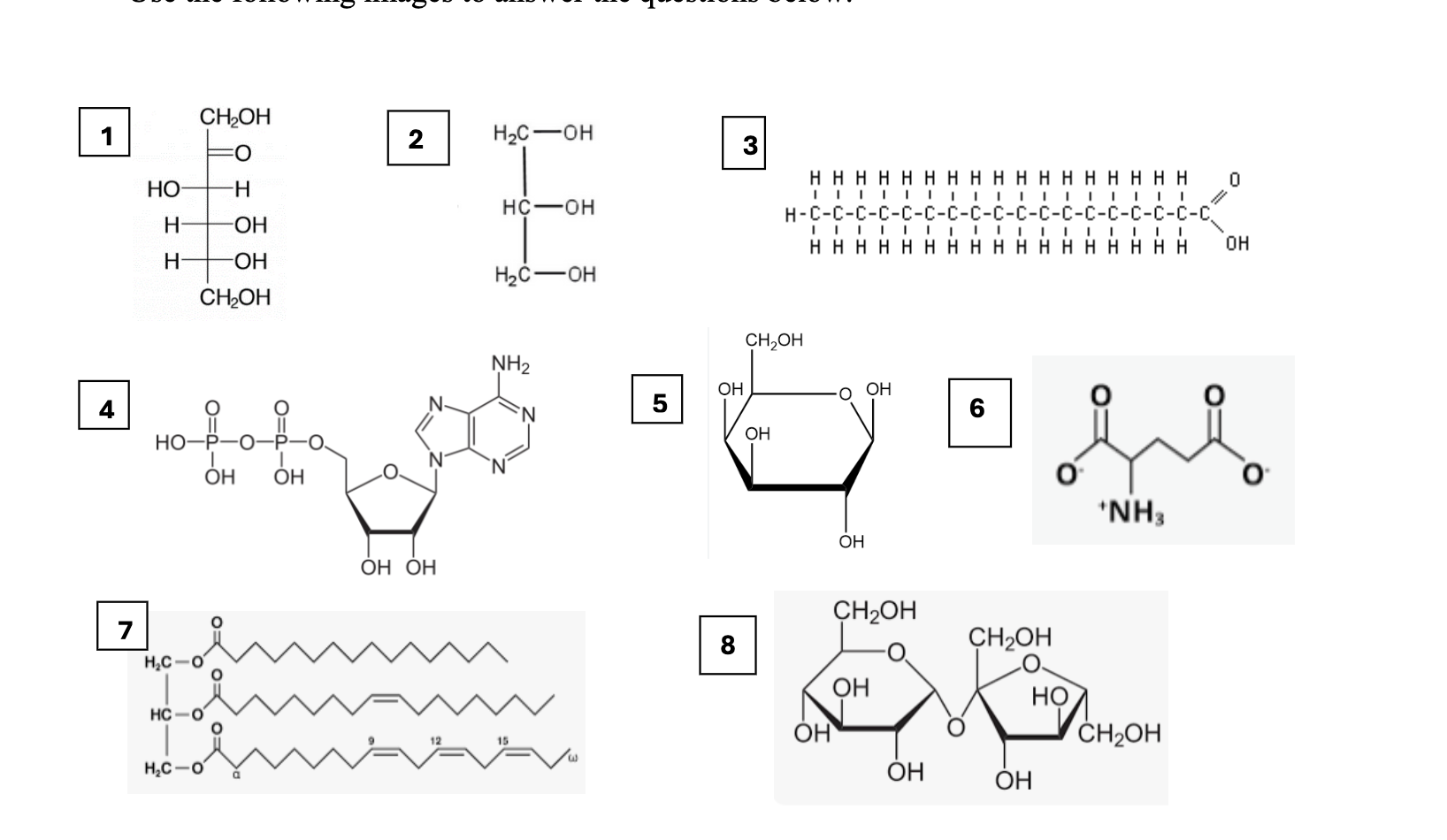
Try solving on your own before revealing the answer!
Final Answer: D-glucose
The molecule shown is D-glucose, a six-carbon aldose monosaccharide. It is a common sugar found in many biological systems.
Q2. Identify the biomolecule shown in image 2.
Background
Topic: Carbohydrates
This question tests your ability to recognize and classify monosaccharides, specifically those with three carbon atoms.
Key Terms:
Triose: A three-carbon sugar.
Aldose/Ketose: Classification based on the carbonyl group.
Step-by-Step Guidance
Count the number of carbon atoms in the molecule.
Identify the functional groups present (hydroxyl, carbonyl).
Determine if the molecule is an aldose or ketose.
Compare the structure to common trioses such as glyceraldehyde or dihydroxyacetone.
Try solving on your own before revealing the answer!
Final Answer: Glycerol
The molecule shown is glycerol, a three-carbon alcohol often found in lipids.
Q3. Identify the biomolecule shown in image 3.
Background
Topic: Lipids
This question tests your ability to recognize fatty acids based on their hydrocarbon chain and carboxyl group.
Key Terms:
Fatty acid: A long hydrocarbon chain with a terminal carboxyl group.
Saturated: No double bonds in the hydrocarbon chain.
Step-by-Step Guidance
Identify the length of the hydrocarbon chain.
Look for the presence of a carboxyl group at one end.
Determine if the chain is saturated (no double bonds) or unsaturated (contains double bonds).
Compare the structure to common fatty acids such as palmitic acid or stearic acid.
Try solving on your own before revealing the answer!
Final Answer: Stearic acid
The molecule shown is stearic acid, a saturated fatty acid with 18 carbon atoms.
Q4. Identify the biomolecule shown in image 4.
Background
Topic: Nucleotides
This question tests your ability to recognize nucleotide structures, which are the building blocks of nucleic acids.
Key Terms:
Nucleotide: Composed of a phosphate group, a pentose sugar, and a nitrogenous base.
ATP: Adenosine triphosphate, a common nucleotide.
Step-by-Step Guidance
Identify the three main components: phosphate group(s), pentose sugar, and nitrogenous base.
Count the number of phosphate groups attached.
Determine the type of nitrogenous base present (purine or pyrimidine).
Compare the structure to common nucleotides such as ATP, ADP, or AMP.
Try solving on your own before revealing the answer!
Final Answer: ATP (Adenosine triphosphate)
The molecule shown is ATP, which contains three phosphate groups, a ribose sugar, and an adenine base.
Q5. Identify the biomolecule shown in image 5.
Background
Topic: Carbohydrates
This question tests your ability to recognize cyclic forms of monosaccharides.
Key Terms:
Monosaccharide: Single sugar molecule.
Pyranose: Six-membered ring form of a sugar.
Step-by-Step Guidance
Identify the ring structure and count the number of carbon atoms.
Look for the presence of hydroxyl groups and their orientation.
Determine if the ring is a pyranose or furanose form.
Compare the structure to common cyclic monosaccharides such as glucose or fructose.
Try solving on your own before revealing the answer!
Final Answer: D-glucose (pyranose form)
The molecule shown is D-glucose in its pyranose (six-membered ring) form.
Q6. Identify the biomolecule shown in image 6.
Background
Topic: Amino acids
This question tests your ability to recognize amino acid structures, specifically those with acidic side chains.
Key Terms:
Amino acid: Building block of proteins.
Acidic side chain: Contains carboxyl groups.
Step-by-Step Guidance
Identify the amino group () and carboxyl groups ().
Count the number of carbon atoms in the side chain.
Determine if the side chain is acidic or basic.
Compare the structure to common amino acids such as glutamate or aspartate.
Try solving on your own before revealing the answer!
Final Answer: Glutamate (Glutamic acid)
The molecule shown is glutamate, an amino acid with an acidic side chain.
Q7. Identify the biomolecule shown in image 7.
Background
Topic: Lipids
This question tests your ability to recognize triglycerides, which are composed of glycerol and three fatty acids.
Key Terms:
Triglyceride: A lipid formed from glycerol and three fatty acids.
Ester bond: The linkage between glycerol and fatty acids.
Step-by-Step Guidance
Identify the glycerol backbone (three-carbon molecule).
Look for three fatty acid chains attached via ester bonds.
Determine if the fatty acids are saturated or unsaturated.
Compare the structure to common triglycerides found in biological systems.
Try solving on your own before revealing the answer!
Final Answer: Triglyceride
The molecule shown is a triglyceride, composed of glycerol and three fatty acids.
Q8. Identify the biomolecule shown in image 8.
Background
Topic: Carbohydrates
This question tests your ability to recognize disaccharides, which are composed of two monosaccharides linked by a glycosidic bond.
Key Terms:
Disaccharide: Two monosaccharides joined by a glycosidic bond.
Glycosidic bond: The linkage between sugar molecules.
Step-by-Step Guidance
Identify the two monosaccharide units present.
Look for the glycosidic bond connecting the sugars.
Determine the orientation and type of glycosidic bond (e.g., alpha or beta).
Compare the structure to common disaccharides such as sucrose, lactose, or maltose.
Try solving on your own before revealing the answer!
Final Answer: Maltose
The molecule shown is maltose, a disaccharide composed of two glucose units linked by an alpha-1,4-glycosidic bond.
