 Indietro
Biomolecules, Origins of Life, and Evolution: Study Guide
Guida di studio - Note intelligenti
 Appunti personalizzati basati sui tuoi materiali, ampliati con definizioni chiave, esempi e contesto.
Water Properties
Cohesion, Adhesion, and Evaporative Cooling
Water is essential for life due to its unique properties, which arise from its molecular structure and hydrogen bonding.
Cohesion: Water molecules stick to each other, enabling surface tension and transport in plants.
Adhesion: Water molecules stick to other substances, aiding capillary action.
Evaporative Cooling: As water evaporates, it removes heat, helping organisms regulate temperature.
Example: Transpiration in plants relies on cohesion and adhesion for water movement.
Carbon Structure and Functional Groups
Carbon Bonding and Functional Groups
Carbon's versatility allows it to form diverse molecules essential for life. Functional groups determine the chemical properties of organic molecules.
Hydroxyl (-OH): Found in alcohols; increases solubility.
Carboxyl (-COOH): Found in acids; acts as a proton donor.
Amine (-NH2): Found in amino acids; acts as a base.
Phosphate (-PO4): Found in nucleic acids and ATP; involved in energy transfer.
Macromolecules
Monomers, Polymers, and Functions
Biological macromolecules are polymers made from monomers, each with specific functions.
Carbohydrates: Monomer: monosaccharide; Function: energy storage, structure; Shape: ring or chain.
Lipids: Monomer: fatty acid; Function: energy storage, membranes; Shape: long hydrocarbon chains.
Proteins: Monomer: amino acid; Function: catalysis, structure, transport; Shape: folded polypeptide.
Nucleic Acids: Monomer: nucleotide; Function: information storage; Shape: double helix (DNA), single strand (RNA).
Dehydration Synthesis and Hydrolysis
Dehydration Synthesis: Joins monomers by removing water.
Hydrolysis: Breaks polymers by adding water.
Elemental Sources for Macromolecules
Organisms obtain elements (O, C, H, N, S, P) from their environment to build macromolecules.
Nitrogen: From soil for proteins.
Phosphorus: From minerals for nucleic acids.
Matching Monomer to Polymer
Macromolecule | Major Elements | Monomer | Function | Shape |
|---|---|---|---|---|
Carbohydrate | C, H, O | Monosaccharide | Energy, Structure | Ring/Chain |
Lipid | C, H, O | Fatty Acid | Energy, Membranes | Chain |
Protein | C, H, O, N, S | Amino Acid | Catalysis, Structure | Folded |
Nucleic Acid | C, H, O, N, P | Nucleotide | Information | Helix/Strand |
Glycosidic Linkage
Glycosidic bonds join monosaccharides to form polysaccharides like starch.
Example: Starch is formed from glucose via glycosidic linkages.
Cell Walls
Plant Cell Walls: Made of cellulose for rigidity.
Fungal Cell Walls: Made of chitin for protection.
Hydrocarbons and Lipids
Hydrocarbons: Nonpolar, energy-rich, form lipid tails.
Types of Lipids: Phospholipids (membranes), Steroids (hormones), Saturated (solid), Unsaturated (liquid).
Phospholipid Bilayer
Phospholipids form cell membranes due to their amphipathic nature.
Example: The phospholipid bilayer separates internal and external environments.
Amino Acids and Protein Structure
Peptide Bonds: Formed by dehydration synthesis between amino acids.
R-Groups: Determine protein folding and function.
Protein Structure Levels:
Primary: Sequence of amino acids (peptide bonds).
Secondary: Alpha helices and beta sheets (hydrogen bonds).
Tertiary: 3D folding (hydrophobic, ionic, disulfide bonds).
Quaternary: Multiple polypeptides (various bonds).
Denaturing: Loss of structure due to environmental changes.
Enzymes
Enzymes are proteins that catalyze biochemical reactions, lowering activation energy.
Example: Amylase breaks down starch.
Nucleic Acids
DNA and RNA Structure
DNA: Double helix, bases A=T (2 hydrogen bonds), C=G (3 hydrogen bonds).
RNA: Single strand, bases A, U, G, C.
Covalent Bonds: Form backbone (sugar-phosphate).
Transcription and Translation: DNA transcribed to RNA, translated to protein; mutations can alter protein function.
RNA Evolution: RNA likely evolved before DNA.
Antiparallel Strands: DNA strands run 5' to 3' and 3' to 5'.
ATP vs ADP
ATP: Stores energy in phosphate bonds.
ADP: Formed when ATP loses a phosphate, releasing energy.
Equation:
History of Life and Origins
The Great Oxygenation Event
Cyanobacteria produced oxygen, transforming Earth's atmosphere and enabling aerobic life.
Cause: Photosynthesis by cyanobacteria.
Effect: Rise in oxygen, extinction of anaerobic organisms, evolution of aerobic metabolism.
Origins of Life: Four Main Stages
Life originated through a series of chemical and biological processes.
Abiotic synthesis of small organic molecules.
Formation of macromolecules.
Formation of protocells (membranes).
Origin of self-replicating molecules.
Importance of Membranes
Membranes allowed compartmentalization, essential for cellular life.
Example: Protocells with lipid bilayers could maintain internal environments.
First Evidence of Life
Fossil evidence suggests life began over 3.5 billion years ago.
Example: Stromatolites are ancient microbial fossils.
Miller-Urey Experiment
Demonstrated that organic molecules could form under early Earth conditions (primordial soup).
Example: Amino acids formed in simulated early atmosphere.
Prokaryotes vs Eukaryotes
Prokaryotes: No nucleus, simple structure (Bacteria, Archaea).
Eukaryotes: Nucleus, complex organelles (Eukarya).
Endosymbiotic Theory
Eukaryotic cells evolved from prokaryotes via symbiosis.
Evidence: Mitochondria and chloroplasts have their own DNA.
Heterotroph First Hypothesis
Suggests first life forms were heterotrophs, consuming organic molecules.
Heterotrophs: Obtain energy from other organisms.
Autotrophs: Produce their own energy (photosynthesis).
Three Domains of Life
Life is classified into three domains based on genetic and cellular differences.
Domain | Characteristics |
|---|---|
Archaea | Prokaryotic, extremophiles |
Bacteria | Prokaryotic, diverse habitats |
Eukarya | Eukaryotic, includes plants, animals, fungi, protists |
Last Common Ancestors and Evolution
Major kingdoms share common ancestors, evidenced by genetic similarities.
Convergent Evolution: Independent evolution of similar traits.
Divergent Evolution: Evolution of different traits from a common ancestor.
Tree of Life
The tree of life illustrates evolutionary relationships among all organisms.
Example: All domains branch from a last universal common ancestor.
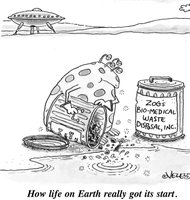
Additional info: The images included visually reinforce the concepts of origins of life and evolutionary relationships, directly supporting the explanations in the adjacent paragraphs.
