Indietro
Biomolecules: The Molecules of Life (Chapter 5 Study Notes)
Guida di studio - Note intelligenti
 Appunti personalizzati basati sui tuoi materiali, ampliati con definizioni chiave, esempi e contesto.
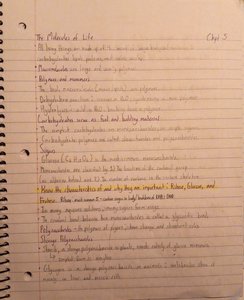
The Molecules of Life
Introduction to Biomolecules
Biomolecules are the fundamental chemical compounds that make up living organisms. They are essential for structure, function, and regulation of the body's tissues and organs.
All living things are made of cells: Cells are the basic unit of life and contain biomolecules.
Biomolecules: Organic molecules found in living organisms, including carbohydrates, lipids, proteins, and nucleic acids.
Monomers and Polymers: Monomers are small, repeating units; polymers are long chains of monomers joined together.
Polymer Formation and Breakdown
Polymers are synthesized and broken down through specific chemical reactions.
Dehydration Synthesis: The process of joining monomers by removing a water molecule.
Hydrolysis: The process of breaking polymers into monomers by adding water.
Carbohydrates
Carbohydrates are biomolecules that serve as fuel and building material in cells.
Monosaccharides: Simple sugars, such as glucose, fructose, and galactose.
Disaccharides: Formed by joining two monosaccharides (e.g., sucrose, lactose).
Polysaccharides: Long chains of monosaccharides (e.g., starch, glycogen, cellulose).
Monosaccharides: Structure and Importance
Monosaccharides are the simplest carbohydrates and are crucial for energy and cellular processes.
General Formula: (where n is typically 3-7).
Examples: Ribose, glucose, and fructose.
Importance: Monosaccharides are used for energy and as building blocks for other biomolecules.
Disaccharides and Polysaccharides
Disaccharides and polysaccharides are formed from monosaccharides and serve various functions in organisms.
Disaccharides: Examples include sucrose (glucose + fructose), lactose (glucose + galactose).
Polysaccharides: Examples include starch (energy storage in plants), glycogen (energy storage in animals), and cellulose (structural component in plants).
Summary Table: Types of Carbohydrates
Type | Examples | Function |
|---|---|---|
Monosaccharides | Glucose, Fructose, Ribose | Energy source, building blocks |
Disaccharides | Sucrose, Lactose | Transport, energy |
Polysaccharides | Starch, Glycogen, Cellulose | Energy storage, structure |
Additional info:
Biomolecules also include lipids, proteins, and nucleic acids, which will be covered in further detail in other chapters.
Carbohydrates are classified based on the number of sugar units: monosaccharides (1), disaccharides (2), and polysaccharides (many).