Indietro
BIO 102 Chapter 42 Part 1 C
Guida di studio - Note intelligenti
 Appunti personalizzati basati sui tuoi materiali, ampliati con definizioni chiave, esempi e contesto.
Open vs. Closed Circulatory Systems
Blood is a specialized connective tissue essential for transport, exchange, and defense in vertebrates. Circulatory systems can be classified as open or closed:
Open Circulation: The circulating fluid (hemolymph) is continuous with the fluid surrounding all body cells.
Closed Circulation: Blood is confined to vessels and is more specialized, supporting efficient transport and defense.
Blood Composition and Function
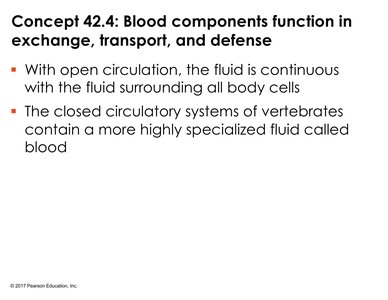
Blood consists of plasma (the liquid matrix) and cellular elements (formed elements). Each component has distinct functions:
Plasma (55%): Contains water, ions, proteins, nutrients, gases, and waste products.
Cellular Elements (45%): Include erythrocytes (red blood cells), leukocytes (white blood cells), and platelets.
Constituent | Major Functions |
|---|---|
Water | Solvent |
Ions (Na+, K+, Ca2+, Mg2+, Cl-, HCO3-) | Osmotic balance, pH buffering, regulation of membrane permeability |
Plasma proteins (Albumin, Immunoglobulins, Apolipoproteins, Fibrinogen) | Osmotic balance, pH buffering, defense, lipid transport, blood clotting |
Nutrients, gases, wastes, hormones | Transport |
Cell Type | Number per μL | Function |
|---|---|---|
Leukocytes | 5,000–10,000 | Defense and immunity |
Platelets | 250,000–400,000 | Blood clotting |
Erythrocytes | 5,000,000–6,000,000 | Transport of O2 and some CO2 |
Erythrocytes: Structure and Function
Form and Function of Red Blood Cells
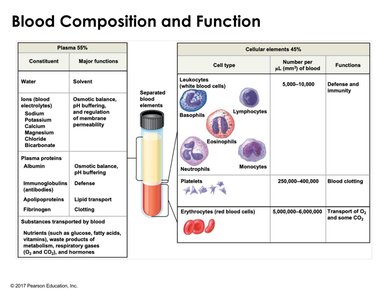
Erythrocytes are highly specialized for gas transport. Their biconcave shape increases surface area to volume ratio, optimizing gas exchange. Mature erythrocytes lack nuclei and most organelles, allowing space for hemoglobin and enzymes.
Size: Approximately 7.5 μm diameter, 2.5 μm thick.
Composition: Mainly hemoglobin and enzymes; no mitochondria (ATP produced via anaerobic fermentation).
Function: Transport O2 and CO2 without consuming the O2 they carry.
Structural Proteins: Spectrin and actin maintain deformability and durability.
Blood Disorders: Sickle Cell Disease
Sickle Cell Disease Overview
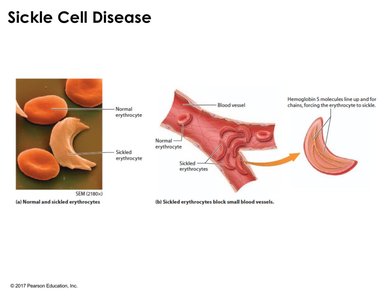
Sickle cell disease is a hereditary disorder caused by a point mutation in the hemoglobin gene, resulting in abnormal hemoglobin and sickle-shaped erythrocytes. These cells are less efficient at transporting oxygen and tend to agglutinate, blocking small blood vessels and causing pain, organ damage, and anemia.
Mutation: Single nucleotide change alters amino acid from polar to nonpolar.
Effects: Hemoglobin polymerizes under low O2, causing sickling and agglutination.
Consequences: Blocked vessels, hemolysis, anemia, hypoxia, pleiotropic effects.
Heterozygote Advantage: Resistance to malaria in affected populations.
Hematopoiesis: Formation of Blood Cells
Stem Cells and Blood Cell Replacement
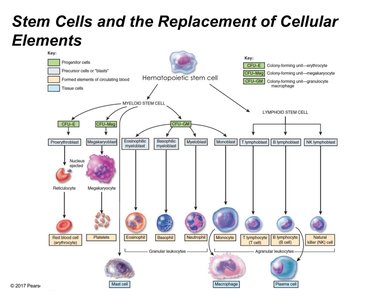
Hematopoiesis is the process of forming new blood cells from hematopoietic stem cells (HSCs) located in bone marrow. HSCs are multipotent, capable of self-renewal and differentiation into various blood cell types via myeloid and lymphoid lineages.
Myeloid Lineage: Produces erythrocytes, megakaryocytes (platelets), granulocytes, monocytes.
Lymphoid Lineage: Produces lymphocytes (B cells, T cells, NK cells).
Plasma Components: Water, nutrients, electrolytes, proteins (from liver and connective tissue).
Hemostasis: Stopping Blood Loss
Mechanisms of Hemostasis
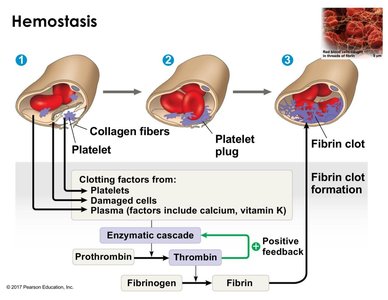
Hemostasis is the process of stopping blood flow after vessel injury. It involves three main mechanisms: vascular spasm, platelet plug formation, and blood coagulation (fibrin clot formation).
Vascular Spasm: Immediate constriction of broken vessel to reduce blood loss.
Platelet Plug: Platelets adhere to exposed collagen, aggregate, and form a temporary seal.
Coagulation: Enzymatic cascade activates prothrombin to thrombin, which converts fibrinogen to fibrin, forming a stable clot.
Key Equations:
Cardiovascular Disease
Overview of Cardiovascular Diseases
Cardiovascular diseases are disorders affecting the heart and blood vessels, ranging from minor disturbances to life-threatening disruptions of blood flow.
Examples: Atherosclerosis, myocardial infarction, aneurysms, strokes, hypertension.
Atherosclerosis
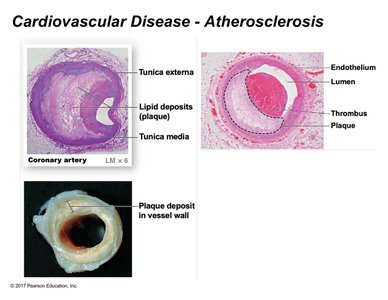
Atherosclerosis is the accumulation of lipid deposits (plaques) in arterial walls, leading to thickening, stiffening, and obstruction of blood flow. Damaged endothelium promotes LDL accumulation and oxidation, recruiting macrophages (foam cells) and forming plaques.
Stages: Endothelial injury, LDL accumulation, foam cell formation, smooth muscle proliferation, plaque formation.
Complications: Thrombus (blood clot), embolus (clot fragment), reduced blood flow.
Lipoproteins and Cholesterol Transport
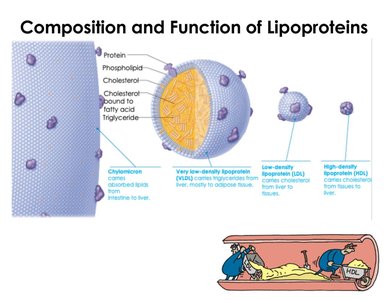
Cholesterol is transported in the blood by lipoproteins, classified by density:
Chylomicrons: Transport dietary lipids from intestine to liver.
Very Low-Density Lipoproteins (VLDL): Transport lipids from liver to adipose tissue.
Low-Density Lipoproteins (LDL): Carry cholesterol from liver to tissues; associated with plaque formation.
High-Density Lipoproteins (HDL): Remove excess cholesterol from tissues to liver; considered "good cholesterol".
Balloon Angioplasty and Stents
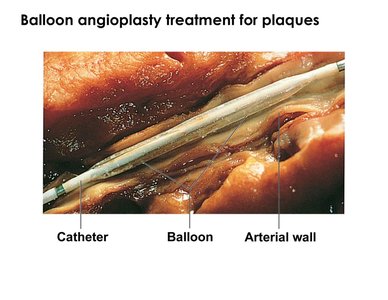
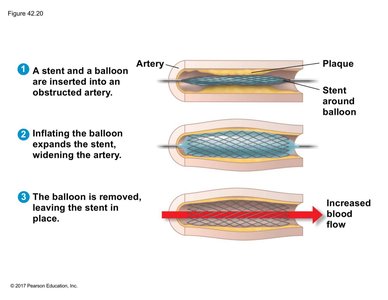
Balloon angioplasty is a surgical technique to widen obstructed arteries by inflating a balloon against plaques. Stents are mesh tubes inserted to keep arteries open and prevent restenosis (reformation of plaques).
Balloon Angioplasty: Temporary widening; risk of restenosis.
Stent Placement: Permanent support to maintain lumen and blood flow.
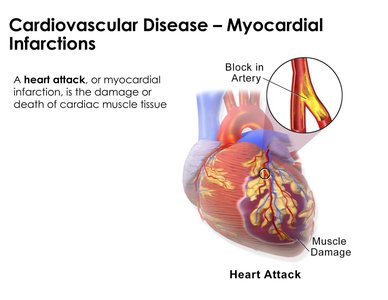
Myocardial Infarction (Heart Attack)
Myocardial infarction is the damage or death of cardiac muscle tissue due to insufficient blood supply, often caused by blocked arteries or blood clots. This impairs heart contractions and can lead to necrosis.
Causes: Blocked coronary arteries, atherosclerosis, blood clots.
Consequences: Muscle damage, necrosis, impaired heart function.
Aneurysms and Strokes
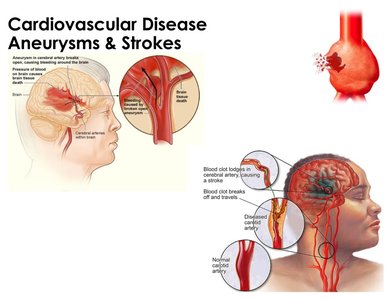
An aneurysm is the swelling and bursting of a major blood vessel, often leading to hemorrhagic stroke. Strokes can also occur from blocked cerebral arteries, resulting in necrosis of brain tissue.
Aneurysm: Vessel wall weakens, swells, and bursts, causing bleeding.
Stroke: Blockage or rupture of cerebral artery, leading to tissue death.
Hypertension (High Blood Pressure)
Hypertension is persistently high blood pressure, often called the "silent killer" due to its asymptomatic nature. It strains the heart and blood vessels, promoting atherosclerosis and increasing risk for heart failure, stroke, and kidney failure.
Causes: Plaques, vessel constriction, risk factors (age, sex, family history, smoking).
Inflammation: Plays a role in plaque and clot formation.
Aspirin: Inhibits inflammation, reducing risk of heart attack and stroke.