 Indietro
Bond Types, Electronegativity, and pH Effects in General Biology
Guida di studio - Note intelligenti
 Appunti personalizzati basati sui tuoi materiali, ampliati con definizioni chiave, esempi e contesto.
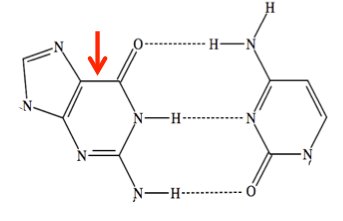
Q1. What atoms are involved in the bond indicated by the arrow? What is the electronegativity difference between the bonded atoms? What is the charge on each atom in this bond? What type of bond is shown by the arrow?
Background
Topic: Chemical Bond Types & Electronegativity
This question tests your ability to identify atoms in a bond, calculate electronegativity differences, and determine the bond type and partial charges. These skills are fundamental for understanding molecular structure and interactions in biology.
Key Terms and Formulas:
Electronegativity: A measure of an atom's ability to attract electrons in a bond.
Bond Types: Non-polar covalent, polar covalent, ionic.
Electronegativity Difference Formula:
Charge Notation: d+ (partial positive), d- (partial negative), +, -, none.
Step-by-Step Guidance
Identify the two atoms involved in the bond indicated by the arrow. Use the structure and the number of bonds to help determine the atom type (e.g., carbon, nitrogen, oxygen).
Look up the electronegativity values for each atom involved. For example, C = 2.5, N = 3.04, O = 3.44, H = 2.1.
Calculate the electronegativity difference using .
Use the difference to determine the bond type: non-polar covalent (difference < 0.5), polar covalent (0.5–1.7), ionic (> 1.7).
Assign partial charges based on which atom is more electronegative (d- for more electronegative, d+ for less).
Try solving on your own before revealing the answer!
Final Answer:
Atoms in this bond: Carbon–Nitrogen
Electronegativity difference:
Charges: Carbon (d+), Nitrogen (d-)
Type of bond: Polar covalent
The bond is polar covalent because the difference is between 0.5 and 1.7, and nitrogen is more electronegative, so it has a partial negative charge.
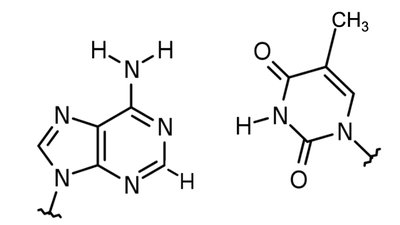
Q2. What atoms are involved in the bond indicated by the arrow? What is the electronegativity difference between the bonded atoms? What is the charge on each atom in this bond? What type of bond is this?
Background
Topic: Bond Types in Biomolecules
This question continues to test your ability to identify atoms, calculate electronegativity differences, and classify bond types, which is essential for understanding molecular interactions in biological systems.
Key Terms and Formulas:
Electronegativity values: C = 2.5, N = 3.04, O = 3.44, H = 2.1
Bond type scale: Non-polar covalent (<0.5), Polar covalent (0.5–1.7), Ionic (>1.7)
Partial charges: d+, d-
Step-by-Step Guidance
Identify the atoms involved in the bond (e.g., nitrogen and hydrogen).
Find the electronegativity values for each atom.
Calculate the difference: .
Determine the bond type using the scale provided.
Assign partial charges based on electronegativity.
Try solving on your own before revealing the answer!
Final Answer:
Atoms in the bond: Nitrogen–Hydrogen
Electronegativity difference:
Charges: Nitrogen (d-), Hydrogen (d+)
Type of bond: Polar covalent
The bond is polar covalent because the difference is between 0.5 and 1.7, and nitrogen is more electronegative.
Q3. What atoms are involved in the bond indicated by the arrow? What is the charge on each atom in this bond? What type of bond is this?
Background
Topic: Bond Types and Partial Charges
This question focuses on identifying atoms in a bond, assigning charges, and classifying the bond type, which is important for understanding molecular polarity and interactions.
Key Terms and Formulas:
Electronegativity
Partial charges (d+, d-)
Bond types: Non-polar covalent, polar covalent, ionic
Step-by-Step Guidance
Identify the atoms involved in the bond (e.g., oxygen and carbon).
Determine which atom is more electronegative.
Assign partial charges based on electronegativity.
Use the electronegativity difference to classify the bond type.
Try solving on your own before revealing the answer!
Final Answer:
Atoms in the bond: Oxygen–Carbon
Charges: Oxygen (d-), Carbon (d+)
Type of bond: Polar covalent
The bond is polar covalent because oxygen is significantly more electronegative than carbon.
Q4. What type of bond is this? (dotted line) Are these atoms sharing electrons with each other? How do you know? How is this bond similar to an ionic bond? How is this bond different from an ionic bond? Label the charges by all atoms connected with dotted lines.
Background
Topic: Hydrogen Bonds vs. Ionic Bonds
This question tests your understanding of hydrogen bonds, their similarities and differences with ionic bonds, and how to identify partial charges.
Key Terms and Formulas:
Hydrogen bond: An attraction between partial charges (d+ and d-) on different molecules or parts of molecules.
Ionic bond: Attraction between full positive and negative charges.
Partial charges: d+, d-
Step-by-Step Guidance
Identify the atoms connected by the dotted line (usually hydrogen and a more electronegative atom like oxygen or nitrogen).
Determine if electrons are shared (hydrogen bonds do not involve electron sharing).
Compare the nature of the charges involved (partial vs. full).
Label the partial charges on each atom.
Try solving on your own before revealing the answer!
Final Answer:
Type of bond: Hydrogen bond
Atoms are not sharing electrons; hydrogen bonds are attractions between partial charges (d+ and d-).
Similar to ionic bonds because both involve attraction between charges, but hydrogen bonds involve partial charges, not full charges.
Charges: Oxygen (d-), Hydrogen (d+)
Q5. Draw the hydrogen bonds that connect these two molecules.
Background
Topic: Hydrogen Bonding in Biomolecules
This question tests your ability to identify and illustrate hydrogen bonds between molecules, which is crucial for understanding DNA structure and protein folding.
Key Terms and Formulas:
Hydrogen bond: Attraction between a hydrogen atom (d+) and a more electronegative atom (d-).
Partial charges: d+, d-
Step-by-Step Guidance
Identify hydrogen atoms bonded to electronegative atoms (N or O).
Find nearby electronegative atoms (N or O) on the other molecule.
Draw dotted lines to represent hydrogen bonds between d+ hydrogen and d- electronegative atom.
Try solving on your own before revealing the answer!
Final Answer:
Hydrogen bonds are drawn as dotted lines between the hydrogen atom (d+) of one molecule and the electronegative atom (d-) of another molecule, such as N or O.
This is how DNA base pairs and protein structures are stabilized.
Q6. Using your own words, explain the steps needed to determine a bond type. What concept(s) became more clear after this assignment? What remaining questions do you have?
Background
Topic: Bond Type Determination & Reflection
This question encourages you to reflect on the process of determining bond types and your understanding of the concepts.
Key Terms and Formulas:
Electronegativity
Bond types: Non-polar covalent, polar covalent, ionic
Step-by-Step Guidance
Identify the atoms involved in the bond.
Find their electronegativity values.
Calculate the difference and use the scale to determine the bond type.
Assign partial charges based on which atom is more electronegative.
Try solving on your own before revealing the answer!
Final Answer:
Steps: Identify atoms, find electronegativity values, calculate difference, use scale to determine bond type, assign partial charges.
Concepts clarified: How electronegativity differences relate to bond types and partial charges.
Remaining questions: (Your own reflection here.)
Q7. Impact of pH on Proteins: What is the functional group R-COOH called? Is it an acid or base? When added to water, does it accept or donate H+?
Background
Topic: Functional Groups and pH
This question tests your understanding of how functional groups behave in different pH environments, which is important for understanding protein structure and function.
Key Terms and Formulas:
Carboxyl group (R-COOH): Acidic functional group
Acid: Donates H+
Base: Accepts H+
Step-by-Step Guidance
Identify the functional group (R-COOH).
Determine if it is an acid or base based on its ability to donate or accept H+.
Consider what happens when it is added to water.
Try solving on your own before revealing the answer!
Final Answer:
R-COOH is called a carboxyl group and is an acid. When added to water, it donates H+ to the solution.
Q8. What is the functional group R-NH2 called? Is it an acid or base? When added to water, does it accept or donate H+?
Background
Topic: Functional Groups and pH
This question tests your understanding of amino groups and their behavior in different pH environments.
Key Terms and Formulas:
Amino group (R-NH2): Basic functional group
Acid: Donates H+
Base: Accepts H+
Step-by-Step Guidance
Identify the functional group (R-NH2).
Determine if it is an acid or base based on its ability to donate or accept H+.
Consider what happens when it is added to water.
Try solving on your own before revealing the answer!
Final Answer:
R-NH2 is called an amino group and is a base. When added to water, it accepts H+ from the solution.
Q9. When the pH is decreased, what happens to [H+] in the solution?
Background
Topic: pH and Hydrogen Ion Concentration
This question tests your understanding of the relationship between pH and hydrogen ion concentration, which is fundamental for understanding acid-base chemistry in biology.
Key Terms and Formulas:
pH: Measure of hydrogen ion concentration
Lower pH = higher [H+]
Step-by-Step Guidance
Recall that pH is inversely related to [H+].
When pH decreases, [H+] increases.
Try solving on your own before revealing the answer!
Final Answer:
When pH is decreased, [H+] is increased in the solution.
Q10. When pH is increased, what happens to [H+] in the solution?
Background
Topic: pH and Hydrogen Ion Concentration
This question tests your understanding of how pH changes affect hydrogen ion concentration.
Key Terms and Formulas:
pH: Measure of hydrogen ion concentration
Higher pH = lower [H+]
Step-by-Step Guidance
Recall that pH is inversely related to [H+].
When pH increases, [H+] decreases.
Try solving on your own before revealing the answer!
Final Answer:
When pH is increased, [H+] is lowered in the solution.
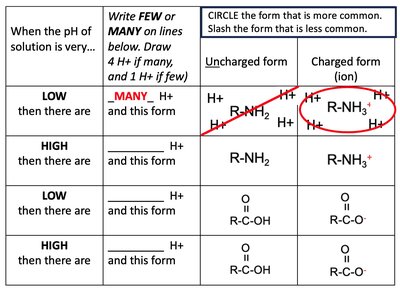
Q11. How does pH alter the form of functional groups (charged or uncharged)?
Background
Topic: pH Effects on Functional Groups
This question tests your understanding of how pH changes can affect the charge state of functional groups, which is important for protein structure and function.
Key Terms and Formulas:
Functional groups: Carboxyl (R-COOH), Amino (R-NH2)
Charged form: Ionized
Uncharged form: Non-ionized
Step-by-Step Guidance
Consider how low pH (high [H+]) affects functional groups (more likely to be protonated).
Consider how high pH (low [H+]) affects functional groups (more likely to be deprotonated).
Use the table to determine which form is more common at different pH values.
Try solving on your own before revealing the answer!
Final Answer:
At low pH, functional groups are more likely to be protonated and uncharged; at high pH, they are more likely to be deprotonated and charged.
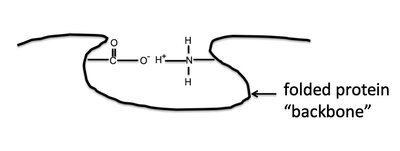
Q12. What type of bond is shown between the two functional groups in the folded protein structure? Are the O- and H+ sharing electrons?
Background
Topic: Protein Structure and Bonding
This question tests your understanding of the types of bonds that stabilize protein structure, specifically hydrogen bonds.
Key Terms and Formulas:
Hydrogen bond: Attraction between partial charges
Protein folding: Driven by interactions between side chains
Step-by-Step Guidance
Identify the functional groups involved (e.g., carboxyl and amino).
Determine if the bond is a hydrogen bond (dotted line between O- and H+).
Assess whether electrons are shared (hydrogen bonds do not involve electron sharing).
Try solving on your own before revealing the answer!
Final Answer:
The bond is a hydrogen bond. The O- and H+ are not sharing electrons; the bond is an attraction between partial charges.
Q13. Draw a picture to indicate what will happen to these functional groups and the bond between them when the pH is very LOW in the solution. Show how this impacts protein structure.
Background
Topic: Protein Structure and pH Effects
This question tests your ability to visualize how pH changes affect protein structure by altering the charge state of functional groups.
Key Terms and Formulas:
Protein folding
Functional group charge state
Step-by-Step Guidance
Consider how low pH (high [H+]) affects the charge state of carboxyl and amino groups.
Draw the protein backbone with functional groups in their protonated (uncharged) forms.
Show how the absence of charge affects the ability to form bonds and protein folding.
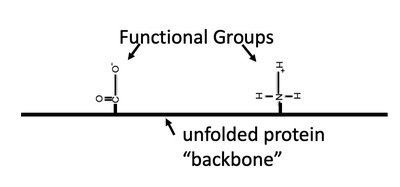
Try solving on your own before revealing the answer!
Final Answer:
At very low pH, functional groups are protonated and uncharged, preventing the formation of bonds that drive protein folding. The protein remains unfolded.
Q14. Draw a picture to indicate what will happen to these functional groups and the bond between them when the pH is very HIGH in the solution. Show how this impacts protein structure.
Background
Topic: Protein Structure and pH Effects
This question tests your ability to visualize how high pH affects protein structure by altering the charge state of functional groups.
Key Terms and Formulas:
Protein folding
Functional group charge state
Step-by-Step Guidance
Consider how high pH (low [H+]) affects the charge state of carboxyl and amino groups.
Draw the protein backbone with functional groups in their deprotonated (charged) forms.
Show how the presence of charge affects the ability to form bonds and protein folding.
Try solving on your own before revealing the answer!
Final Answer:
At very high pH, functional groups are deprotonated and charged, which can disrupt the bonds that drive protein folding, potentially leading to an unfolded or misfolded protein.
Q15. What are 2 factors that can impact protein structure? Will the proteins in 3c and 3d have the same function as the original, folded protein?
Background
Topic: Protein Structure and Function
This question tests your understanding of factors that affect protein structure and how changes in structure impact function.
Key Terms and Formulas:
Protein folding
Structure determines function
Step-by-Step Guidance
Identify factors that impact protein structure (e.g., pH, temperature).
Consider how changes in structure affect protein function.
Compare the function of unfolded/misfolded proteins to the original folded protein.
Try solving on your own before revealing the answer!
Final Answer:
Two factors that impact protein structure are pH and temperature. Proteins in 3c and 3d will not have the same function as the original, folded protein because structure determines function.
