 Indietro
Broad Patterns of Evolution: Fossil Record, Mass Extinctions, and Macroevolution
Guida di studio - Note intelligenti
 Appunti personalizzati basati sui tuoi materiali, ampliati con definizioni chiave, esempi e contesto.
Broad Patterns of Evolution
Introduction to Macroevolution
Macroevolution refers to broad evolutionary changes that occur above the species level, such as the emergence of new groups, mass extinctions, and major transitions in the history of life. The fossil record and geologic history provide crucial evidence for understanding these patterns and the biodiversity present on Earth today.
The Fossil Record and Life’s History
Formation and Biases of the Fossil Record
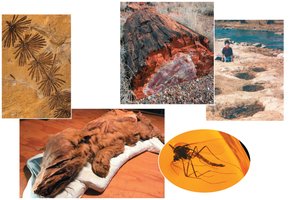
The fossil record is the collection of all discovered fossils and their placement in sedimentary rock layers, or strata. Fossils are more likely to form from species that existed for a long time, were abundant and widespread, and had hard parts such as shells or bones. However, only a small fraction of organisms ever fossilize, and even fewer are discovered, leading to biases in the record.
Sedimentary rocks are the richest source of fossils, deposited in layers called strata.
Fossilization is rare and favors certain organisms and environments.
The fossil record is incomplete and biased, but it remains our best window into the history of life.
Major Fossil Discoveries and Transitional Forms
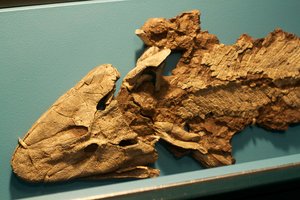
Transitional fossils, such as Tiktaalik, provide evidence for major evolutionary transitions, such as the move from aquatic to terrestrial life in vertebrates.
Transitional forms show intermediate characteristics between ancestral and derived groups.
Tiktaalik is a famous example, displaying features of both fish and early tetrapods.

Timeline of Major Fossil Groups
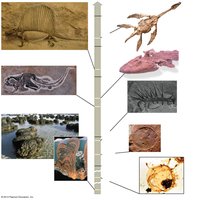
The fossil record documents the appearance and extinction of major groups over time, helping to reconstruct the tree of life and evolutionary relationships.
Dating Fossils and the Geologic Record
Relative and Absolute Dating
Fossils are dated using two main methods: relative dating, which uses the position of fossils in strata, and absolute dating, which uses radiometric techniques to determine actual ages.
Relative dating: Older fossils are found in lower strata, while younger fossils are in higher strata.
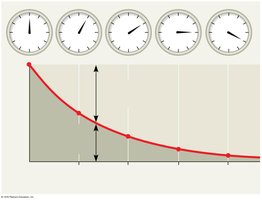
Radiometric dating: Measures the decay of radioactive isotopes to determine the absolute age of rocks and fossils.
The rate of decay is expressed as a half-life, the time required for half of the parent isotope to decay into the daughter isotope.
Equation for radioactive decay:
Where is the amount remaining after time , is the initial amount, and is the half-life.
The Geologic Time Scale
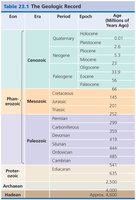
The geologic record divides Earth's history into eons, eras, periods, and epochs. Major boundaries often correspond to mass extinction events.
The Phanerozoic Eon includes most of the time that animals have existed on Earth and is divided into the Paleozoic, Mesozoic, and Cenozoic eras.
Major extinction events mark the boundaries between these eras.
Eon | Era | Period | Epoch | Age (Millions of Years Ago) |
|---|---|---|---|---|
Cenozoic | Quaternary | Holocene | 0.01 | |
Pleistocene | 2.6 | |||
Neogene | Pliocene | 5.3 | ||
Miocene | 23 | |||
Paleogene | Oligocene | 33.9 | ||
Eocene | 56 | |||
Paleocene | 66 | |||
Phanerozoic | Mesozoic | Cretaceous | 145 | |
Jurassic | 201 | |||
Triassic | 252 | |||
Paleozoic | Permian | 299 | ||
Carboniferous | 359 | |||
Devonian | 419 | |||
Silurian | 444 | |||
Ordovician | 485 | |||
Cambrian | 541 | |||
Proterozoic | 2,500 | |||
Archean | 4,000 | |||
Hadean | Approx. 4,600 |
Macroevolutionary Trends and the Origin of New Groups
Evolution of Major Groups
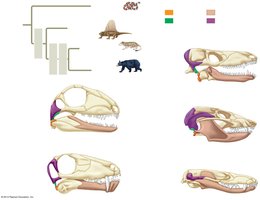
Macroevolutionary trends are observed in the fossil record, such as the origin of mammals from synapsid ancestors. These trends reflect changes in speciation and extinction rates over time.
Major evolutionary transitions are often marked by the appearance of new anatomical features.
For example, the evolution of the mammalian jaw and ear bones from reptilian ancestors is well documented in the fossil record.
Speciation, Extinction, and Biodiversity
Speciation and Extinction Rates
The rise and fall of groups of organisms reflect differences in their rates of speciation (formation of new species) and extinction (loss of species). Most species that have ever lived are now extinct.
Extinction can be caused by environmental changes, competition, or catastrophic events.
Speciation and extinction together shape the diversity of life over time.
Mass Extinctions
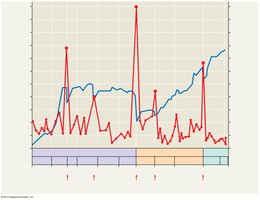
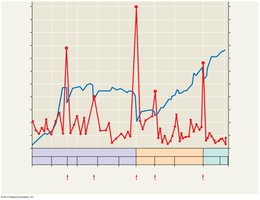
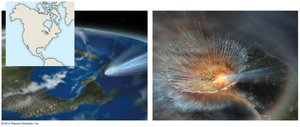
Mass extinctions are periods when extinction rates increase dramatically, often due to global environmental changes. The fossil record documents five major mass extinction events, known as the "Big Five." These events have had profound effects on the history of life.
The Permian extinction (about 252 million years ago) resulted in the loss of 96% of marine animal species, likely due to intense volcanism, global warming, and ocean anoxia.
The Cretaceous extinction (about 66 million years ago) led to the extinction of the dinosaurs and many marine species, possibly caused by a meteor impact.
Consequences of Mass Extinctions
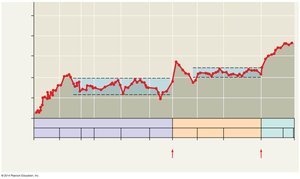
Mass extinctions can drastically alter ecological communities and the niches available to organisms. Recovery of biodiversity after a mass extinction can take millions of years, and the types of organisms that dominate may change.
After mass extinctions, the percentage of marine predators increased.
Mass extinctions often pave the way for adaptive radiations, where new groups rapidly diversify to fill available niches.
Adaptive Radiations
Definition and Examples
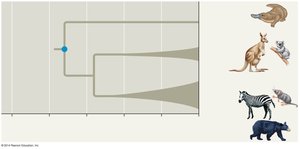
Adaptive radiation is the rapid evolution of many diversely adapted species from a common ancestor, often following mass extinctions, the evolution of novel traits, or the colonization of new environments.
Mammals underwent a major adaptive radiation after the extinction of terrestrial dinosaurs.
Adaptive radiations contribute significantly to the diversity of life.
Current Biodiversity and Extinction Rates
Modern Extinction Rates
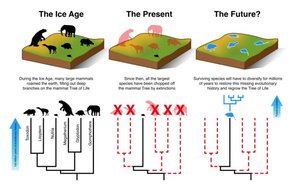
Estimates suggest that 10–30 million species exist today. However, current extinction rates are 100 to 1,000 times higher than background rates, likely due to human activities and global climate change. This has led scientists to propose that a sixth mass extinction may be underway.
Background extinction rate: 0.1–1.0 species per year per million species.
Current estimated extinction rate: 300–3,000 species per year.
Recovery from mass extinction can take millions of years.
Evolutionary Innovations: The Evolution of the Eye
Stepwise Evolution of Complex Structures
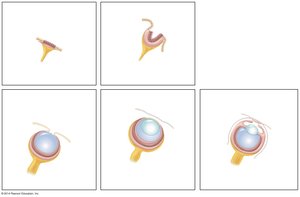
Complex structures, such as the eye, can evolve through a series of small, incremental changes. The evolution of the eye in mollusks demonstrates how natural selection can produce complex organs from simple beginnings.
Eyes evolved from simple patches of photoreceptor cells to complex camera-type eyes.
Each intermediate stage provided a selective advantage.
Evolution is Not Goal-Oriented
Nature of Evolutionary Change
Evolution does not work toward a specific goal or perfect organism. Instead, it is a process of modification and adaptation, often described as "tinkering" with existing structures. The direction of evolution is shaped by environmental pressures, chance events, and the constraints of ancestry.
Evolutionary changes are not predetermined or progressive.
Organisms are adapted to their current environments, not striving for perfection.
