 Indietro
Campbell Biology Exam 3 Study Guide: Molecular Genetics, Gene Expression, and Evolutionary Biology
Guida di studio - Note intelligenti
 Appunti personalizzati basati sui tuoi materiali, ampliati con definizioni chiave, esempi e contesto.
MODULE 1: Molecular Genetics & Gene Expression
Definitions and Foundations of Genetic Processes
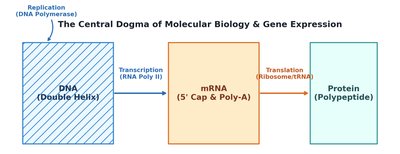
The Central Dogma of Molecular Biology describes the flow of genetic information within a cell, from DNA to RNA to protein. Understanding these processes is fundamental to molecular biology.
Replication: The process by which a cell duplicates its DNA, ensuring genetic continuity during cell division.
Transcription: The synthesis of RNA from a DNA template, converting genetic information into a form that can be used for protein synthesis.
Translation: The process by which ribosomes synthesize proteins using the information encoded in mRNA.
Central Dogma: Information flows from DNA → RNA → Protein.
Key Enzymes: DNA Polymerase (replication), RNA Polymerase II (transcription), Ribosome (translation).
Example: The production of insulin protein from the insulin gene in human cells.
Detailed Walkthrough of Protein Synthesis
Protein synthesis in eukaryotic cells is compartmentalized and involves multiple molecular helpers and energy inputs.
Transcription & Pre-mRNA Processing: Occurs in the nucleus, where the primary transcript is modified before export.
Translation: Occurs in the cytoplasm, either on free ribosomes or those bound to the rough ER.
Molecular Helpers: DNA Polymerase III, Helicase, Topoisomerase, RNA Polymerase II, Transcription Factors, Spliceosome, tRNA, Aminoacyl-tRNA Synthetase, Ribosome, Signal Recognition Particle.
Energy Inputs: ATP is used for tRNA charging; GTP is used for ribosome assembly, elongation, and termination.
Example: The synthesis of hemoglobin protein in red blood cells.
Mathematical Proof of the Triplet Codon Reading Frame
The genetic code uses triplet codons to encode 20 amino acids using only four nucleotide bases.
Single base codons: combinations (insufficient).
Double base codons: combinations (still insufficient).
Triplet codons: combinations (sufficient and allows redundancy).
Reading Frame: Established at the start codon (AUG); frameshift mutations disrupt protein function.
MODULE 2: Eukaryotic Genomes, Biotechnology & Development
Histones & Levels of Eukaryotic DNA Packaging
Eukaryotic DNA is tightly packaged in the nucleus using histones, forming hierarchical structures for efficient storage and regulation.
10-nm Fiber: DNA wraps around histone octamers, forming nucleosomes.
30-nm Fiber: Nucleosomes coil into thicker fibers.
300-nm Fiber: Fibers loop and attach to scaffolds.
Metaphase Chromosome: Highly condensed structure during cell division.
Pseudogenes, Transposons & Retrotransposons
Genomic elements such as pseudogenes and transposons contribute to genome evolution and diversity.
Pseudogenes: Nonfunctional gene remnants.
Transposons: DNA elements that move within the genome.
Retrotransposons: Move via RNA intermediates; constitute a large portion of the human genome.
Evolutionary Significance: Drive genetic variation and adaptation.
Cell Differentiation & Regulation Levels
Cell differentiation is achieved through differential gene expression, regulated primarily at transcription initiation.
Genomic Equivalence: All somatic cells have identical DNA.
Regulation: Chromatin modification and transcription factors control gene expression.
Alternative RNA Splicing
Alternative splicing allows a single gene to produce multiple protein isoforms, increasing functional diversity.
Mechanism: Different exons are included or excluded from the final mRNA.
Significance: Explains high protein diversity from a limited number of genes.
Morphogenesis, Restriction Enzymes & Recombinant DNA
Morphogenesis shapes organismal form, while restriction enzymes and recombinant DNA technology enable genetic engineering.
Morphogenesis: Organizes cells into tissues and organs.
Restriction Enzymes: Cut DNA at specific sequences, producing sticky ends.
Recombinant DNA: Combines DNA from different sources using restriction enzymes and ligase.
Hybridization, Forensic DNA & Genome Complexity
Nucleic acid hybridization and forensic DNA analysis are powerful tools for genetic identification and research.
Hybridization: Base-pairing of complementary nucleic acid strands.
Forensic DNA: STR analysis enables individual identification.
Genome Complexity: Vertebrates achieve complexity through splicing, regulatory elements, microRNAs, and gene duplication.
Stem Cells, Developmental Signals & Hox Genes
Stem cells possess self-renewal and differentiation potential, guided by developmental signals and master regulator genes.
Stem Cells: Totipotent, pluripotent, and multipotent types.
Developmental Information: Cytoplasmic determinants and inductive signals.
Hox Genes: Control body plan development; exhibit collinearity.
MODULE 3: Evolutionary Biology & Macroevolution
Historical Foundations & Natural Selection Mechanism
Evolutionary theory is built on contributions from multiple scientists and the mechanism of natural selection.
Linnaeus: Taxonomy.
Cuvier: Extinctions and fossil strata.
Hutton & Lyell: Gradualism and uniformitarianism.
Lamarck: Use/disuse and acquired characteristics.
Malthus: Population growth and resource limitation.
Natural Selection: Differential survival and reproduction leads to adaptation.
Hardy-Weinberg Equilibrium Derivation & Deviations
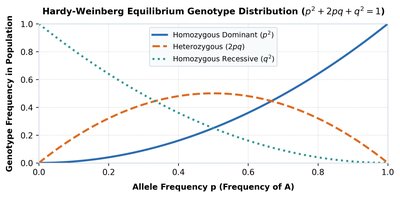
The Hardy-Weinberg model describes allele and genotype frequencies in a non-evolving population and the effects of evolutionary forces.
Allele Frequencies:
Genotype Frequencies:
Assumptions: No mutation, random mating, no selection, large population, no gene flow.
Violations: Lead to microevolution via mutation, non-random mating, selection, genetic drift, and gene flow.
Sources of Variation & Modes of Selection
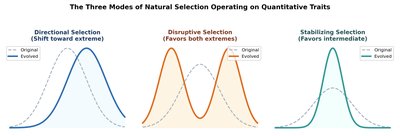
Genetic variation arises from mutation and sexual reproduction, and natural selection operates in three distinct modes.
Sources of Variation: Mutation, independent assortment, crossing over, random fertilization.
Directional Selection: Favors one extreme phenotype.
Disruptive Selection: Favors both extremes.
Stabilizing Selection: Favors intermediate phenotypes.
Example: Antibiotic resistance, finch beak size, human birth weight.
Biological Species Concept & Reproductive Isolation
The biological species concept defines species by reproductive compatibility, and reproductive isolation mechanisms prevent interbreeding.
Population: Interbreeding group of the same species.
Biological Species Concept: Species are groups that can interbreed and produce fertile offspring.
Reproductive Isolation: Prezygotic (habitat, temporal, behavioral, mechanical, gametic) and postzygotic (hybrid viability, fertility, breakdown) barriers.
Allopatric Speciation & Macroevolution Models
Speciation can occur via geographic isolation, and macroevolutionary change can be gradual or punctuated.
Allopatric Speciation: Physical barriers divide populations, leading to divergence.
Adaptive Radiation: Rapid diversification in isolated environments.
Gradualism: Slow, steady change.
Punctuated Equilibrium: Rapid bursts of change followed by stasis.
Fossil Record, Geologic Eras & Extinctions
The fossil record documents evolutionary history, geologic eras, and mass extinctions.
Fossilization: Burial and mineralization of remains.
Microevolution vs. Macroevolution: Small-scale vs. large-scale evolutionary changes.
Geologic Eras: Precambrian, Paleozoic, Mesozoic, Cenozoic.
Mass Extinctions: K-Pg extinction caused by asteroid impact.
Homologous vs. Analogous Structures: Shared ancestry vs. convergent evolution.
Early Earth, Abiogenesis & Serial Endosymbiosis
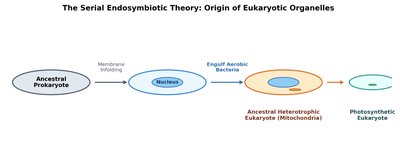
The origin of life involved abiotic synthesis, polymerization, protocell formation, and the evolution of self-replicating RNA. The serial endosymbiotic theory explains the origin of eukaryotic organelles.
Abiogenesis: Formation of organic molecules, polymers, protocells, and RNA world.
Three Domains of Life: Bacteria, Archaea, Eukarya distinguished by cell structure and genetics.
Metabolic Diversity: Photoautotrophs, chemoautotrophs, photoheterotrophs, chemoheterotrophs.
Serial Endosymbiotic Theory: Eukaryotes evolved by engulfing prokaryotes, forming mitochondria and plastids.
Evidence: Double membranes, circular DNA, prokaryotic ribosomes, independent replication.
Feature / Trait | Domain Bacteria | Domain Archaea | Domain Eukarya |
|---|---|---|---|
Nuclear Envelope | Absent | Absent | Present |
Membrane-Bound Organelles | Absent | Absent | Present |
Peptidoglycan Cell Wall | Present | Absent (Pseudopeptidoglycan) | Absent (Cellulose/Chitin) |
Membrane Lipids | Unbranched hydrocarbons | Branched hydrocarbons | Unbranched hydrocarbons |
RNA Polymerase | One simple type | Several complex types | Three complex types (I, II, III) |
Initiator Amino Acid | Formyl-methionine (fMet) | Methionine (Met) | Methionine (Met) |
Growth at >100°C | No | Yes (Extremophiles) | No |
Nutritional Mode | Energy Source | Carbon Source | Example Organisms |
|---|---|---|---|
Photoautotroph | Light | , , or related carbon | Cyanobacteria, plants, algae |
Chemoautotroph | Inorganic chemicals () | , , or related carbon | Sulfolobus, nitrifying bacteria |
Photoheterotroph | Light | Organic compounds | Chloroflexus, Rhodobacter |
Chemoheterotroph | Organic compounds | Organic compounds | Clostridium, fungi, animals, humans |
