 Indietro
Carbohydrates and Lipids: Structure, Function, and Biological Importance
Guida di studio - Note intelligenti
 Appunti personalizzati basati sui tuoi materiali, ampliati con definizioni chiave, esempi e contesto.
Carbohydrates
Overview of Carbohydrates
Carbohydrates are essential biomolecules that serve as energy sources, structural components, and cellular identifiers. They are composed of carbon, hydrogen, and oxygen, typically following the general formula (CH2O)n.
Monosaccharides: The simplest carbohydrates, acting as monomers for larger carbohydrate structures.
Oligosaccharides: Short chains of monosaccharide units (2–10 units).
Polysaccharides: Long chains of monosaccharide units, often used for energy storage or structural support.
Monosaccharide Structure and Isomerism
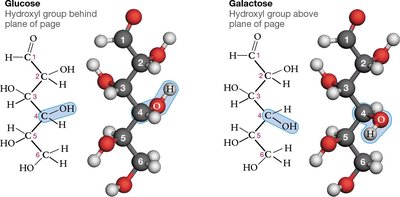
Monosaccharides can share the same chemical formula but differ in the arrangement of their atoms, resulting in structural isomers. This structural variation leads to different chemical and biological properties.
Glucose and Galactose: Both have the formula C6H12O6, but differ in the orientation of the hydroxyl group on carbon 4.
Isomerism: Small changes in structure can have significant effects on function.
Polysaccharide Formation
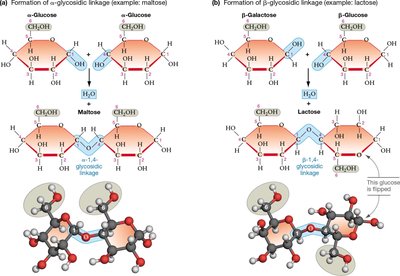
Polysaccharides are formed when monosaccharides are linked together by condensation (dehydration) reactions, which remove a water molecule to form a covalent bond known as a glycosidic linkage.
Condensation Reaction: Involves the removal of H2O to join two monosaccharides.
Glycosidic Linkages: The bond formed between two monosaccharides; can be α (alpha) or β (beta) depending on the orientation of the linkage.
Multiple Bonding Sites: Each monosaccharide has several hydroxyl (–OH) groups, allowing for various bonding patterns and complex structures.
Functions of Carbohydrates
Carbohydrates perform a variety of functions in living organisms:
Energy Storage: Polysaccharides like starch (in plants) and glycogen (in animals) store energy for later use.
Structural Support: Cellulose in plants and chitin in fungi and arthropods provide rigidity and protection.
Cellular Identification: Oligosaccharides on cell surfaces act as molecular ID tags, important for cell recognition and signaling.
Lipids
Overview of Lipids
Lipids are a diverse group of hydrophobic organic molecules, including fats, oils, waxes, and steroids. They are characterized by their insolubility in water and are primarily composed of hydrocarbons.
Fats and Oils: Serve as long-term energy storage molecules.
Waxes: Provide protective coatings.
Steroids: Include hormones and cholesterol, characterized by a four-ring structure.
Saturation in Lipids
The degree of saturation in fatty acids affects their physical properties and biological roles:
Saturated Fats: All carbons are bonded to the maximum number of hydrogens (no double bonds); typically solid at room temperature.
Unsaturated Fats: Contain one or more double bonds between carbons, reducing the number of hydrogens; usually liquid at room temperature.
Steroids
Steroids are a family of lipids with a characteristic four-ring structure. Important examples include:
Testosterone and Estrogen: Key hormones in animal physiology.
Cholesterol: An essential component of cell membranes and precursor for steroid hormones.
Phospholipids and Membrane Structure
Phospholipids are major components of cell membranes. They have hydrophilic (water-attracting) heads and hydrophobic (water-repelling) tails, leading to unique behaviors in aqueous environments:
Bilayers: Two layers of phospholipids with hydrophobic tails facing inward and hydrophilic heads facing outward, forming the basic structure of cell membranes.
Micelles: Spherical structures with hydrophobic tails in the center and hydrophilic heads on the outside.
Phospholipid Bilayers and Membrane Permeability
Cell membranes are composed of phospholipid bilayers, which are selectively permeable:
Selective Permeability: Small, nonpolar molecules can pass through easily; large, uncharged polar molecules and ions cannot.
Effect of Fatty Acid Saturation: The degree of saturation in the fatty acid tails influences membrane fluidity and permeability.
