 Indietro
Carbon & Molecular Diversity of Life: Biomolecules and Their Structure
Guida di studio - Note intelligenti
 Appunti personalizzati basati sui tuoi materiali, ampliati con definizioni chiave, esempi e contesto.
Carbon and Molecular Diversity of Life
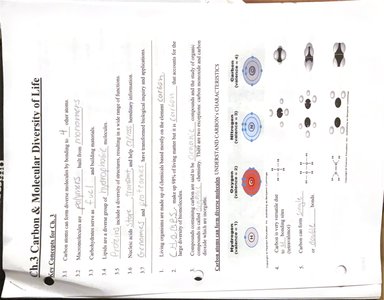
Importance of Carbon in Biological Molecules
Carbon is the foundational element in organic molecules, enabling the diversity of life due to its versatile bonding properties. Its ability to form four covalent bonds allows for complex structures such as chains, rings, and branches.
Valence: Carbon has four valence electrons, allowing it to form stable covalent bonds with many elements, including hydrogen, oxygen, and nitrogen.
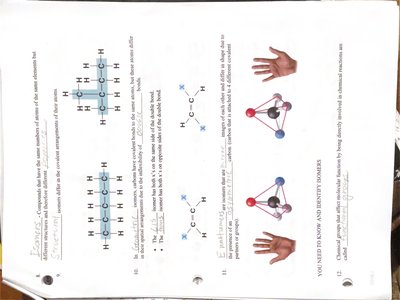
Isomers: Molecules with the same chemical formula but different structures. Types include structural isomers, cis-trans isomers, and enantiomers.
Functional Groups: Specific groups of atoms within molecules that determine the chemical properties and reactions of those molecules (e.g., hydroxyl, carbonyl, carboxyl, amino).
Isomerism in Organic Molecules
Isomers are compounds with the same molecular formula but different structural arrangements, leading to distinct properties.
Structural Isomers: Differ in the covalent arrangement of atoms.
Cis-Trans Isomers: Differ in spatial arrangement around a double bond.
Enantiomers: Mirror images of each other, important in biological systems due to their different effects.
Example: Glucose and fructose are structural isomers; L- and D-amino acids are enantiomers.
Biomolecules: Structure and Function
Carbohydrates
Carbohydrates are organic molecules composed of carbon, hydrogen, and oxygen, serving as energy sources and structural components.
Monosaccharides: Simple sugars (e.g., glucose, fructose).
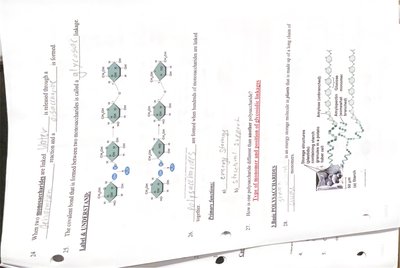
Disaccharides: Two monosaccharides joined by glycosidic linkage (e.g., sucrose).
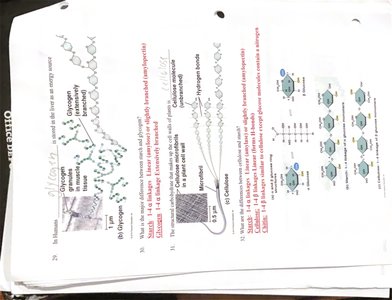
Polysaccharides: Long chains of monosaccharides (e.g., starch, cellulose, glycogen).
Structural Polysaccharides: Cellulose in plants, chitin in fungi and arthropods.
Lipids
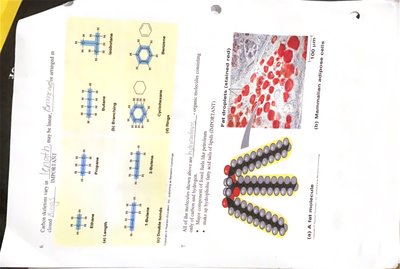
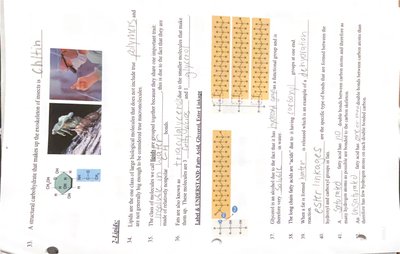
Lipids are hydrophobic molecules, including fats, phospholipids, and steroids, essential for energy storage, membrane structure, and signaling.
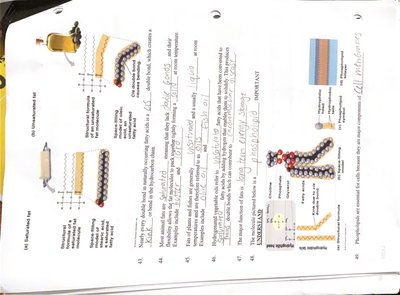
Fats: Composed of glycerol and fatty acids; saturated fats have no double bonds, unsaturated fats have one or more double bonds.
Phospholipids: Major component of cell membranes, with hydrophilic heads and hydrophobic tails.
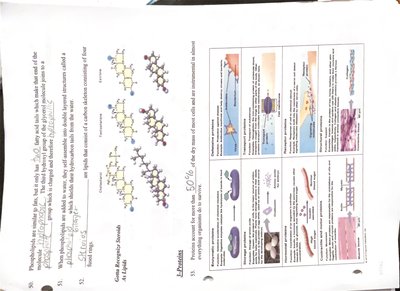
Steroids: Lipids with a four-ring structure (e.g., cholesterol).
Proteins
Proteins are polymers of amino acids, performing diverse functions such as catalysis, structure, transport, and signaling.
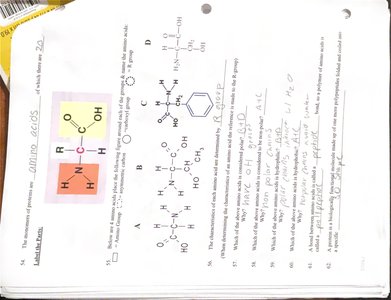
Amino Acids: Building blocks of proteins, each with a central carbon, amino group, carboxyl group, and side chain (R group).
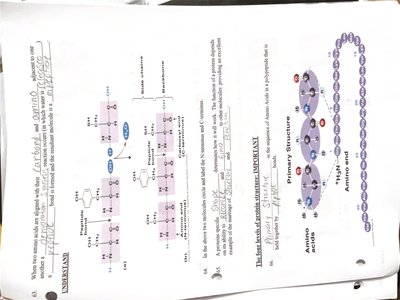
Peptide Bonds: Covalent bonds linking amino acids in a polypeptide chain.
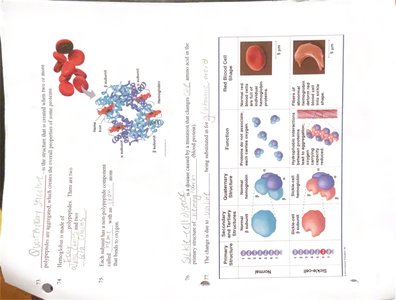
Protein Structure: Four levels—primary (sequence), secondary (alpha helix, beta sheet), tertiary (3D folding), quaternary (multiple polypeptides).
Example: Hemoglobin is a quaternary protein responsible for oxygen transport.
Nucleic Acids
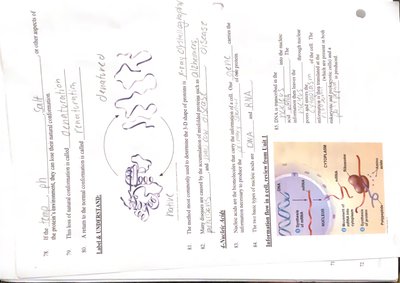
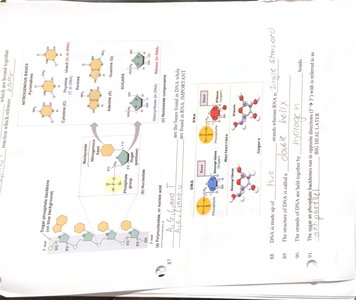
Nucleic acids (DNA and RNA) store and transmit genetic information. They are polymers of nucleotides, each consisting of a sugar, phosphate, and nitrogenous base.
DNA: Double helix structure, stores hereditary information.
RNA: Single-stranded, involved in protein synthesis and regulation.
Nucleotide Structure: Includes a pentose sugar, phosphate group, and nitrogenous base (adenine, thymine, cytosine, guanine, uracil).
Base Pairing: Hydrogen bonds between complementary bases (A-T, C-G in DNA).
Summary Table: Biomolecule Comparison
Biomolecule | Monomer | Bond Type | Main Function |
|---|---|---|---|
Carbohydrates | Monosaccharide | Glycosidic | Energy, structure |
Lipids | Fatty acid, glycerol | Ester | Energy storage, membranes |
Proteins | Amino acid | Peptide | Catalysis, structure, transport |
Nucleic Acids | Nucleotide | Phosphodiester | Genetic information |
Key Equations
Formation of Peptide Bond:
Formation of Glycosidic Bond:
Additional info: Some diagrams and images were used to clarify structural differences and biological functions of biomolecules, as well as to illustrate isomerism and protein folding.
