Indietro
Carbon and the Molecular Diversity of Life
Guida di studio - Note intelligenti
 Appunti personalizzati basati sui tuoi materiali, ampliati con definizioni chiave, esempi e contesto.
Carbon and the Molecular Diversity of Life
Introduction to Organic Chemistry
Organic chemistry is the study of compounds that contain carbon, regardless of their origin. Carbon's unique properties make it the foundation for all biological molecules, enabling the formation of a vast diversity of compounds essential for life.
Organic compounds range from simple molecules to large, complex macromolecules.
The electron configuration of carbon determines its chemical characteristics and bonding behavior.
Carbon can form four covalent bonds, allowing for a variety of molecular structures.
Electron Configuration and Bonding
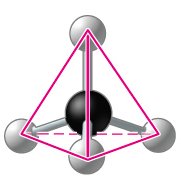
The electron configuration of carbon (1s2 2s2 2p2) gives it four valence electrons, allowing it to form four covalent bonds with other atoms. This versatility enables carbon to create large and complex molecules with diverse shapes and functions.
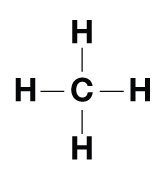
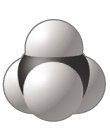
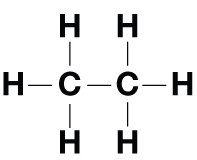
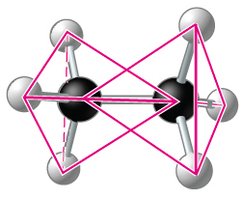
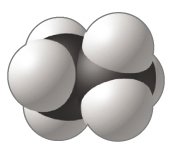
When carbon forms four single bonds, the resulting geometry is tetrahedral.
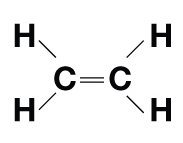
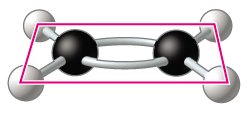
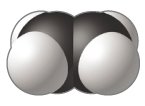
When two carbons are joined by a double bond, the atoms attached to them lie in the same plane.
Valence and Bonding Partners
The number of unpaired electrons in the valence shell of an atom is generally equal to its valence, which determines the number of covalent bonds it can form. The major elements in organic molecules—hydrogen, oxygen, nitrogen, and carbon—have characteristic valences.
Hydrogen: Valence of 1
Oxygen: Valence of 2
Nitrogen: Valence of 3
Carbon: Valence of 4




Covalent Compatibility and Molecular Diversity
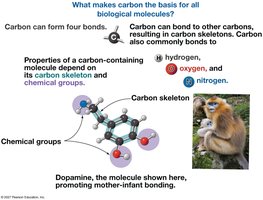
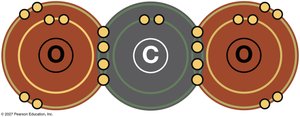
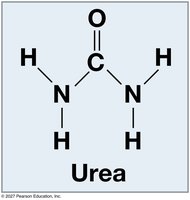
Carbon's electron configuration allows it to bond covalently with many elements, most commonly hydrogen, oxygen, and nitrogen. Carbon can also bond with other carbon atoms, forming chains and rings that serve as the backbone for organic molecules.
Examples include carbon dioxide and urea.
Carbon Skeletons and Their Variations
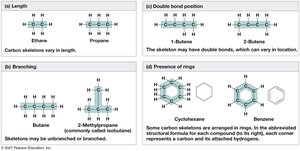
Carbon chains form the skeletons of most organic molecules. These skeletons can vary in length, branching, double bond position, and the presence of rings, contributing to the diversity of organic compounds.
Skeletons may be straight, branched, or arranged in rings.
Double bonds can vary in location.
Hydrocarbons
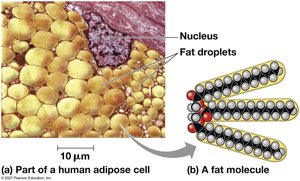
Hydrocarbons are organic molecules consisting entirely of carbon and hydrogen. They are nonpolar and can store significant amounts of energy, making them important components of biological molecules such as fats.
Hydrocarbons can undergo reactions that release energy.
Isomers
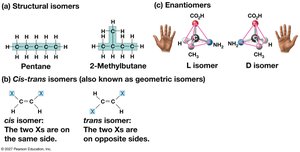
Isomers are compounds with the same molecular formula but different structures and properties. There are three main types of isomers:
Structural isomers: Differ in the covalent arrangement of atoms.
Cis-trans (geometric) isomers: Have the same covalent bonds but differ in spatial arrangement.
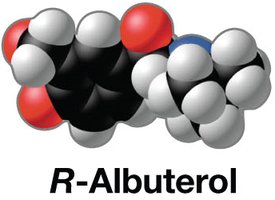
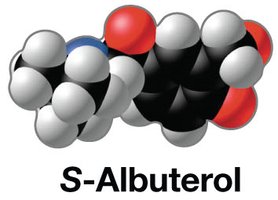
Enantiomers: Are mirror images of each other and cannot be superimposed.
Biological Importance of Enantiomers
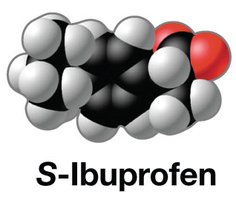
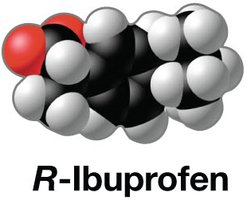
Enantiomers are especially important in biology and pharmacology. Two enantiomers of a drug may have different effects in the body, with only one often being biologically active. This sensitivity to molecular structure highlights the specificity of biological interactions.
Example: S-ibuprofen is effective as a pain reliever, while R-ibuprofen is not.
Example: R-albuterol is effective for asthma, while S-albuterol is not.
Functional Groups
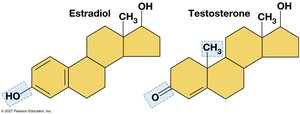
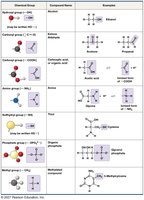
Functional groups are specific groups of atoms within molecules that are responsible for the characteristic chemical reactions of those molecules. The number and arrangement of functional groups give each molecule its unique properties. The seven most important functional groups in biology are:
Hydroxyl group (–OH)
Carbonyl group (C=O)
Carboxyl group (–COOH)
Amino group (–NH2)
Sulfhydryl group (–SH)
Phosphate group (–OPO32−)
Methyl group (–CH3)
Adenosine Triphosphate (ATP)
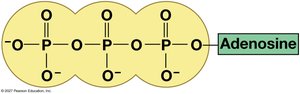
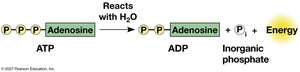
Adenosine triphosphate (ATP) is a crucial organic phosphate that stores and transfers energy within cells. ATP consists of adenosine attached to three phosphate groups. The hydrolysis of ATP releases energy that can be used for cellular work.
ATP hydrolysis: