 Indietro
Carbon and the Molecular Diversity of Life: Study Notes
Guida di studio - Note intelligenti
 Appunti personalizzati basati sui tuoi materiali, ampliati con definizioni chiave, esempi e contesto.
Carbon: The Backbone of Life
Importance of Carbon in Living Organisms
Carbon is the fundamental element in the chemistry of life, forming the backbone of organic molecules such as proteins, DNA, and carbohydrates. Its unique ability to form four covalent bonds allows for the creation of large, complex, and diverse molecules essential for biological processes.
Key Point 1: Living organisms are primarily composed of carbon-based compounds.
Key Point 2: Carbon's versatility enables the formation of a wide variety of molecular structures.
Example: The diversity of life forms is largely due to the molecular diversity enabled by carbon.

Properties of Carbon
Bonding Capabilities
Carbon can form four covalent bonds, which allows it to create molecules with different shapes and sizes. This property is crucial for the complexity and diversity of organic molecules.
Key Point 1: Carbon's four bonds can be single, double, or triple, leading to structural variety.
Key Point 2: The major elements of life (C, H, O, N, S, P) are found in similar proportions across organisms.
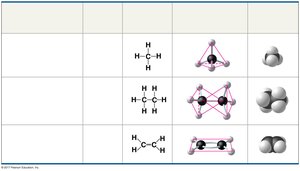
Example: Methane (CH4), ethane (C2H6), and ethene (C2H4) are simple carbon compounds.
Molecule | Molecular Formula | Structural Formula | Ball-and-Stick Model | Space-Filling Model |
|---|---|---|---|---|
Methane | CH4 | H—C—H |
|
|
Ethane | C2H6 | H—C—C—H |
|
|
Ethene | C2H4 | H2C=CH2 |
|
|
Valence and Electron Configuration
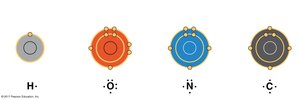
The number of unpaired electrons in the valence shell determines the number of covalent bonds an atom can form. Carbon's electron configuration allows it to bond with many elements, including hydrogen, oxygen, and nitrogen.
Key Point 1: Valence is the number of covalent bonds an atom can form.
Key Point 2: Carbon's valence is 4, oxygen's is 2, nitrogen's is 3, and hydrogen's is 1.
Covalent Compatibility
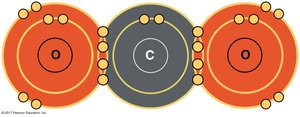
Carbon's electron configuration makes it compatible with many elements, forming the basis for the architecture of living molecules. For example, carbon can bond with oxygen to form carbon dioxide (CO2).
Key Point 1: Carbon forms stable covalent bonds with hydrogen, oxygen, and nitrogen.
Example: Carbon dioxide (CO2) is a simple molecule formed by carbon and oxygen.
Molecular Diversity from Carbon Skeletons
Variation in Carbon Chains
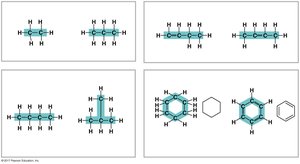
Carbon chains form the skeletons of most organic molecules. These chains can vary in length, branching, double bond position, and the presence of rings, contributing to molecular diversity.
Key Point 1: Carbon skeletons can be straight, branched, or ring-shaped.
Key Point 2: The arrangement of carbon atoms affects the properties of the molecule.
Example: Butane and isobutane are structural isomers with different branching.
Hydrocarbons
Definition and Biological Importance
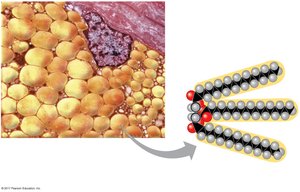
Hydrocarbons are organic molecules consisting only of carbon and hydrogen. They are found in many biological molecules, such as fats, and can undergo reactions that release energy.
Key Point 1: Hydrocarbons are nonpolar and hydrophobic.
Key Point 2: They serve as energy storage molecules in living organisms.
Example: Fat molecules contain hydrocarbon chains that store energy.
Isomers
Types of Isomers
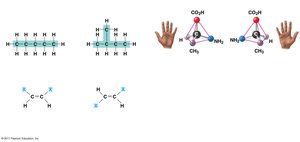
Isomers are compounds with the same molecular formula but different structures and properties. The three main types are structural isomers, cis-trans isomers, and enantiomers.
Key Point 1: Structural isomers differ in the covalent arrangement of atoms.
Key Point 2: Cis-trans isomers differ in spatial arrangement around a double bond.
Key Point 3: Enantiomers are mirror images of each other and can have different biological activities.
Example: Pentane and 2-methylbutane are structural isomers; cis and trans isomers differ in the arrangement of groups around a double bond.
Biological Significance of Enantiomers
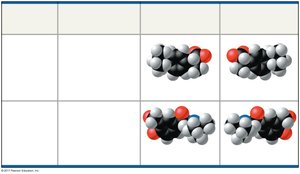
Enantiomers are important in pharmaceuticals, as only one enantiomer may be biologically active. Organisms are sensitive to subtle molecular variations.
Key Point 1: Different enantiomers of a drug can have different effects.
Example: S-Ibuprofen is effective for pain relief, while R-Ibuprofen is not; R-Albuterol relaxes airway muscles, while S-Albuterol does not.
Chemical Groups and Molecular Function
Functional Groups
Functional groups are specific groups of atoms within molecules that are responsible for the characteristic chemical reactions of those molecules. The number and arrangement of functional groups give each molecule its unique properties.
Key Point 1: Functional groups are commonly involved in chemical reactions.
Key Point 2: Seven functional groups are most important in the chemistry of life: hydroxyl, carbonyl, carboxyl, amino, sulfhydryl, phosphate, and methyl.
Functional Groups in Biological Molecules
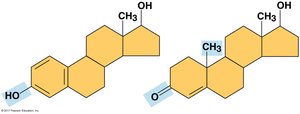
Estradiol and testosterone are steroids with a common carbon skeleton but differ in the chemical groups attached, which determines their function as sex hormones.
Key Point 1: Small changes in functional groups can lead to significant differences in biological activity.
Example: Estradiol and testosterone differ only in their attached functional groups.
The Seven Functional Groups
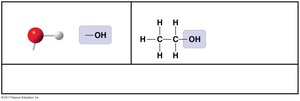
Hydroxyl Group (—OH)
The hydroxyl group is polar due to the electronegative oxygen and forms hydrogen bonds with water, increasing solubility.
Compound Name: Alcohol
Example: Ethanol
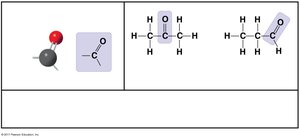
Carbonyl Group (C═O)
The carbonyl group is found in ketones and aldehydes. Sugars with ketone groups are called ketoses; those with aldehydes are called aldoses.
Compound Name: Ketone or aldehyde
Example: Acetone (ketone), propanal (aldehyde)
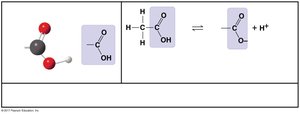
Carboxyl Group (—COOH)
The carboxyl group acts as an acid, donating H+ ions. It is found in carboxylic acids and organic acids.
Compound Name: Carboxylic acid
Example: Acetic acid
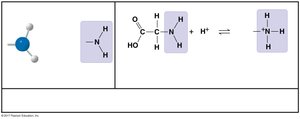
Amino Group (—NH2)
The amino group acts as a base, picking up H+ ions. It is found in amines and amino acids.
Compound Name: Amine
Example: Glycine
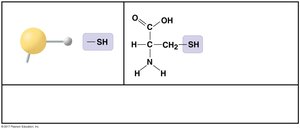
Sulfhydryl Group (—SH)
The sulfhydryl group can form cross-links that stabilize protein structure. It is found in thiols.
Compound Name: Thiol
Example: Cysteine
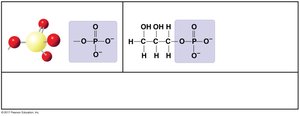
Phosphate Group (—OPO32−)
The phosphate group contributes negative charge and enables molecules to react with water, releasing energy. It is found in organic phosphates.
Compound Name: Organic phosphate
Example: Glycerol phosphate
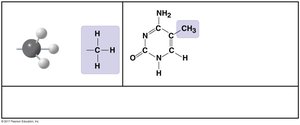
Methyl Group (—CH3)
The methyl group affects gene expression and the shape and function of sex hormones. It is found in methylated compounds.
Compound Name: Methylated compound
Example: 5-Methylcytosine
ATP: An Important Source of Energy for Cellular Processes
Structure and Function of ATP
Adenosine triphosphate (ATP) is a key energy carrier in cells. It consists of adenosine attached to three phosphate groups. ATP stores potential energy, which is released when it reacts with water.
Key Point 1: ATP hydrolysis releases energy for cellular processes.
Key Point 2: The reverse reaction, phosphorylation, stores energy.
Example: ATP → ADP + inorganic phosphate + energy
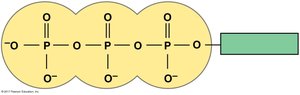

Equation:
Additional info: ATP hydrolysis is a fundamental reaction in metabolism, powering processes such as muscle contraction, active transport, and biosynthesis.
