 Indietro
Carbon and the Molecular Diversity of Life: Study Notes
Guida di studio - Note intelligenti
 Appunti personalizzati basati sui tuoi materiali, ampliati con definizioni chiave, esempi e contesto.
Carbon and the Molecular Diversity of Life
Organic Chemistry and the Origin of Life
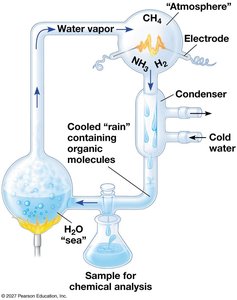
Organic chemistry is the branch of science that studies carbon-containing compounds, regardless of their origin. The diversity of life is rooted in the versatility of carbon, which forms the backbone of organic molecules ranging from simple methane to complex proteins and DNA. Early experiments, such as Stanley Miller's spark-discharge experiment, demonstrated that life's building blocks could form abiotically under conditions similar to those of early Earth.
Organic molecules: Compounds containing carbon, from simple to complex structures.
Abiogenesis: The formation of life’s building blocks without biological processes.
Miller’s experiment: Provided evidence that amino acids and other organic compounds can form under prebiotic conditions.
Key elements in life: Carbon, hydrogen, oxygen, nitrogen, sulfur, and phosphorus.

Carbon’s Four Bonds Build Diverse Molecules
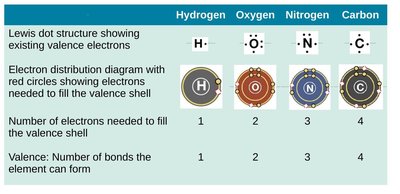
Carbon atoms have four electrons in their outer shell, allowing them to form four covalent bonds. This property enables carbon to create large, complex molecules, including chains and rings. The arrangement of these bonds determines the shape and function of the molecule.
Covalent bonds: Carbon forms four, resulting in tetrahedral geometry for single bonds and planar geometry for double bonds.
Valence: The number of bonds an atom forms, determined by electrons needed to fill the outer shell (H=1, O=2, N=3, C=4).
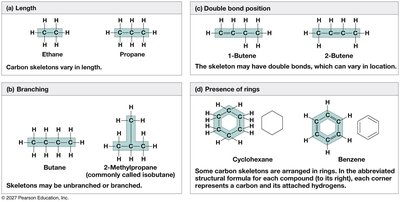
Carbon skeletons: Chains of carbon atoms that vary in length, branching, double-bond position, and ring formation.
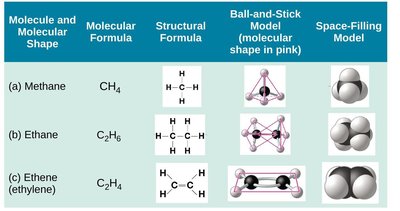
Hydrocarbons: Carbon’s Simplest Molecules
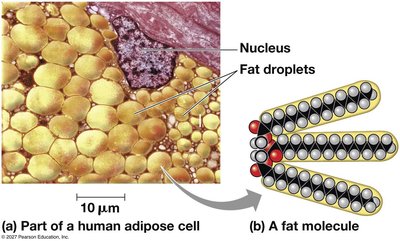
Hydrocarbons are molecules composed only of carbon and hydrogen. They are major components of biological molecules like fats, and their bonds store significant energy.
Hydrocarbon chains: Found in fats, provide concentrated energy.
Energy storage: Breaking hydrocarbon bonds releases energy.
Isomers: Same Formula, Different Molecule
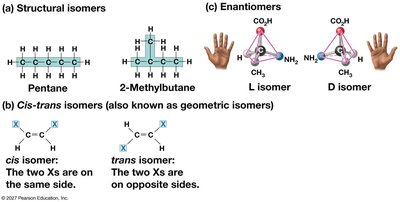
Isomers are molecules with the same molecular formula but different structures, resulting in distinct properties. There are three main types: structural isomers, cis-trans isomers, and enantiomers.
Structural isomers: Differ in the order of atom connections.
Cis-trans isomers: Differ in spatial arrangement around a double bond.
Enantiomers: Mirror-image molecules around an asymmetric carbon.
Why Isomers Matter: Enantiomers in Medicine
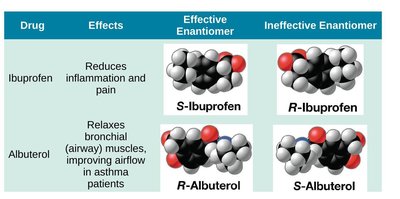
Biological systems are sensitive to molecular shape. Enantiomers can have drastically different effects in medicine, as only one may be biologically active.
Enzymes and receptors: Often interact only with one enantiomer.
Drug activity: Example—S-ibuprofen is effective, R-ibuprofen is not.
A Few Chemical Groups Are Key to Molecular Function
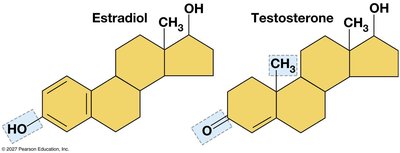
The function of organic molecules is determined not only by their carbon skeletons but also by the chemical groups attached. Small differences in these groups can lead to significant changes in biological activity, as seen in hormones like estradiol and testosterone.
Functional groups: Clusters of atoms that participate in chemical reactions.
Estradiol vs. testosterone: Same skeleton, different functional groups, different effects.
Functional Groups: The Reactive Parts of a Molecule
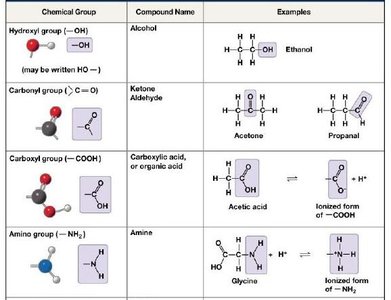
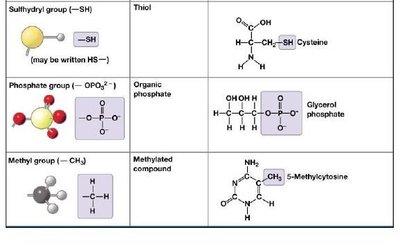
Functional groups are the parts of molecules most involved in chemical reactions. The seven main functional groups in biology are hydroxyl, carbonyl, carboxyl, amino, sulfhydryl, phosphate, and methyl.
Hydroxyl (–OH): Found in alcohols.
Carbonyl (C=O): Found in ketones and aldehydes.
Carboxyl (–COOH): Found in organic acids.
Amino (–NH₂): Found in amines.
Sulfhydryl (–SH): Found in thiols.
Phosphate (–OPO₃²⁻): Found in organic phosphates.
Methyl (–CH₃): Found in methylated compounds.

ATP: Carbon Skeleton Meets Energy Storage
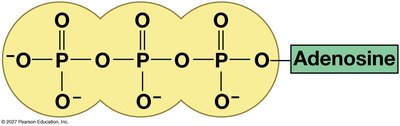
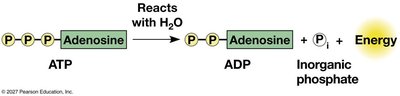
ATP (adenosine triphosphate) is a crucial organic phosphate that stores energy in its phosphate bonds. Hydrolysis of ATP releases energy for cellular processes.
ATP structure: Adenosine attached to three phosphate groups.
Energy release: Hydrolysis breaks the outer phosphate bond, converting ATP to ADP and releasing energy.
Summary: From Atoms to Life’s Diversity
Carbon’s ability to form four bonds, its capacity for skeleton variation, and the presence of functional groups enable the vast diversity of organic molecules. This molecular diversity is the foundation of biological diversity.
Key points: Carbon’s bonding versatility, skeleton variation, isomerism, and functional groups drive molecular and biological diversity.
ATP: Central to energy storage and release in cells.
