 Indietro
Chapter 4: Carbon: The Molecular Diversity of Life – Study Notes
Guida di studio - Note intelligenti
 Appunti personalizzati basati sui tuoi materiali, ampliati con definizioni chiave, esempi e contesto.
Carbon: The Molecular Diversity of Life
Introduction to Carbon in Biology
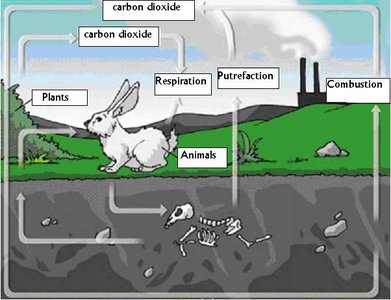
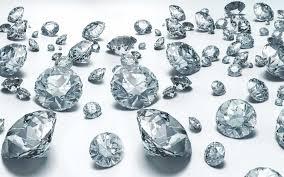
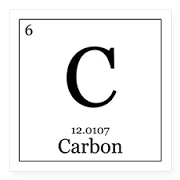
Carbon is the foundational element for all life on Earth due to its unique chemical properties. Its ability to form four covalent bonds allows for the creation of large, complex, and diverse molecules essential for biological processes. - Key Point 1: Carbon forms the backbone of organic molecules, including proteins, DNA, carbohydrates, and lipids. - Key Point 2: The versatility of carbon enables it to bond with hydrogen, oxygen, nitrogen, and other elements, resulting in a vast array of compounds. - Example: Carbon is present in various forms such as coal, graphite, diamond, and carbon black, each with distinct uses in industry and daily life. 

Concept 4.1: Organic Chemistry and Carbon Compounds
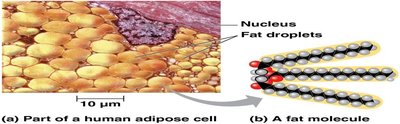
Organic chemistry is the study of carbon compounds, which are the basis of living organisms. Most organic compounds contain hydrogen atoms in addition to carbon. - Key Point 1: Living organisms are primarily composed of carbon-based compounds. - Key Point 2: Hydrocarbons, molecules consisting only of carbon and hydrogen, are important energy sources and structural components in biological systems. - Example: Lipids (fats) contain hydrocarbon tails that store energy. 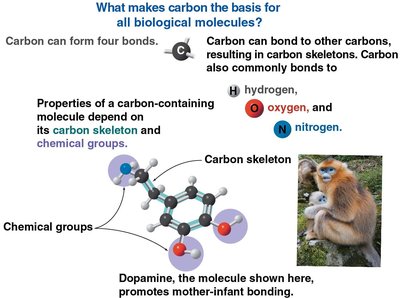
Concept 4.2: Carbon Bonding and Molecular Diversity
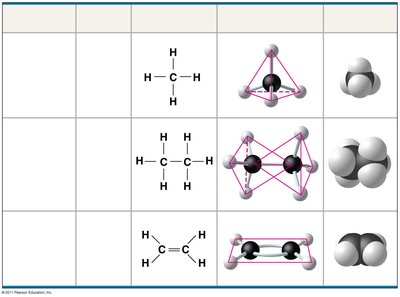
Carbon atoms can form diverse molecules by bonding to four other atoms, resulting in a variety of shapes and structures. - Key Point 1: Carbon has four valence electrons, allowing it to form four covalent bonds. - Key Point 2: The shape of carbon-containing molecules depends on the bonding: tetrahedral for single bonds, planar for double bonds. - Example: Methane (CH4) is tetrahedral, while ethene (C2H4) is planar. 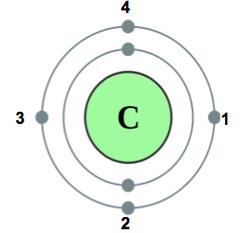
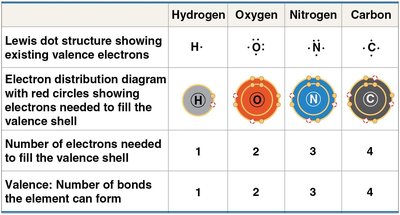
Molecular Diversity from Carbon Skeleton Variation
The skeletons of organic molecules are formed by carbon chains, which can vary in length, branching, and ring formation. - Key Point 1: Carbon chains can be straight, branched, or arranged in rings. - Key Point 2: Nomenclature for carbon chains includes prefixes such as meth-, eth-, prop-, and but-. - Example: Alkanes (single bonds), alkenes (double bonds), and alkynes (triple bonds) are types of hydrocarbons. 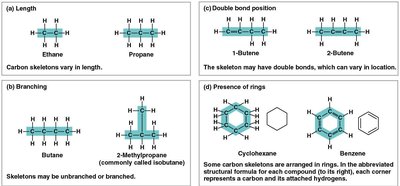
Hydrocarbons and Energy Storage
Hydrocarbons are organic molecules made only of carbon and hydrogen. They are important in biological systems for energy storage. - Key Point 1: Hydrocarbons are found in fats and can undergo reactions that release energy. - Key Point 2: Adipose tissue stores fat as a fuel reserve. 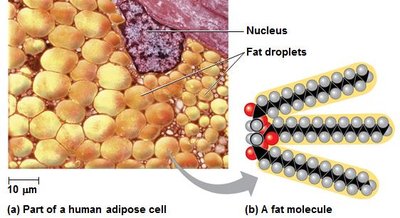
Isomers: Structural, Cis-Trans, and Enantiomers
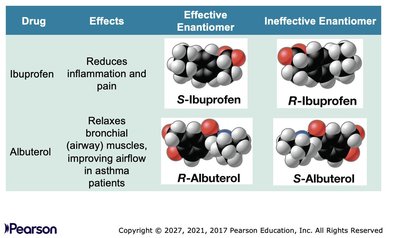
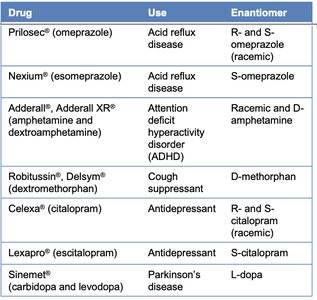
Isomers are compounds with the same molecular formula but different structures and properties. - Key Point 1: Structural isomers differ in covalent arrangement of atoms. - Key Point 2: Cis-trans isomers (geometric isomers) differ in spatial arrangement around a double bond. - Key Point 3: Enantiomers are mirror images of each other and can have different biological activities. - Example: Enantiomers are important in pharmaceuticals, where only one isomer may be biologically active. 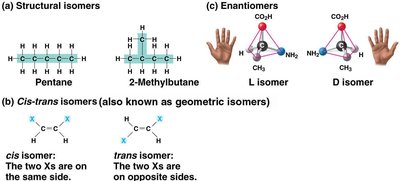
Functional Groups and Biological Molecule Function
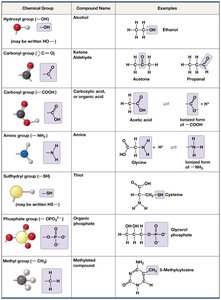
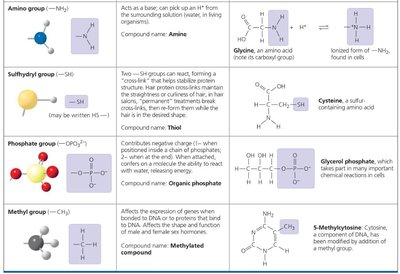
Functional groups are specific groups of atoms attached to carbon skeletons that determine the chemical properties and reactivity of organic molecules. - Key Point 1: The properties of organic molecules depend on both the carbon skeleton and the functional groups attached. - Key Point 2: Functional groups are commonly involved in chemical reactions and influence solubility, polarity, and biological activity. - Example: Testosterone and estradiol are steroids with similar carbon skeletons but different functional groups, resulting in distinct biological functions. 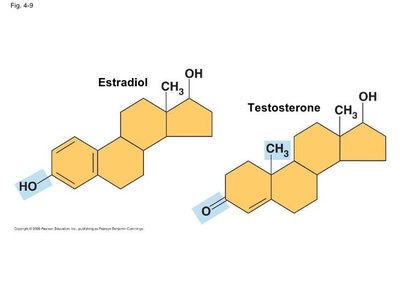
The Seven Chemical Functional Groups
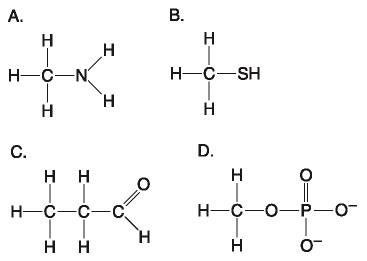
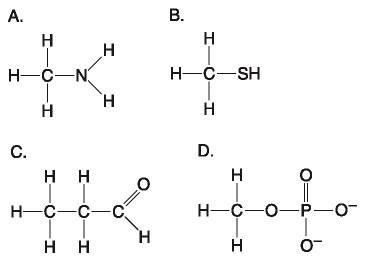
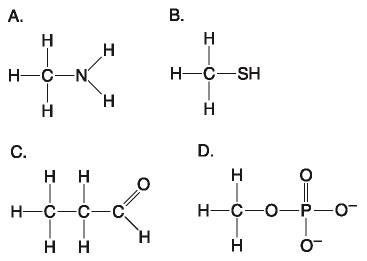
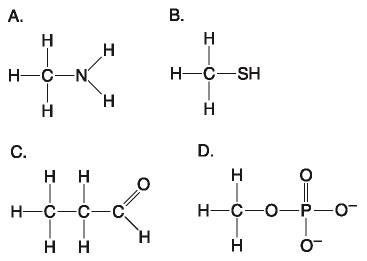
There are seven major functional groups important in biological chemistry: Hydroxyl, Carbonyl, Carboxyl, Amino, Sulfhydryl, Phosphate, and Methyl. - Key Point 1: The first six groups are hydrophilic, polar, and increase solubility in water; methyl is hydrophobic and non-polar. - Key Point 2: Each functional group imparts specific properties to the molecule, such as acidity, basicity, or reactivity. 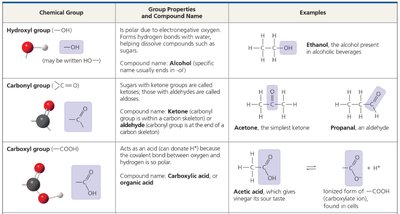
ATP: The Energy Currency of the Cell
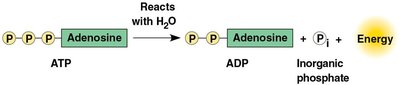
ATP (adenosine triphosphate) is the primary energy-transferring molecule in cells. - Key Point 1: ATP consists of adenosine attached to three phosphate groups. - Key Point 2: Hydrolysis of ATP releases energy for cellular processes. Equation:
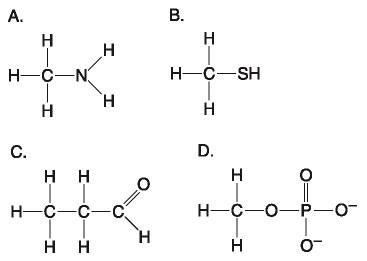
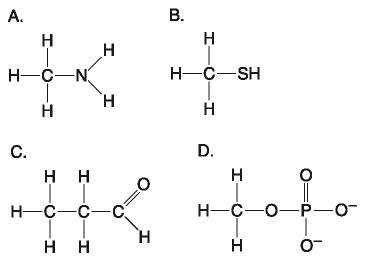
Practice Questions: Functional Groups Identification
Understanding functional groups is essential for classifying amino acids and other biomolecules. - Key Point 1: Amino acids contain a carboxylic acid group, an amino group, an alpha carbon, and an R group. - Key Point 2: R groups determine the properties of amino acids: acidic, basic, neutral polar, or neutral nonpolar. - Example: Alanine has a nonpolar, neutral R group (-CH3); Arginine has a basic R group containing an amino group. 
Summary
Carbon's unique chemical properties make it the basis for the molecular diversity of life. Its ability to form four covalent bonds, create varied skeletons, and interact with functional groups enables the formation of complex biological molecules. Understanding carbon chemistry is fundamental for studying more advanced topics in biology. Additional info: Some context and explanations were expanded for clarity and completeness, including definitions, examples, and academic context for functional groups and isomers.
