 Indietro
Cell-Cell Interactions and Cell Signaling
Guida di studio - Note intelligenti
 Appunti personalizzati basati sui tuoi materiali, ampliati con definizioni chiave, esempi e contesto.
Cell-Cell Interactions and Cell Signaling
Overview of Cell Junctions
Cells in multicellular organisms are held together and communicate through specialized structures called cell junctions. These junctions are essential for maintaining tissue integrity and enabling coordinated cellular responses.
Tight Junctions: Seal cells together, preventing the passage of molecules between them.
Desmosomes: Anchor the cytoskeletons of adjacent cells, providing mechanical strength.
Gap Junctions: Create channels for direct communication between animal cells.
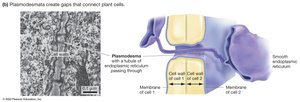
Plasmodesmata: Connect plant cells, allowing cytoplasmic exchange.
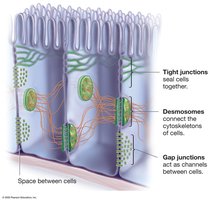
Tight Junctions
Tight junctions are formed by membrane proteins that bind adjacent cells together, creating a watertight seal. They are commonly found in epithelial tissues such as the intestines and lungs, where they prevent leakage of substances between cells.
Function: Maintain distinct compartments within tissues.
Structure: Network of proteins that encircle the cell and connect to similar proteins in neighboring cells.
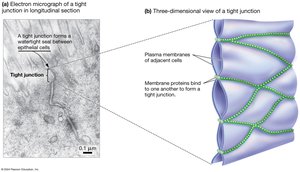
Desmosomes
Desmosomes are strong, adhesive junctions that connect the cytoskeletons of adjacent cells. They provide continuous structural support, especially in tissues subjected to mechanical stress, such as cardiac muscle and epithelial layers.
Function: Resist stretching and tearing forces.
Structure: Composed of linking and anchoring proteins attached to intermediate filaments inside the cell.
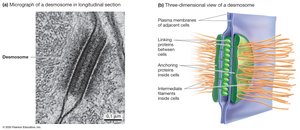
Gap Junctions
Gap junctions are specialized connections that allow ions and small molecules to pass directly from one animal cell to another, enabling rapid communication and coordination of cellular activities.
Function: Facilitate electrical and metabolic coupling between cells.
Structure: Formed by connexin proteins that create channels spanning adjacent cell membranes.
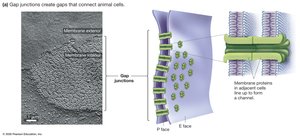
Plasmodesmata
Plasmodesmata are channels that traverse the cell walls of plant cells, connecting the cytoplasm of neighboring cells. Unlike gap junctions, plasmodesmata do not involve protein channels but are lined by the plasma membrane and often contain strands of endoplasmic reticulum.
Function: Allow the movement of water, ions, and small molecules between plant cells.
Structure: Continuous plasma membrane and cytoplasm between cells.
Cell-Cell Signaling: Distant Communication
Hormones and Their Types
Cells communicate over long distances using hormones, which are signaling molecules secreted into the bloodstream or extracellular fluid. Hormones coordinate and synchronize the functions of different organs and tissues.
Steroids: Lipid-soluble molecules (e.g., sex hormones, glucocorticoids).
Peptides: Chains of amino acids (e.g., insulin, glucagon).
Gases: Small molecules (e.g., ethylene in plants, nitric oxide in animals).
Amino Acid Derivatives: Modified amino acids (e.g., adrenaline).
Steps of Cell-Cell Signaling
Cell signaling involves a series of steps that ensure the correct cellular response to external signals:
Signal Reception: Detection of the signaling molecule by a receptor.
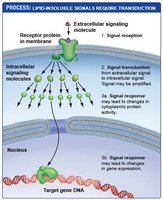
Signal Transduction: Conversion of the signal into a form that can trigger a cellular response, often involving second messengers and phosphorylation cascades.
Signal Response: The cell changes its behavior, such as altering gene expression or protein activity.
Signal Termination: The response is stopped to reset the cell for future signals.
Signal Reception: Receptors
Types and Localization of Receptors
Receptors are proteins that change their activity upon binding to a signaling molecule (first messenger). Their location depends on the chemical nature of the signal:
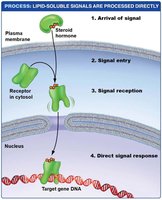
Lipid-soluble signals: Receptors are found in the cytoplasm or nucleus.
Lipid-insoluble signals: Receptors are embedded in the plasma membrane.
Pharmaceutical agents can block or activate receptors to modulate physiological responses (e.g., beta-blockers inhibit adrenaline receptors to lower blood pressure).
Signal Reception: Lipid-Soluble vs. Lipid-Insoluble Signals
Lipid-soluble signals (e.g., steroid hormones) diffuse across the plasma membrane and bind to intracellular receptors, often directly influencing gene expression. Lipid-insoluble signals (e.g., peptide hormones) bind to membrane-bound receptors and require signal transduction mechanisms to relay the message inside the cell.
Lipid-soluble: Direct action, little amplification.
Lipid-insoluble: Indirect action, involves amplification via second messengers.
Signal Transduction Pathways
G-Protein-Coupled Receptors (GPCRs)
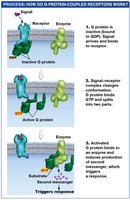
GPCRs are a large family of membrane receptors that activate heterotrimeric G proteins upon ligand binding. The activated G protein then triggers the production of second messengers, leading to a cascade of intracellular events.
Ligand binding induces a conformational change in the receptor.
G protein exchanges GDP for GTP and splits into active subunits.
Active G protein subunits activate effector enzymes, producing second messengers.
Second Messengers and Phosphorylation Cascades
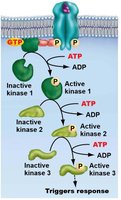
Second messengers are small molecules that amplify the signal within the cell. Common examples include cyclic AMP (cAMP) and calcium ions (Ca2+). Phosphorylation cascades involve a series of kinases that activate each other by adding phosphate groups, resulting in a strong amplification of the signal.
cAMP: Activates protein kinases, leading to phosphorylation of target proteins.
Ca2+: Triggers muscle contraction and activates various enzymes.
Phosphorylation cascade: Sequential activation of kinases amplifies the response.
Receptor Tyrosine Kinases (RTKs)
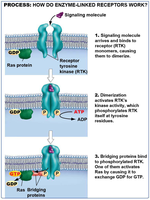
RTKs are enzyme-linked receptors that, upon ligand binding, dimerize and autophosphorylate. This activates downstream signaling proteins such as Ras, which initiates a phosphorylation cascade leading to cell growth and proliferation. Mutations in RTK pathways are implicated in many cancers.
Ligand binding causes dimerization and autophosphorylation of RTKs.
Activated RTKs recruit and activate Ras, a small GTPase.
Ras triggers a kinase cascade, resulting in cellular responses such as growth.
Signal Response and Termination
Cellular Responses
The ultimate effect of cell signaling is a change in cell behavior. This can include alterations in gene expression, protein activity, secretion, or cell division. The same hormone can elicit different responses in different cell types, depending on the receptors and signaling pathways present.
Example: Adrenaline binding to α-adrenergic receptors increases Ca2+, while binding to β-adrenergic receptors increases cAMP.
Signal Termination
To maintain homeostasis, signaling pathways must be rapidly deactivated after the response is achieved.
G proteins: Inactivated by GTP hydrolysis.
Phosphorylation cascades: Terminated by phosphatases removing phosphate groups.
Second messengers: Removed by pumps (Ca2+) or degraded by enzymes (cAMP by phosphodiesterase).
Signaling Pathways Vocabulary
First messengers: Extracellular signals (hormones, local factors).
Receptor: Protein that detects and transmits the signal.
G-protein: GTP-binding protein that relays signals from receptors to effectors.
Effector enzyme: Enzyme activated by G-proteins, often producing second messengers.
Second messengers: Small molecules that amplify and propagate the signal (e.g., cAMP, Ca2+).
Protein phosphorylation: Addition of phosphate groups to proteins, regulating their activity.
Phosphatases: Enzymes that remove phosphate groups, turning off signaling pathways.
Termination: Processes that stop the signaling response.
Crosstalk Between Signaling Pathways
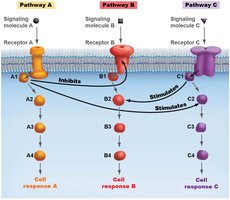
Signaling pathways often interact, a phenomenon known as crosstalk. This allows cells to integrate multiple signals and coordinate complex responses.
Practice Problem: Steroid Hormone Receptors
Question: The receptors for steroid hormones are located inside the cell instead of on the membrane surface like most other signal receptors. Why is this not a problem? What are the advantages and disadvantages of such localization?
Not a problem: Steroid hormones are lipid-soluble and can diffuse through the plasma membrane to reach intracellular receptors.
Advantages: Direct regulation of gene expression; rapid and specific effects on target genes.
Disadvantages: Slower onset of action compared to membrane-bound receptors; limited amplification of the signal.
