 Indietro
Cell Communication and Cell-Cell Connections in Multicellular Organisms
Guida di studio - Note intelligenti
 Appunti personalizzati basati sui tuoi materiali, ampliati con definizioni chiave, esempi e contesto.
Cell Communication and Connections
Introduction to Cell Communication
Multicellular organisms rely on direct and indirect connections between cells to maintain structural integrity and coordinate cellular activities. These connections are essential for cells to determine their location, identity, and the behavior of neighboring cells. Cell communication occurs through physical connections and signaling pathways, forming the basis of multicellularity.
Cell Connections in Plants
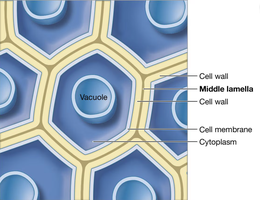
Plant cells are connected by specialized structures that provide both mechanical support and communication channels.
Middle Lamella: The middle lamella is a pectin-rich layer that "glues" adjacent plant cells together, ensuring tissue cohesion.
Cell Wall: Provides rigidity and protection, but also limits direct cell-cell contact compared to animal cells.
Plasmodesmata: Channels that traverse cell walls, allowing direct communication and transport of molecules between plant cells.
Example: The middle lamella is crucial during fruit ripening, as its breakdown leads to fruit softening.
Cell Connections in Animals
Animal cells lack cell walls, enabling them to form a variety of direct and indirect connections through membrane proteins and the extracellular matrix (ECM).
Extracellular Matrix (ECM): A network of proteins and carbohydrates that provides structural support and anchors cells.
Direct Cell-Cell Connections: Animal cells express membrane proteins that form specialized junctions, allowing for both anchoring and communication.
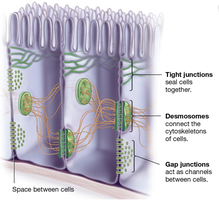
Types of Cell Junctions in Animals
Tight Junctions: Create a waterproof seal between cells, commonly found in epithelial tissues. They regulate the passage of substances and maintain tissue integrity.
Desmosomes: Provide strong adhesion between cells via linking and anchoring proteins (e.g., cadherins), connecting to intermediate filaments for structural support.
Gap Junctions: Form channels that allow ions and small molecules to pass directly between adjacent cells, facilitating rapid communication.
Tight Junctions
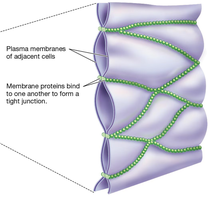
Tight junctions are formed by membrane proteins binding together, sealing cells and preventing leakage of extracellular fluid.
Location: Often found in epithelial cells lining organs such as the intestine.
Function: Maintain selective permeability and protect underlying tissues.
Desmosomes and Selective Adhesion
Desmosomes are specialized junctions that provide mechanical strength to tissues. Cadherins, a family of linking proteins, mediate selective adhesion, ensuring cells of similar type aggregate together.
Cadherins: Responsible for tissue-specific cell adhesion. Different tissues express distinct cadherins, guiding proper tissue formation during development.
Example: In developing embryos, cells expressing the same cadherin type adhere together, forming organized tissues.
Cell-Cell Communication via Junctions
Cells communicate through specialized junctions that allow the transfer of signals and molecules.
Gap Junctions (Animals): Permit direct exchange of ions and small molecules, enabling synchronized activity (e.g., cardiac muscle contraction).
Plasmodesmata (Plants): Facilitate movement of water, nutrients, and signaling molecules between plant cells.
Signal Types: Some signals regulate gene expression (slow response), while others activate/inactivate proteins (fast response).
Signal Transduction and Cell Fate
Signal transduction is the process by which cells convert extracellular signals into intracellular responses. This is crucial for communication between distant cells and for determining cell fate during development.
Notch Signaling: A conserved pathway requiring physical contact between adjacent cells, essential for cell differentiation and tissue development.
Example: Notch signaling guides the formation of specialized cell types in embryos.
Experimental Design: Cell Adhesion and Communication
Understanding cell adhesion often involves experimental approaches to distinguish the roles of proteins and carbohydrates in cell-cell interactions.
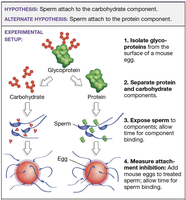
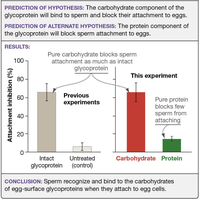
Hypothesis: Sperm attach to the carbohydrate component of glycoproteins on egg cells.
Alternate Hypothesis: Sperm attach to the protein component.
Experimental Setup: Glycoproteins are isolated and separated into carbohydrate and protein components. Sperm are exposed to each, and attachment inhibition is measured.
Results and Interpretation
Prediction: If carbohydrates mediate attachment, pure carbohydrate should block sperm binding as effectively as intact glycoprotein.
Results: Pure carbohydrate blocks sperm attachment, while pure protein does not.
Conclusion: Sperm recognize and bind to carbohydrates of egg-surface glycoproteins.
Summary Table: Types of Cell Junctions
Junction Type | Structure | Function | Location |
|---|---|---|---|
Tight Junction | Membrane proteins binding adjacent cells | Seals cells, prevents leakage | Epithelial tissues |
Desmosome | Linking and anchoring proteins (cadherins) | Strong adhesion, structural support | Muscle, skin, other tissues |
Gap Junction | Channel proteins | Direct communication, molecule transfer | Cardiac muscle, other tissues |
Plasmodesmata | Channels through cell walls | Communication, molecule transfer | Plant cells |
Key Terms and Definitions
Multicellularity: The state of being composed of multiple cells that coordinate activities and share structural connections.
Extracellular Matrix (ECM): A complex network of proteins and carbohydrates outside animal cells, providing support and anchorage.
Cadherins: Cell adhesion molecules critical for selective cell-cell binding and tissue formation.
Signal Transduction: The process by which cells convert external signals into internal responses.
Notch Signaling: A pathway involved in cell fate determination, requiring direct cell-cell contact.
Equations and Formulas
Diffusion Rate through Gap Junctions: Where = diffusion rate, = area of junction, = concentration difference, = length of channel.
Additional info:
Notch signaling is a highly conserved pathway across animal species and is essential for proper tissue development.
Cadherins are absent in red blood cells, which lack the need for tissue-specific adhesion.
