 Indietro
Cell Communication and Signal Transduction in General Biology
Guida di studio - Note intelligenti
 Appunti personalizzati basati sui tuoi materiali, ampliati con definizioni chiave, esempi e contesto.
Cell Communication in Multicellular Organisms
Overview of Cell Signaling
Cell communication is essential for coordinating activities across different parts of a multicellular organism. Signals can be transmitted over long distances, such as when the brain senses dehydration and releases signaling molecules to the kidneys, triggering the expression of aquaporins. Cellular responses to signals typically involve either a change in gene expression or a change in the activity of proteins already present in the cell.
Gene Expression Change: Activation or repression of specific genes in response to signals.
Protein Activity Change: Modification of existing proteins, often through phosphorylation or other post-translational mechanisms.
Example: Brain cells release antidiuretic hormone to regulate water balance in kidneys.
Signal Reception
Receptor Molecules and Signal Specificity
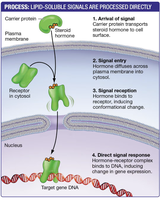
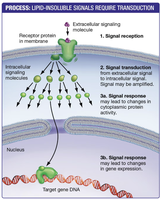
Cell-cell signals deliver their message by binding to receptor molecules. The presence of an appropriate receptor determines which cells will respond to a signaling molecule. The location of the receptor depends on whether the signaling molecule can cross the cell membrane.
Conformation Change: Binding of a signal molecule induces a structural change in the receptor, initiating the cellular response.
Receptor Location: Lipid-soluble signals often have intracellular receptors, while lipid-insoluble signals have membrane-bound receptors.
Signal Transduction: G-Protein-Coupled Receptors (GPCRs)
Mechanism of GPCR Activation
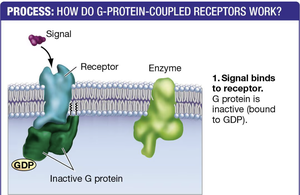
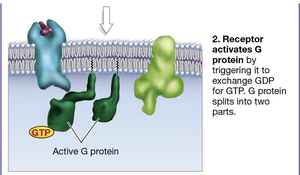
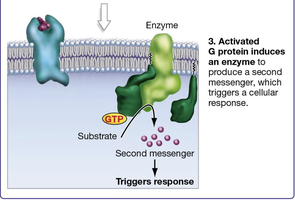
G-protein-coupled receptors (GPCRs) are a major class of membrane receptors. When activated, they often trigger the production of a second messenger, which is a small non-protein molecule or ion that elicits an intracellular response. This process allows for rapid diffusion and amplification of the signal.
G-Protein Activation: G-proteins are activated when bound to GTP and deactivated when bound to GDP.
Signal Diversification: Different G protein subunits can carry out distinct tasks, leading to diverse cellular responses.
Second Messenger: Examples include cyclic AMP (cAMP), which activates kinases and opens ion channels.
Epinephrine and cAMP Synthesis
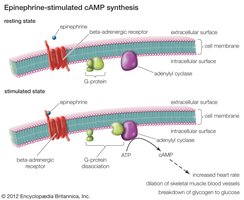
Under acute stress, adrenal glands release epinephrine, which binds to GPCRs in heart cells. This triggers the production of cAMP, a second messenger that activates kinases and opens ion channels, collectively increasing heart rate.
Epinephrine: A hormone belonging to the class of biological macromolecules known as amines (specifically, catecholamines).
Beta Blockers: Competitive antagonists that block epinephrine binding, reducing heart rate; prescribed for hypertension and certain heart conditions.
Signal Transduction: Enzyme-Linked Receptors
Mechanism of Enzyme-Linked Receptor Activation
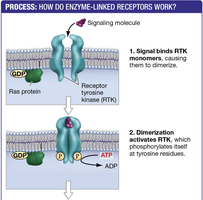
Enzyme-linked receptors, such as receptor tyrosine kinases (RTKs), catalyze reactions inside the cell upon activation. Phosphorylation cascades are often initiated by mitogens, which are signaling molecules that activate cell division. In these cascades, kinases called mitogen-activated protein kinases (MAPKs) play a central role.
Phosphorylation Cascade: Sequential activation of kinases, leading to amplification and diversification of the signal.
Mitogens: Molecules that stimulate cell division and growth.
Crosstalk in Signal Transduction
Integration of Multiple Signals
Crosstalk refers to the integration of information from multiple signaling pathways. Cells exposed to different combinations of signaling molecules (e.g., A + B, A + C, or C alone) may exhibit distinct responses, allowing for complex regulation of cellular activities.
Signal Integration: Multiple pathways can converge or diverge, modulating gene expression or protein activity.
Example: A cell exposed to both mitogen and growth factor may divide and differentiate, while exposure to only one may result in a different outcome.
Summary Table: Types of Cell Signaling and Receptors
Signal Type | Receptor Location | Transduction Mechanism | Example |
|---|---|---|---|
Lipid-soluble | Intracellular | Direct gene expression change | Steroid hormones |
Lipid-insoluble | Membrane-bound | Signal transduction via second messengers | Peptide hormones |
Enzyme-linked | Membrane-bound | Phosphorylation cascade | Growth factors |
Additional info: Academic context was added to clarify the mechanisms of cell signaling, the role of second messengers, and the integration of multiple signals (crosstalk). Definitions and examples were expanded for completeness.
