 Indietro
Cell Communication and Signal Transduction in Multicellular Organisms
Guida di studio - Note intelligenti
 Appunti personalizzati basati sui tuoi materiali, ampliati con definizioni chiave, esempi e contesto.
Cell Communication in Multicellular Organisms
Overview of Cell Communication
Cell communication is essential for coordinating activities across different parts of a multicellular organism. Signals can be transmitted over long distances, allowing cells to respond to changes in their environment or internal state. For example, dehydration sensed by the brain can trigger the release of signaling molecules that affect kidney function.
Key Point: Cells respond to signals by either changing gene expression or altering the activity of proteins already present.
Example: Brain cells release a signaling molecule that activates aquaporin expression in kidney cells during dehydration.
Signal Reception
Cell-cell signals deliver their message by binding to specific receptor molecules. The presence and location of these receptors determine which cells will respond to a given signaling molecule.
Conformation Change: Binding of a signal molecule induces a conformational change in the receptor, initiating the cellular response.
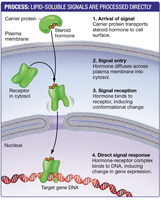
Receptor Location: The location of the receptor depends on whether the signaling molecule can cross the cell membrane.
Lipid-Soluble vs. Lipid-Insoluble Signals
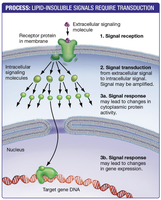
Lipid-soluble signals (such as steroid hormones) can cross the plasma membrane and bind to receptors inside the cell, often directly affecting gene expression. Lipid-insoluble signals require membrane-bound receptors and signal transduction mechanisms.
Lipid-Soluble Signals: Processed directly, often leading to changes in gene expression.
Lipid-Insoluble Signals: Require transduction, leading to changes in protein activity or gene expression.
Signal Transduction Pathways
G-Protein-Coupled Receptors (GPCRs)
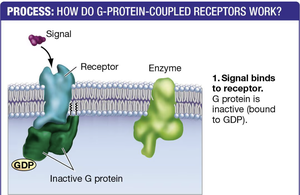
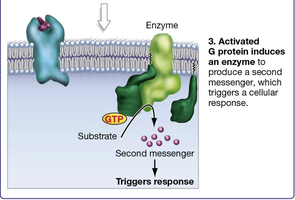
GPCRs are a major class of membrane receptors that, when activated, trigger the production of second messengers. These second messengers amplify the signal and elicit rapid cellular responses.
Second Messenger: A small non-protein molecule or ion that diffuses rapidly and amplifies the signal.
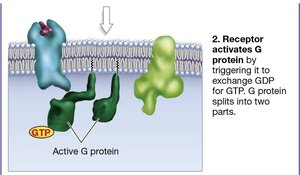
G-Protein Activation: G-proteins are active when bound to GTP and inactive when bound to GDP.
Diversification: Different G protein subunits carry out different tasks, allowing for diverse cellular responses.
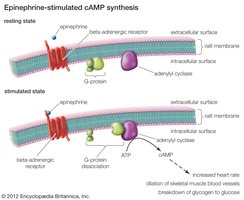
Epinephrine and cAMP Pathway
Under acute stress, epinephrine (a hormone) binds to GPCRs in heart cells, triggering the production of cyclic AMP (cAMP), which activates kinases and opens ion channels, increasing heart rate.
Epinephrine: Belongs to the class of biological macromolecules known as hormones (specifically, it is a catecholamine derived from amino acids).
Beta Blockers: Competitive antagonists that block epinephrine binding, reducing heart rate; prescribed for hypertension and certain heart conditions.
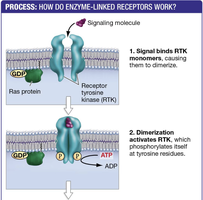
Enzyme-Linked Receptors
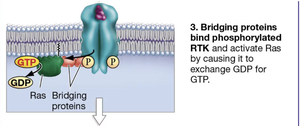
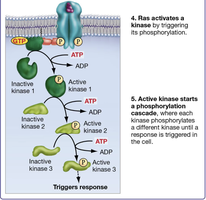
Enzyme-linked receptors, such as receptor tyrosine kinases (RTKs), catalyze reactions inside the cell upon activation. These often initiate phosphorylation cascades, which are common in cell division and growth signaling.
Mitogens: Signaling molecules that activate cell division; kinases involved are called mitogen-activated protein kinases (MAPKs).
Phosphorylation Cascade: A series of kinase activations, each phosphorylating the next, amplifying the signal and triggering a cellular response.
Crosstalk and Signal Integration
Crosstalk Between Signaling Pathways
Cells often receive multiple signals simultaneously. Crosstalk refers to the integration of information from different signaling pathways, allowing cells to coordinate complex responses.
Integration: Multiple signals can be combined to produce unique cellular responses.
Example: Exposure to signaling molecules A + B, A + C, or C alone can result in different cellular outcomes, depending on pathway interactions.
Summary Table: Types of Cell Signaling and Responses
Signal Type | Receptor Location | Transduction Required | Typical Response |
|---|---|---|---|
Lipid-soluble | Intracellular | No | Change in gene expression |
Lipid-insoluble | Membrane-bound | Yes | Change in protein activity or gene expression |
GPCR | Membrane-bound | Yes | Second messenger production, rapid response |
Enzyme-linked | Membrane-bound | Yes | Phosphorylation cascade, cell division |
Key Terms and Definitions
Receptor: Protein that binds a signaling molecule and initiates a cellular response.
Second Messenger: Intracellular molecule that amplifies and transmits signals from receptors.
Kinase: Enzyme that adds phosphate groups to proteins, often regulating their activity.
Phosphorylation Cascade: Series of events where kinases activate each other in sequence.
Crosstalk: Interaction between different signaling pathways within a cell.
Equations and Formulas
ATP Hydrolysis (for kinase activity):
cAMP Synthesis:
Additional info: Academic context was added to clarify the role of epinephrine, beta blockers, and the general principles of signal transduction and crosstalk.
